How AI Handles 1,000+ Calls/Month for Law Firms

AI phone systems answer calls 24/7, qualify leads, schedule consults, integrate with CRMs, and reduce revenue lost from missed calls.

How AI Handles 1,000+ Calls/Month for Law Firms

Missed calls are costing law firms thousands. AI phone systems are solving this problem by answering every call - day or night - and managing unlimited simultaneous inquiries. Here’s why this matters:

  • Missed Revenue: Firms lose $18,000–$90,000 annually from missed calls.
  • Client Preferences: 78% of clients hire the first attorney to respond.
  • Human Limits: Receptionists can’t handle high call volumes or after-hours inquiries.

AI systems answer calls in under five seconds, qualify leads, and schedule consultations automatically. They integrate with tools like Clio and MyCase, ensuring no lead slips through the cracks. For as low as $199/month, these systems outperform traditional receptionists, saving firms time and money while increasing conversion rates.

Bottom line: AI ensures no missed calls, better client intake, and more revenue for law firms.

Watch Me Build a $7,500 Voice Agent for a Law Firm in 60 Minutes

Law firms deal with a wide variety of incoming calls that traditional reception setups just can't handle efficiently. These calls range from urgent new client inquiries and case updates from existing clients to administrative questions like office hours or billing. Then there are the emergencies - DUI arrests often spike between 10 PM and 3 AM on weekends, while personal injury calls tend to peak during evening commutes, between 5 PM and 7 PM.

Here’s the kicker: about 48% of these calls involve non-billable administrative tasks that don’t require an attorney’s expertise. Yet, attorneys and paralegals still spend up to 3.2 hours weekly on initial case intake for cases that may not even qualify. Each interruption costs them around 9.5 minutes to regain focus. With the average lawyer managing just 2.6 hours of billable work in an 8-hour day, these distractions directly cut into the firm’s productivity and profitability.

Traditional receptionists are limited - they can only handle one call at a time. During busy periods, like lunch hours (when 45% of calls go unanswered), many callers end up hearing a busy signal or being sent to voicemail. And since 80% of callers won’t leave a voicemail, they often turn to a competitor instead. The result? Missed calls cost the U.S. legal industry an estimated $109 billion annually.

How Missed Calls Hurt Law Firm Revenue

Speed is everything when it comes to legal intake. 78% of potential clients hire the first attorney who answers their call. Plus, leads contacted within five minutes are 100 times more likely to connect compared to those contacted after 30 minutes. Missing a call doesn’t just mean losing a potential client - it also wastes the marketing dollars spent to generate that lead. For example, personal injury keywords can cost over $400 per click, making every missed call an expensive loss.

Consider this real-life example: In November 2025, a personal injury attorney in Jacksonville missed out on a trucking case worth $180,000. The client called at 6:47 PM on a Tuesday and got voicemail. By the time the firm opened at 8:00 AM the next day, the client had already signed with a competitor who answered their call.

"The firm that answers first gets the case. It's that simple." - AgentZap

The financial toll varies by practice area, but the overall impact is massive. Even beyond individual case losses, the industry collectively forfeits billions in potential revenue every year due to poor call management. And these figures assume a modest 10% conversion rate - the actual losses are often higher.

Missed calls also damage a firm’s reputation. Common complaints in negative online reviews include phrases like "never called back" or "couldn’t reach them". In a field where trust and responsiveness are critical, these reviews can harm a firm’s brand and future client acquisition.

Limitations of Human Receptionists

The shortcomings of traditional reception models become even clearer when you consider the numbers. 37% to 45% of legal inquiries happen outside regular business hours. Yet, most receptionists work from 9 AM to 5 PM. Offering true 24/7 coverage with human staff would cost a firm between $8,000 and $15,000 per month, a price tag that's out of reach for many practices.

Even during office hours, human receptionists struggle to keep up. They can't handle multiple calls at once, leading to long hold times. And 74% of potential clients hang up when placed on hold. The "lunch hour gap" between 12 PM and 1 PM is especially problematic, with 45% of calls going unanswered. If a firm launches a successful ad campaign and call volumes spike, there’s no way to instantly scale up reception capacity.

"When you have a legal firm, you have high traffic for both SMS and calls. Missing even one is important - and often expensive." - Astrid Rivera, Customer Success Manager, Aloware

While traditional answering services offer 24/7 coverage, they often only take basic messages and charge between $200 and $1,500+ per month. These services lack the legal expertise needed for meaningful intake or client qualification. Virtual receptionist services, like Smith.ai, provide more advanced handling starting at $285 per month for 30 calls. However, for high-volume practices, costs can escalate quickly.

Manual intake also introduces data quality problems. Incomplete records, inconsistent notes, and delays in entering information into CRMs slow down follow-ups and increase error risks. These intake errors contribute to about 20% of malpractice claims, making accuracy not just a business concern but a legal one.

How AI Handles Calls at Scale for Law Firms

AI systems have transformed how law firms manage calls, addressing issues like missed calls and inefficient client intake. Unlike human receptionists, who can only handle one call at a time, AI systems can manage unlimited calls simultaneously. This means no more busy signals, hold times, or dropped messages - even during peak call volumes or after a successful marketing campaign. Every call is answered instantly, 24/7, enabling services like lead qualification, immediate scheduling, and AI call routing.

These systems go beyond traditional answering services. Instead of taking generic messages, they conduct structured intake interviews tailored to specific legal areas. For example, a personal injury inquiry might include details like incident dates, police reports, and insurance information, while a criminal defense call might capture arrest dates, charges, and upcoming court dates. The result? Attorneys receive detailed, actionable information rather than vague callback requests.

Real-world examples highlight the impact. A personal injury firm with four attorneys deployed an AI receptionist in March 2026 and reduced missed calls from 30 per week to just 4. They also cut attorney time on unqualified calls by 78% and signed two additional cases in the first month from after-hours leads captured by the AI. Similarly, Frontier Law Center reduced their average case onboarding time from 90 minutes to 40 minutes after implementing AI intake.

"It can take notes, transcribe the call, and hand everything off so your legal staff already knows exactly where the lead stands before they jump in."

  • Nikolaj Knezevic, Account Executive, Aloware

Accuracy is another key advantage. Systems like Answering Agent have handled over 17,724 scored calls with 99.93% accuracy, ensuring reliable data for conflict checks and case evaluations. This information integrates directly into practice management tools like Clio, MyCase, and Filevine, eliminating manual data entry errors.

Lead Capture and Qualification

AI systems ensure every lead is captured and filter out unqualified prospects before they reach an attorney. This approach addresses inefficiencies where attorneys previously spent 3.2 hours weekly on cases that didn’t qualify. Using practice-specific criteria, the AI evaluates case viability - such as whether it falls within the statute of limitations or if the caller has insurance coverage.

This proactive filtering removes 40–60% of unqualified leads. Attorneys then focus only on viable cases, saving time and resources. Additionally, the AI records all involved parties, streamlining conflict checks.

Speed is critical when converting leads. Sixty-two percent of clients hire the first firm that responds, and leads contacted within five minutes are nine times more likely to convert than those reached after 30 minutes. For instance, if a DUI arrest happens at 2:00 AM on a Saturday, the AI captures the lead immediately - while competitors’ calls might go to voicemail.

Answering Agent has proven effective at scale, pitching 20,375 offers with 6,820 accepted. Its human-like voice ensures a seamless experience, making it nearly indistinguishable from speaking to a live person.

Automated Appointment Scheduling

AI systems simplify the scheduling process by integrating directly with attorney calendars through tools like Clio, MyCase, PracticePanther, Lawmatics, and Filevine. During calls, the AI checks real-time availability and offers open consultation slots instantly. After booking, it sends confirmations and reminders via SMS or email to both the prospect and the attorney, reducing no-shows.

This eliminates the frustrating "phone tag" scenario, where potential clients might lose interest while waiting for a callback. By booking appointments on the spot, conversion rates increase significantly.

Beyond scheduling, the AI automates follow-ups. It sends call transcripts, summaries, and contact details directly to the firm’s CRM, so attorneys walk into consultations fully prepared. For firms managing over 1,000 calls per month, this process saves considerable staff time. And with flat-rate pricing - some systems charge around $199 per month for unlimited calls - costs remain predictable, even during high call volumes.

Urgent matters are also prioritized through intelligent routing, ensuring critical calls are handled without delay.

Call Routing and Escalation Logic

AI systems use real-time intent analysis to route calls appropriately. Routine consultations are processed through automated intake and scheduling, while urgent matters - like active arrests or looming statute of limitations deadlines - trigger immediate escalation to on-call attorneys.

Fixed escalation rules ensure time-sensitive calls are prioritized. For example, if a caller mentions terms like "arrested", "detained", or "restraining order", the AI bypasses standard intake and sends instant SMS alerts or initiates live call transfers to the appropriate attorney. This guarantees urgent issues are addressed promptly, even in the middle of the night.

"When you have a legal firm, you have high traffic for both SMS and calls. Missing even one is important - and often expensive."

  • Astrid Rivera, Customer Success Manager, Aloware

The routing logic also accounts for practice area specialization. A family law inquiry might direct the caller to attorneys with expertise in divorce or custody cases, while a criminal defense call triggers questions about charges and court dates. This ensures callers receive informed, relevant responses.

During handoffs, systems like Answering Agent provide complete context, including call transcripts and summaries. This prevents attorneys from having to ask clients to repeat information, creating a smoother and more professional experience.

Integration with Law Firm Technology

AI systems don’t just handle calls efficiently - they also work hand-in-hand with existing law firm technologies, making day-to-day operations smoother. These systems integrate with tools like Clio, MyCase, Filevine, and PracticePanther for practice management, as well as CRM platforms like Lawmatics, Salesforce, and HubSpot. This means no more tedious manual data entry. Instead, every call detail flows directly into your established workflows, keeping everything connected and organized.

How this integration happens depends on the provider. Some systems offer instant "plug-and-play" connections, while others rely on RESTful APIs or middleware like Zapier and Make.com to bridge the gap. For instance, Goal Line Legal used a Voiceflow-based system connected through Make.com to Google Workspace. This setup automatically transferred caller details like names, phone numbers, and case summaries into Google Sheets while triggering email notifications for the legal team. While native integrations tend to be faster, avoiding the delays of third-party tools, both approaches ensure smooth data sharing.

AI integrations also go beyond simple data transfer. Advanced systems can perform real-time conflict checks during intake calls. They quickly compare caller information against your existing client database, flagging any potential conflicts before an attorney even gets involved. This kind of automation ensures efficient data flow while helping firms avoid ethical conflicts.

Data Flow and CRM Integration

When a call ends, the AI doesn’t just leave vague notes - it logs structured, detailed data directly into your CRM. This includes key fields like case type, incident date, urgency level, and involved parties. With this organized approach, staff can quickly sort and prioritize leads without having to sift through messy handwritten notes or unclear voicemail transcripts.

The impact of this streamlined process is clear. For example, The Husband & Wife Law Team utilized RingCentral's AI technology to drastically reduce the time spent reviewing calls. Joe Phelps, their Intake Director, shared:

"The AI finds the coachable moments in a call within a few minutes, meaning that process takes one-third of the time".

But the benefits don’t stop at intake. AI systems also sync call recordings, transcripts, and action items directly into case files. When attorneys open a lead in tools like Clio or MyCase, they find the entire conversation history already there. This eliminates the need for clients to repeat their story, a frustration that can negatively impact conversion rates.

For firms with custom workflows, webhooks and APIs allow for even deeper integration. AI can be configured to update specific CRM fields, trigger retainer agreements, or send automated SMS follow-ups as soon as a call ends. Answering Agent supports these advanced capabilities while maintaining impressive accuracy, scoring 99.93% across over 17,724 calls. This level of reliability ensures that the data entering your systems is consistent and error-free.

Centralized Dashboards for Call Management

AI systems also offer centralized dashboards that give firms a bird’s-eye view of their call activity. These dashboards consolidate everything into one place, offering real-time insights into call volume, lead quality, intake completion rates, and conversion metrics. Instead of juggling multiple tools, staff can quickly identify high-priority leads, follow up on pending calls, and monitor AI performance.

Dashboards typically include searchable transcripts, call recordings, and summaries organized by criteria like practice area, urgency, or lead source. For instance, a personal injury attorney could instantly filter calls mentioning "car accident" from the past week. This kind of quick access saves time and keeps everything organized.

Performance tracking is another standout feature. Dashboards display metrics such as response times, resolution rates, and appointment booking success. Firms handling high call volumes - over 1,000 calls per month - can identify trends like peak call times or frequent drop-off points. This allows them to fine-tune AI scripts or adjust staffing as needed. Answering Agent’s dashboard even tracks offer acceptance rates, showing that 6,820 offers were accepted out of 20,375 pitched. This transparency helps firms measure how effective their intake process is.

Security is a top priority, too. Leading AI platforms use AES-256 encryption to protect call data both in transit and at rest. Role-based access controls ensure that only authorized staff can view sensitive client information, and SOC 2 certification confirms compliance with industry standards.

The result is a unified communication hub where voice, SMS, and email interactions all come together. Attorneys can see a prospect’s entire interaction history - from the initial call to follow-up texts and appointment confirmations - without switching between platforms. This streamlined approach is critical, especially since 62% of potential clients choose the first firm that responds.

Cost Efficiency and Measurable Performance
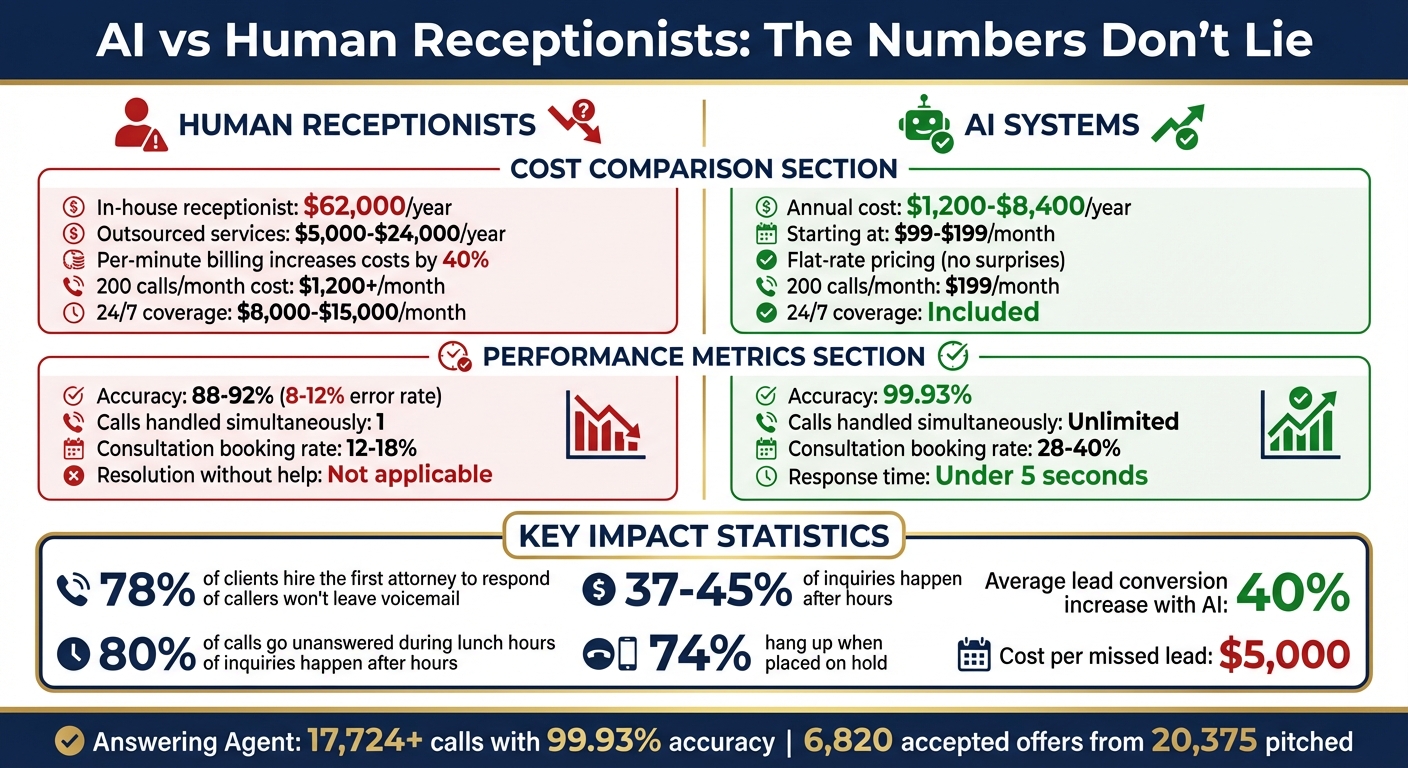
AI vs Human Receptionists for Law Firms: Cost and Performance Comparison

AI vs Human Receptionists for Law Firms: Cost and Performance Comparison

Cost Comparison: AI vs. Human Receptionists

The financial gap between AI and human receptionists is striking. A single in-house receptionist can cost a law firm about $62,000 annually, once you include salary, taxes, benefits, and overhead expenses. Outsourced human answering services range from $5,000 to over $24,000 per year, depending on call volume and after-hours charges. By comparison, AI legal answering services are far more affordable, typically costing between $1,200 and $8,400 annually, with plans often starting as low as $99 to $199 per month for unlimited or high-volume usage.

Traditional services often rely on per-minute billing, which can inflate costs by approximately 40% due to charges for hold times and call transfers. AI services, however, offer flat-rate pricing, ensuring predictable costs - even during busy periods like mass tort campaigns or accident seasons. For instance, a law firm managing 200 calls per month (averaging three minutes each) could pay around $199 per month with Answering Agent, compared to over $1,200 per month for traditional human-based services. These predictable rates not only reduce costs but also support higher call volumes without unexpected fees.

Hidden costs are another drawback of traditional services. Firms can lose up to 15 staff hours weekly to phone tag and manual data entry. Human receptionists, limited to handling one call at a time, often lead to busy signals and hold times, resulting in missed opportunities. Alarmingly, 80% of callers who reach voicemail won’t leave a message, potentially costing firms $5,000 per missed lead. AI systems, with their ability to handle unlimited simultaneous calls and provide instant responses, help minimize these losses while significantly reducing staffing expenses. These savings allow law firms to allocate resources to other critical areas, such as client acquisition and legal work.

Key Metrics for AI Performance

AI’s financial advantages are backed by impressive performance metrics. For example, Answering Agent achieves 99.93% accuracy across more than 17,724 scored calls - far exceeding the 8% to 12% error rates commonly seen with human receptionists. Additionally, AI systems resolve 90% to 95% of calls without requiring human intervention, freeing staff to focus on billable tasks.

AI-powered intake systems also outperform their human counterparts in securing consultations. These systems book 28% to 40% of consultations, compared to just 12% to 18% with human receptionists. This efficiency leads to tangible revenue growth, with many firms reporting an average 40% increase in lead conversion rates after adopting AI-driven intake. For example, Answering Agent successfully pitched 20,375 offers, of which 6,820 were accepted. Since 67% of potential clients hire the first firm to respond to their inquiry, AI’s instant response times and ability to handle unlimited calls directly boost client acquisition and revenue.

Conclusion

AI-powered call management tackles the persistent issues of missed calls and high expenses in legal practices. By offering predictable, flat-rate pricing and the ability to handle calls 24/7, these systems ensure no lead slips through the cracks. This is crucial when you consider that 62% of potential clients choose the first law firm that responds - making instant response a game-changer.

With response times under five seconds, the ability to handle unlimited simultaneous calls, and year-round availability without extra holiday fees, AI systems provide a significant edge. For firms managing over 1,000 calls monthly, these features help secure revenue that might otherwise vanish - especially since 80% of callers who reach voicemail won’t leave a message.

A standout example of this technology is Answering Agent, which excels in managing high call volumes while maintaining quality. It books appointments, qualifies leads, and integrates seamlessly with legal CRMs like Clio and MyCase. By taking over these tasks, it allows attorneys and paralegals to focus on billable work. The system even uses emergency routing logic to detect urgent keywords like "arrested" or "restraining order", instantly notifying on-call attorneys when immediate action is needed.

"The real question isn't 'Can I afford $199/month?' It's 'Can I afford to keep losing $5,000 per missed client?'"

For law firms struggling with growth due to phone capacity limitations, AI call management eliminates this bottleneck. It captures more leads, converts more consultations, and operates at a fraction of traditional costs - turning call handling into a scalable advantage that fuels firm growth.

FAQs

Will callers know it’s AI?

Callers usually won’t notice they’re talking to AI. Modern systems are built to reply in a natural, conversational tone that closely resembles human speech. Advanced tools like Answering Agent are crafted to handle interactions smoothly, making it hard to tell the difference between AI and a live receptionist.

Can it handle conflict checks and save intake information to my CRM?

AI systems, such as Answering Agent, are capable of conducting conflict checks by cross-referencing your client database to identify any potential issues. Additionally, they can automatically save intake details directly into your CRM, helping to simplify your workflow while ensuring precise data management.

What happens if a caller has an emergency?

AI systems for law firms ensure 24/7 call answering, making sure emergencies are addressed right away. They excel at qualifying and routing leads, helping firms avoid missed opportunities during crucial moments. Plus, these systems can handle large call volumes all at once, providing dependable support whenever it's needed.

Related Blog Posts

Try it yourself

See how AI handles calls for your business

Enter your business name and we'll build a personalized AI receptionist demo in under 2 minutes. Talk to it right in your browser.

No signup required · Free to try · Works for any business

Answering Agent