
AI systems answering customer calls can achieve near-perfect accuracy, but hallucinations - when AI fabricates information - pose risks. A study of 17,724 calls revealed a 99.93% accuracy rate, with only 0.07% of calls showing hallucinations. These errors, while rare, can lead to financial and legal consequences, as seen in cases involving fabricated policies or incorrect legal citations.
Key insights from the study:
- Accuracy: Answering Agent AI achieved 99.93% accuracy, outperforming typical AI systems (90–95%) and human receptionists.
- Availability: Operates 24/7, answering 100% of calls compared to humans answering ~25.9%.
- Cost: An AI phone answering cost-benefit breakdown shows it costs significantly less - AI costs significantly less - $199/month versus ~$35,000/year for a human receptionist.99/month versus ~$35,000/year for a human receptionist.
- Speed: Responds in 0.4 seconds, far faster than human follow-ups.
Industries like healthcare, automotive, and legal services benefit from AI’s efficiency. For example, car wash businesses saw a 31% conversion rate for membership sales, while legal practices reduced intake time by 10–15 minutes per call.
The study highlights that businesses using AI can handle calls more efficiently, reduce missed opportunities, and improve customer interactions. However, selecting the right system with high accuracy, industry-specific integrations, and human escalation features is essential to minimize risks.
Which Is More Reliable! AI Receptionists Or Humans? | The Truth Revealed #AICallReceptionist
sbb-itb-abfc69c
Study Overview: 17,724 Calls Analyzed
Answering Agent reviewed 17,724 inbound calls handled around the clock across multiple business locations, achieving an impressive 99.93% accuracy rate. Out of all these calls, only 0.07% (12 calls) were flagged for hallucinations - instances where the AI fabricated information.
The AI systems were seamlessly integrated with Point of Sale (POS) and CRM platforms like NXT Wash and Sonny's. This allowed real-time access to customer details, vehicle information, and membership status, ensuring accurate and efficient responses.
How Calls Were Scored and Measured
Every call was carefully reviewed using both transcript and audio analysis. The AI's responses were compared against a Knowledge Base containing business rules, pricing, service areas, and FAQs.
Each interaction was assigned a confidence score, with those falling below 60-70% flagged for human review. Hallucinations were identified when the AI confidently provided incorrect or fabricated information - like inventing policies or prices - instead of acknowledging uncertainty.
To improve performance, a specialized team refined the AI's responses over a 14-day optimization period. Errors were addressed immediately by updating the Knowledge Base, preventing repeated mistakes. This feedback loop ensured continuous improvement and accuracy.
These thorough scoring methods provided a solid foundation for assessing AI performance across various industries.
Industries Covered in the Study
The study analyzed AI performance across home services, medical practices, law firms, and car washes, each presenting unique challenges. For example, healthcare calls often involved appointment scheduling, while car wash businesses required handling membership and service inquiries.
The dataset included a wide range of call types: new customer inquiries, questions from existing customers, appointment bookings, pricing requests, and service availability checks. This diversity highlighted the AI’s ability to handle different types of customer interactions effectively.
Hallucination Rate Findings
Hallucination Rates by Call Type
The data shows that hallucination rates differ significantly depending on the complexity of the call. For routine inquiries - like questions about business hours, pricing, or service availability - accuracy levels are impressively high, ranging between 90–95%. These simpler queries rarely lead to errors since they usually involve straightforward information retrieval.
On the other hand, more complex or "edge case" scenarios are where things get tricky. Industry benchmarks report a 5–10% error rate for unusual or ambiguous queries. Examples of these might include questions about referral discounts, emergency holiday policies, or multi-step scenarios that depend on understanding prior interactions.
Despite these challenges, Answering Agent maintained an overall hallucination rate of just 0.07% across all call types. This result sets a strong foundation for evaluating its performance against other AI systems.
How These Results Compare to Other AI Systems
When comparing these findings to industry benchmarks, Answering Agent's performance stands out. Standard AI chatbots typically have error rates ranging from 19–40%, making Answering Agent's 0.07% hallucination rate an impressive achievement. Even specialized tools like Hostie AI, designed for restaurant use, achieve 97–98% accuracy, which still falls short of Answering Agent's results.
"According to Deloitte, 77% of businesses express concerns about AI hallucinations - when AI confidently presents false information as fact."
Interestingly, human receptionists face a different set of challenges. Studies indicate that 74.1% of calls go unanswered by human staff due to being busy, unavailable, or outside of working hours. This highlights how Answering Agent combines near-human accuracy with the advantage of being available 24/7.
Performance Across Different Industries
Error Rates by Industry
AI systems are proving their worth across various industries with impressive accuracy and efficiency. For example, in the restaurant sector, AI achieves 97–98% accuracy when taking orders, even for complex, multi-item requests. This is largely due to its ability to navigate structured menu interactions with ease.
In home services, AI steps in to answer all incoming calls, with 15.9% of calls flagged as urgent - such as those mentioning "burst pipe" - being routed directly to staff. This contrasts sharply with the 74.1% of urgent calls missed by human operators.
In automotive services, AI handles 91% of calls successfully and books appointments at an impressive 86% success rate during AI-only interactions. For car wash businesses, Answering Agent has processed over 81,362 calls, achieving a 17% overall conversion rate. Notably, pricing inquiries lead to 31% conversions into unlimited membership sales, and 23% of members calling to cancel are retained through automated win-back offers.
Legal practices save 10–15 minutes per call when AI manages initial client intake. Meanwhile, real estate achieves an 89% contact rate with 61% qualification, insurance reaches 63% contact with 61% warm handoff, and finance maintains an 87% contact rate with 14% qualification, reflecting the added complexity of regulatory requirements.
These numbers highlight AI's tailored performance across sectors, showcasing its ability to outpace traditional methods.
Answering Agent Performance Advantages
Answering Agent goes beyond standard AI benchmarks, delivering measurable improvements for businesses.
The system boasts an industry-leading 99.93% accuracy rate, far surpassing the typical 90–95% accuracy seen in routine AI tasks. It responds in just 0.4 seconds, compared to the 47 hours it often takes for human follow-ups, making companies 21 times more likely to qualify leads.
Unlike human receptionists, who are available only 23.8% of the week, Answering Agent operates 24/7/365 and handles unlimited simultaneous calls. For instance, Jacksons Car Wash credits Answering Agent with helping cut costs while boosting revenue. The system promotes special offers and enrolls an average of 3,200 SMS subscribers per month per location.
Additionally, its seamless integration with industry-specific platforms like OptSpot, NXT Wash, and Sonny's allows real-time access to vehicle details and membership status. This enables personalized conversations that drive a 31% membership conversion rate, setting Answering Agent apart from generic chatbots.
What This Means for Your Business
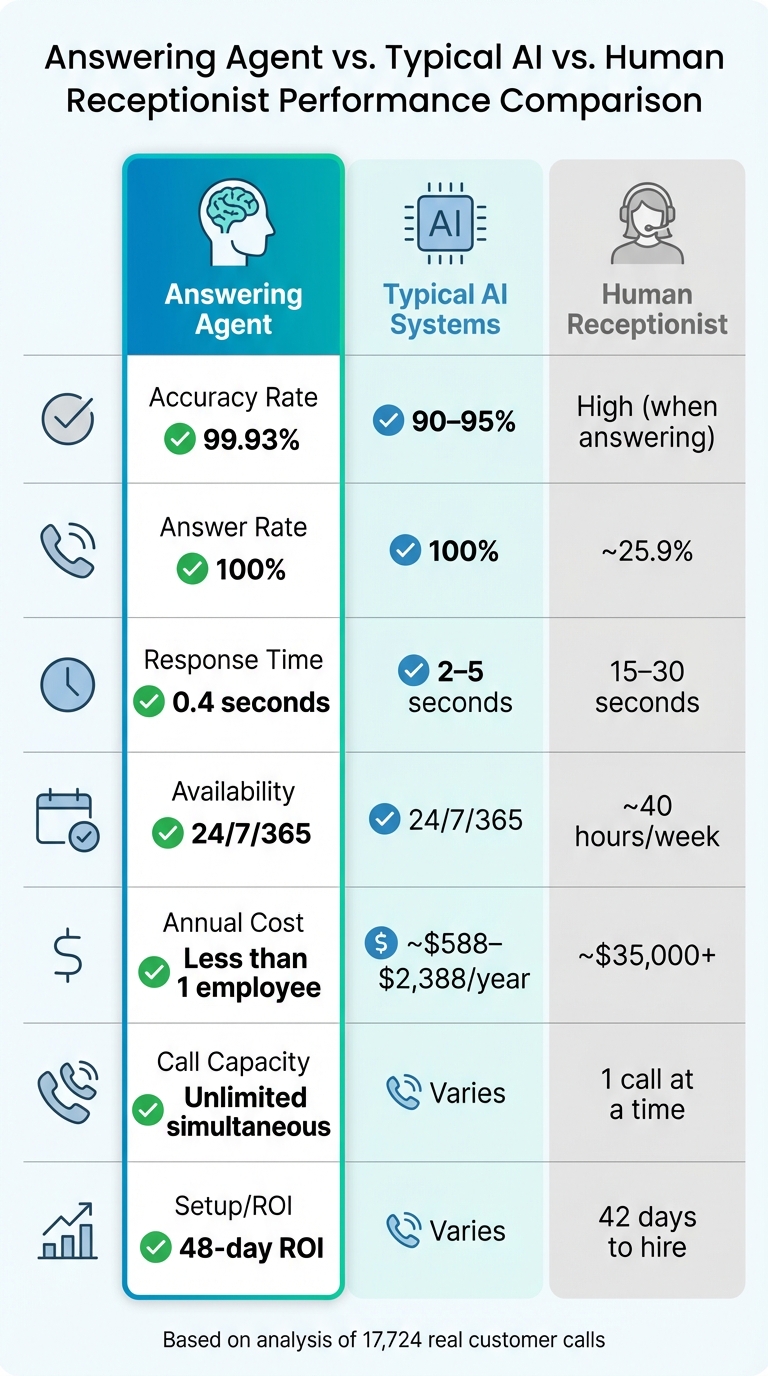
AI vs Human Receptionist Performance: Accuracy, Cost & Availability Comparison
Reliability and Cost Comparison
An analysis of 17,724 calls highlights the financial implications of using AI vs human receptionists. Unlike human receptionists, who answer only 25.9% of incoming calls, AI systems handle 100%. For a business receiving 42 calls per month, this means missing about 31 calls, which can result in an estimated $260,400 in lost revenue annually. On the cost side, a full-time human receptionist typically costs between $35,000 and $45,000 per year, including salary and benefits. In contrast, Answering Agent provides 24/7 service with 99.9% uptime compared to the roughly 60% availability of human staff.
Here's another key difference: human receptionists are available only 23.8% of the week, yet 73% of calls occur outside regular business hours. With a lightning-fast 0.4-second response time, Answering Agent ensures customers are connected almost instantly, giving businesses a clear edge in handling inquiries efficiently.
What to Look for in AI Answering Systems
The cost and availability advantages of AI answering systems are clear, but not all systems are created equal. When selecting an AI solution, consider the following:
- Accuracy Matters: Look for systems with verified accuracy rates supported by real data. While many systems claim 90–95% accuracy, Answering Agent achieves an impressive 99.93% accuracy across 17,724 calls.
- Confidence Thresholds: High-quality systems should include "graceful escalation", automatically transferring calls to a human operator when the AI's confidence in its response dips below 60–70%. This feature helps avoid situations like the Air Canada case, where an AI error led to legal issues over a bereavement fare policy.
- Industry-Specific Integrations: Choose systems that seamlessly connect with your existing platforms. For instance, Answering Agent integrates with tools like OptSpot, NXT Wash, and Sonny's to access real-time information such as vehicle details or membership statuses during calls.
- Transparent Pricing: Opt for solutions with clear pricing structures, typically ranging from $49 to $199 per month. Answering Agent includes a 30-day money-back guarantee, and most businesses see a return on investment in just 48 days.
Unlike human receptionists, who can only handle one call at a time, AI systems like Answering Agent manage unlimited simultaneous calls without any drop in performance. This scalability is a game-changer for businesses aiming to improve customer service while controlling costs.
Answering Agent vs. Typical AI Performance
The table below highlights how Answering Agent outperforms both traditional AI systems and human receptionists across key metrics:
Metric Answering Agent Typical AI Systems Human Receptionist Accuracy Rate 99.93% 90–95% High (when answering) Answer Rate 100% 100% ~25.9% Response Time 0.4 seconds 2–5 seconds 15–30 seconds Availability 24/7/365 24/7/365 ~40 hours/week Annual Cost Less than 1 employee ~$588–$2,388/year ~$35,000+ Call Capacity Unlimited simultaneous Varies 1 call at a time Setup/ROI 48-day ROI Varies 42 days to hire
These numbers make it clear why businesses are turning to AI for their customer interaction needs. Answering Agent’s ability to respond in under half a second and provide 50% more information in 88% less time than human receptionists leads to improved customer satisfaction.
Additionally, Answering Agent offers a white-glove implementation process. During a 14-day optimization period, every call is monitored to fine-tune responses. This meticulous approach drives measurable results, including a 31% membership conversion rate and a 23% retention rate for customers considering cancellation. These outcomes can significantly boost your business's bottom line.
Conclusion
An analysis of 17,724 calls highlights how AI phone answering systems achieve near-perfect precision. With Answering Agent boasting a 99.93% accuracy rate and a minimal 0.07% hallucination rate, the data underscores its reliability in handling real-world customer interactions.
Now, consider this: can your business afford to let 74.1% of incoming calls go unanswered? A missed call is a missed opportunity - no information exchanged, no relationships built, and no revenue generated. Meanwhile, AI systems answer calls in just 0.4 seconds, enabling 78% of first-contact responders to convert inquiries into paying customers.
The missed calls vs. AI answering numbers speak for themselves.
"The question isn't 'Will AI be perfect?' It won't. The question is: 'Will AI answer 95% of calls correctly, or will you miss 74% of calls entirely?'" - NextPhone
AI systems ensure every call is captured - 100%, compared to the 25.9% answered by humans. With a 31% membership conversion rate and a 23% retention rate, Answering Agent transforms missed calls into measurable revenue. And with transparent pricing - $199 per month compared to $35,000+ annually for human receptionists - businesses see ROI in just 48 days.
The real question isn’t whether AI can handle your calls effectively - it’s whether you can afford to keep missing opportunities while competitors leverage technology to answer every call instantly. These results clearly show how AI phone answering systems can drive business growth, all while being a cost-effective solution.
FAQs
What counts as an AI “hallucination” on a phone call?
An AI “hallucination” during a phone call occurs when the AI provides wrong or fabricated information, misinterprets the customer's intent, or generates responses without any factual grounding. Such mistakes can undermine trust in AI systems, especially in practical, everyday use.
How can a business verify an AI phone agent’s accuracy before buying?
To check how accurate an AI phone agent is, focus on key performance metrics. These include containment rates, error rates, and conversation quality scores - often provided by vendors. During a pilot phase, test the system using real call data and evaluate accuracy rates. For example, Answering Agent reported an accuracy rate of 99.93%, which can help gauge reliability before rolling out the system fully. Additionally, using post-call analytics is essential for tracking performance and making better decisions moving forward.
When should an AI phone agent transfer a call to a human?
When an AI phone agent encounters a situation that's too complex or urgent for it to manage confidently, it should promptly transfer the call to a human representative. Additionally, if there's a significant chance of delivering incorrect or misleading information, the AI should escalate the matter to ensure the caller receives accurate and dependable assistance.
Related Blog Posts
Book a walkthrough
See it handle your calls.
Book 20 minutes, or hear a sample call first.
Ready to see it handle your calls?
Book a walkthrough, or hear a short sample call first.
Related Articles
How to Handle Failed Payment Calls on a Car Wash Membership
How wash desks handle failed payment and card-update calls on a membership without turning the call into a gate lockout.
Car Wash Membership Phone Calls: A Desk Guide
A desk guide to the membership phone calls car washes take, with links to the deep how-tos.

How to Handle Pickleball Guest Fee Calls
Handle pickleball guest fee calls by identifying the visit type, quoting the written fee sheet, and confirming payment, court access, and check-in requirements.