
Fraud in call centers is increasing at a shocking rate, with deepfake calls surging by 1,337% in 2024 and identity fraud losses hitting $27.2 billion. Traditional methods, like Knowledge-Based Authentication (KBA), are failing, often letting fraudsters slip through while frustrating legitimate customers. Enter AI voice agents - a game-changer in fraud prevention. These systems detect fraud in real time using voice biometrics, behavioral monitoring, and anomaly detection, offering unmatched speed, accuracy, and consistency compared to older methods.
Key Benefits of AI Voice Agents:
- Real-Time Detection: Analyze voice patterns and behaviors instantly, flagging suspicious activity during calls.
- High Accuracy: Reduce false positives by up to 75%, cutting fraud-related losses significantly.
- 24/7 Monitoring: Operate round-the-clock, ensuring no fraudulent activity goes unnoticed.
- Cost Savings: Lower operational costs while improving efficiency, making them accessible for scaling service businesses.
- Better Customer Experience: Verify trusted callers in seconds, reducing frustration and improving satisfaction.
These systems are already delivering results. For example, a private-sector bank in India cut fraud losses by 40% in just 30 days, and a U.S. insurer boosted fraud detection rates from 9% to 41%, saving $6.8 million in one year. AI voice agents are not just a tool for security - they’re reshaping how businesses handle fraud while ensuring smoother customer interactions. The time to act is now.
Deepfake Detection with Voice AI: How Real-Time AI Stops Fraud & Security Threats | Carter Huffman
sbb-itb-abfc69c
How AI Voice Agents Detect Fraud
AI voice agents rely on three main techniques to identify fraud during calls: voiceprint analysis, behavioral monitoring, and anomaly detection algorithms. These tools work together, analyzing data in real time to uncover threats that might go unnoticed by human agents. By combining these methods, the system offers a thorough, real-time approach to fraud detection.
Voiceprint and Audio Analysis
Voice biometrics generate a unique "fingerprint" for each voice, analyzing over 1,000 vocal traits like spectral frequencies, vocal tract dimensions, cadence, and pitch. When someone claims an identity, the AI compares their live voice to the stored voiceprint, producing a confidence score. If the score falls below 85%, the system flags the call as high-risk.
At the same time, liveness detection confirms whether the caller is genuine by spotting synthetic artifacts or deepfake markers. This process is highly precise, with a 99.2% accuracy rate and a response time of under 200 milliseconds.
Behavioral Pattern Recognition
The AI also keeps an eye on how callers behave during conversations. It tracks changes in cadence, tone, and tactics like creating artificial urgency. These behavioral cues are used to update a dynamic risk score in real time, ensuring that every security step is followed without fail. Unlike human agents, who might overlook certain protocols under pressure, AI consistently enforces all verification measures. It can also connect behavioral patterns across multiple calls, identifying signs of coordinated fraud.
Anomaly Detection Algorithms
To uncover complex fraud schemes, anomaly detection relies on Graph Neural Networks (GNNs) and Deep Reinforcement Learning (DRL). GNNs map relationships across account networks, revealing suspicious patterns that traditional rule-based systems might miss. Meanwhile, DRL adjusts fraud detection thresholds based on real-world outcomes, ensuring the system stays effective against evolving tactics and avoids model drift.
A notable example of this approach comes from the U.S. Department of the Treasury. Using advanced AI detection, they managed to prevent and recover over $4 billion in fraud losses during fiscal year 2024. These algorithms analyze hundreds of data points - such as identity, transaction speed, geolocation, and device intelligence - to assign a risk score from 0 (low risk) to 99 (high risk). By evaluating this data simultaneously, the system delivers a strong defense, combining high accuracy with cost efficiency. These methods work together to provide the reliable, scalable security features explored in the next section.
Benefits of AI Voice Agents for Fraud Prevention
Businesses that integrate AI voice agents into their fraud prevention strategies report significant savings. Long-term users save as much as $4.3 million in lost revenue, compared to $2.2 million for those newer to the technology. These systems excel at blending speed, consistency, and intelligence, safeguarding businesses while ensuring smooth verification processes for legitimate customers. By leveraging advanced fraud detection techniques, companies can see measurable improvements in both security and operational efficiency.
Scalability and 24/7 Monitoring
AI voice agents offer round-the-clock protection, reacting faster than traditional human teams. This ensures no fraudulent activity goes unnoticed, even during off-hours or high-demand periods. Unlike human agents, who might skip verification steps under pressure, AI systems consistently enforce all security protocols - regardless of call volume. For example, a leading private-sector bank in India introduced AI-powered scam alert workflows in August 2025. Within just 30 days, fraud losses dropped by 40%, verification success climbed to 85%, and response times shrank to just 3 seconds. Additionally, smart queue algorithms can reduce the fraud-related workload on human agents by 45%.
Better Accuracy and Fewer False Positives
AI-driven systems significantly reduce false alerts, cutting them by as much as 75% compared to traditional rule-based approaches. A prominent U.S. bank reported a 72% drop in false alerts after switching to an AI-powered platform, while a healthcare organization achieved a 90% reduction in false positives, saving their fraud team 70% of its time. Banks utilizing AI frameworks have seen fraud detection accuracy improve by 6% to 20%. Mastercard highlights this impact:
"83% of industry leaders say AI has reduced false positives and churn, marking a new era in fraud prevention." - Mastercard
These advancements not only enhance detection but also improve customer satisfaction by reducing unnecessary disruptions.
Cost Efficiency for Small and Medium Businesses
AI voice agents are particularly valuable for small and medium-sized enterprises, as they minimize the need for large fraud teams and constant staffing. In fact, 80% of organizations report that AI has helped eliminate unnecessary manual reviews, allowing resources to focus on higher-priority tasks. PayPal, for instance, implemented NVIDIA GPU-powered AI for fraud detection, achieving a 10% boost in real-time detection while cutting server capacity needs by nearly eight times. Similarly, the New York Department of Labor used AI to identify over 1.5 million fraudulent claims, preventing more than $33 billion in attempted theft during the pandemic. With these cost savings, even smaller companies can access fraud prevention tools that were once out of reach.
Improved Customer Trust and Experience
AI voice agents use voice biometrics to verify trusted callers in seconds, avoiding the hassle of traditional Knowledge-Based Authentication (KBA), which fails for 10–25% of legitimate customers. Voice biometrics not only reduce fraud by over 95% but also cut handling times by 30%. On average, AI voicebots resolve fraud-related account breaches in just four minutes - three times faster than traditional methods. This combination of speed and precision ensures accounts remain secure while delivering a seamless customer experience.
"The real value of AI voice agents is not that they 'spot fraud' in theory. It is that they can enforce the right workflow every time, add friction only where needed, and send risky calls to the right human path." - CallBotics
These benefits highlight how AI voice agents are reshaping fraud prevention, delivering both enhanced security and better customer interactions. The next section will dive into how these solutions perform in real-world deployments.
Answering Agent: AI Voice Fraud Prevention for Service Businesses
Answering Agent showcases how AI voice technology can safeguard service businesses from fraud while managing everyday customer interactions. These businesses often face unique challenges, such as impersonators attempting to cancel memberships or alter payment information. Answering Agent addresses these risks while supporting industries like home services, medical practices, law firms, car washes, and staffing agencies. With 99.93% accuracy across 17,724+ scored calls and 24/7/365 availability, it provides dependable verification through seamless integration with POS and CRM systems.
99.93% Accuracy and Real-Time Fraud Detection
Answering Agent connects directly with systems like Sonny's, OptSpot, and NXT Wash, enabling it to verify caller identities and detect fraud in real time. This integration allows the system to immediately flag inconsistencies in membership details, account information, or call context - stopping suspicious requests before they can proceed. Uniform security protocols are applied to every interaction. For high-risk actions, such as resetting passwords or updating payment methods, the system initiates extra verification steps or escalates the case to human fraud teams. A complete audit trail accompanies these escalations. Beyond its fraud detection capabilities, Answering Agent ensures smooth handling of high call volumes without compromising accuracy.
Unlimited Simultaneous Call Handling
Unlike traditional receptionists who can manage only one call at a time, Answering Agent can handle unlimited simultaneous calls, ensuring no customer interaction is missed - even during peak hours or after business hours. This eliminates the pressure on human staff that can sometimes lead to lapses in security protocols. For example, Jacksons Car Wash reports that the system not only reduces operational costs but also boosts revenue by promoting special offers and enrolling customers in text clubs - tasks that go beyond the scope of traditional receptionists. This dual capability of fraud prevention and revenue generation makes Answering Agent a valuable asset for service businesses.
Cost Savings Compared to Human Receptionists
Operating at a lower cost than a single human receptionist, Answering Agent offers unlimited capacity while removing expenses tied to training or turnover. With 188,362+ total conversations handled, the system has converted 31% of price inquiries into memberships and retained 23% of members who initially sought to cancel through automated win-back offers. Waves Car Wash highlights how the AI's summary interface allows staff to quickly review customer details before callbacks, reducing call times and improving efficiency. This cost-effective approach not only streamlines operations but also strengthens fraud prevention efforts with AI-driven precision.
Traditional Methods vs. AI Voice Agents: Comparison
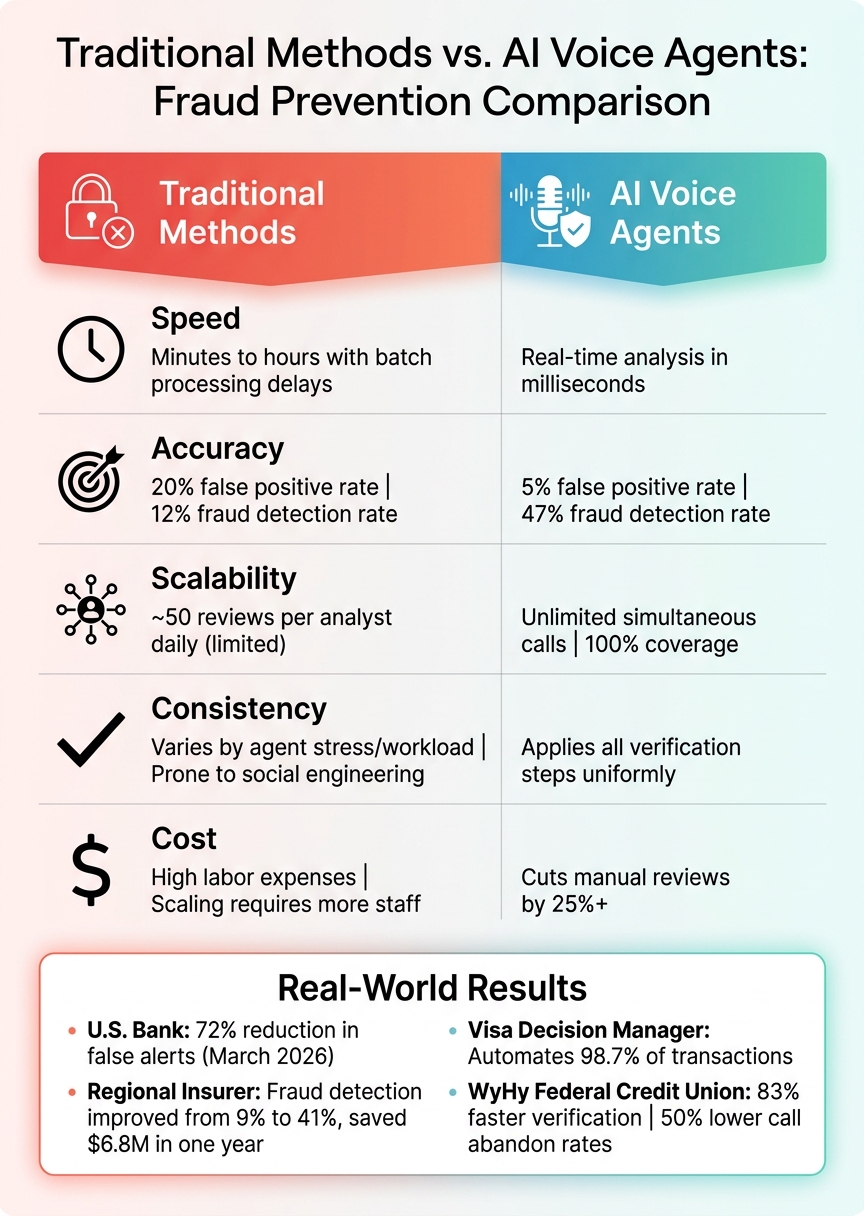
Traditional Fraud Prevention vs AI Voice Agents Comparison
After examining the techniques and advantages of AI voice agents, it becomes clear that they outperform traditional methods in nearly every aspect.
Traditional fraud prevention relies heavily on human agents using scripted verification processes and static rule-based systems that flag specific dollar amounts or transaction types. These approaches are often no match for modern fraud tactics. Social engineers exploit human vulnerabilities, and delays caused by batch processing give fraudsters an edge.
AI voice agents, on the other hand, analyze calls in milliseconds, leveraging hundreds of data points like voice biometrics, speech patterns, and behavioral anomalies. For example, a regional property and casualty carrier showcased this transformation in 2026. Over 12 months, they processed 45,000 claims using AI voice analytics, boosting their fraud detection rate from 9% to 41% and preventing $6.8 million in fraudulent claims - compared to just $1.4 million with traditional methods.
Feature Traditional Methods AI Voice Agents Speed Minutes to hours, with delays from batch processing Real-time analysis in milliseconds Accuracy 20% false positive rate; 12% fraud detection rate 5% false positive rate; 47% fraud detection rate Scalability Limited to ~50 reviews per analyst daily Unlimited simultaneous calls; 100% coverage Consistency Varies by agent stress and workload; prone to social engineering Applies all verification steps uniformly Cost High labor expenses; scaling requires more staff Cuts manual reviews by 25% or more
Real-world examples reinforce these benefits. A leading U.S. bank upgraded its anti-money laundering systems in March 2026 and achieved a 72% reduction in false alerts while improving fraud detection rates. Similarly, WyHy Federal Credit Union adopted AI voice authentication in October 2025, slashing member verification time by 83% and cutting call abandon rates by 50%.
"The AI does not replace our investigators - it makes them dramatically more effective. Instead of sifting through thousands of claims looking for needles in haystacks, they receive cases with the needle already identified and highlighted." – VP of Claims, Regional Property and Casualty Carrier
The financial impact is equally compelling. Platforms like Visa's Decision Manager automate fraud prevention, resolving 98.7% of transactions without manual intervention. In contrast, traditional methods manually review only 8% of claims, leaving the majority of fraud attempts unchecked. In 2023 alone, this automation helped prevent an estimated $33 billion in fraud losses across 3.2 billion transactions.
The shift from outdated methods to AI-driven solutions not only strengthens fraud prevention but also builds greater trust among customers in service industries.
The Future of AI-Driven Fraud Prevention
AI voice systems are evolving rapidly, moving beyond traditional security questions to more sophisticated methods like physiological identity verification. Modern voice biometrics now analyze over 1,000 unique vocal traits - such as tone, pitch, cadence, and spectral frequencies - to combat increasingly complex fraud attempts. By moving away from Knowledge-Based Authentication (KBA), which is vulnerable to social engineering, these systems pave the way for continuous identity verification throughout an interaction.
One major breakthrough is continuous authentication. Instead of a single verification at the start of a call, AI monitors the conversation in real time. If a caller's voice suddenly changes or their behavior seems unusual, the system can instantly trigger additional security measures. This constant monitoring is critical as threats like deepfakes become more sophisticated and harder to detect.
Another game-changer is cross-channel intelligence. AI systems now integrate data from various sources - voice calls, mobile apps, and web logins - to identify coordinated fraud attempts that might otherwise go unnoticed when analyzed in isolation. For example, the BarmeniaGothaer insurance group adopted Parloa's AI Agent Management Platform in 2026, cutting switchboard workload by 90% while adhering to GDPR and BIPA regulations. These systems also delve deeper into behavioral patterns, analyzing micro-hesitations (brief pauses of 400–800 ms before key details) and subtle verbal cues like saying "the vehicle" instead of "my car." Such insights help uncover deceptive or staged narratives.
A striking example of AI's potential comes from a regional property and casualty carrier. Between April 2025 and May 2026, the company used CallSphere's AI voice analytics to process 45,000 claims. This technology identified a staged accident ring involving 23 related claims across four counties by matching voice biometrics and narrative patterns that human adjusters had overlooked.
"AI shifts fraud decisions from delayed investigation to real-time action during the call." – Joe Huffnagle, VP Solution Engineering & Delivery, Parloa
Looking ahead, the most effective fraud prevention strategies will combine AI's precision with human oversight for high-risk cases. Current AI models can identify synthetic voices with 99.53% accuracy, while voice biometrics have been shown to reduce fraud by over 95% and cut call handling times by around 30%. Systems capable of continuously adapting to emerging fraud patterns will shape the future of secure and customer-friendly call operations.
Conclusion
AI voice agents are transforming fraud prevention by enabling real-time risk management during calls. These systems analyze over 1,000 vocal traits while monitoring behaviors instantly, achieving what traditional methods can't. For example, they’ve reduced false positives from around 20% to just 5% while operating 24/7 at scale.
The financial impact is striking. A regional property and casualty insurer handling 45,000 claims annually boosted its fraud detection rate from 9% to 41%, saving $6.8 million in fraudulent claims within a year using AI voice analytics. Similarly, a major private-sector bank in India reduced fraud losses by 40% in just 30 days, safeguarding over 110,000 accounts monthly through AI-powered scam detection workflows.
For service-based businesses, tools like Answering Agent showcase these advancements. With an impressive 99.93% accuracy across 17,724+ scored calls, it manages unlimited simultaneous calls round-the-clock at a fraction of the cost. As discussed earlier, AI call quality monitoring and analytics now ensure consistent, error-free verification - exactly what modern fraud prevention demands.
The real question for businesses isn’t whether to adopt AI voice agents, but how quickly they can integrate them. With deepfake call activity surging by 1,337% in 2024 and identity fraud losses hitting $27.2 billion, delays only heighten exposure to risk. This proven technology delivers measurable results across industries, from insurance companies to banks and service providers of all sizes. The time to act is now.
FAQs
How does an AI voice agent stop deepfake callers in real time?
AI voice agents can now spot deepfake callers in real time. By analyzing speech patterns, emotional tones, and behavioral cues, these systems can identify synthetic voices and signs of fraud. What's impressive is that this process adds a layer of security without causing any inconvenience to genuine callers.
Do voice biometrics replace security questions completely?
Voice biometrics don't completely eliminate the need for security questions, but they offer a safer and smoother way to verify identity. By examining distinct vocal traits, this method cuts down on the dependence on traditional knowledge-based questions while improving both precision and user experience.
What data do you need to set up AI voice fraud detection?
Setting up AI voice fraud detection involves combining voice biometrics, caller behavior analysis, and contextual call details. AI creates voiceprints by analyzing elements like tone, pitch, cadence, and speech patterns. At the same time, it monitors behavioral cues such as pauses, emotional shifts, and unusual requests. By cross-referencing this information with fraud databases, the system enhances its ability to identify threats.
This layered approach enables real-time risk assessments, making it easier to flag high-risk calls while reducing false positives. The result? Stronger security measures and a better sense of trust for customers.
Related Blog Posts
Book a walkthrough
See it handle your calls.
Book 20 minutes, or hear a sample call first.
Ready to see it handle your calls?
Book a walkthrough, or hear a short sample call first.
Related Articles

How to Handle Pickleball After-Hours and Door Access Calls
Handle pickleball after-hours door access calls by forking member fob, guest, hours, and booking asks before you promise entry.

Car Wash Membership Billing Phone Calls: A Desk Guide
Desk guide for car wash membership billing calls: fork failed payment, double charge, plan change, and pause vs cancel before you process.

How to Handle Pickleball Membership Cancellation Calls
How pickleball club desks handle membership cancellation calls without inventing policy or fighting the member.