Call Analytics in AI Feedback Loops

How real-time call analytics and AI feedback loops boost lead conversion, accuracy, and 24/7 scalability.

Call Analytics in AI Feedback Loops

Call analytics transforms raw call data into actionable insights by analyzing conversations, caller intent, outcomes, and more. Unlike basic transcription tools, modern systems provide 100% call coverage, enabling businesses to optimize performance and conversion rates through AI feedback loops. These loops refine AI systems using real-time data and user feedback, improving metrics like accuracy, latency, and sentiment analysis.

Key Points:

  • AI Feedback Loops: Systems improve by analyzing explicit (e.g., ratings) and implicit signals (e.g., sentiment shifts, repeated queries).
  • Real-Time Data Insights: Advanced analytics detect issues like latency spikes or intent errors within minutes.
  • Business Impact: 51.2% of inbound calls are potential leads, but 34.8% occur after hours. Responding within 5 minutes increases lead qualification by 21x.
  • Automation Benefits: AI systems achieve high containment rates (80%+), reducing reliance on human agents and cutting costs.

Example: Answering Agent

Answering Agent

  • Accuracy: 99.93% across 17,724 calls.
  • Lead Conversion: Delivered 6,820 accepted offers with 0.07% hallucination rate.
  • Scalability: Handles unlimited simultaneous calls, ensuring no missed opportunities.

Takeaway: Call analytics, paired with AI feedback loops, maximizes efficiency and revenue by analyzing every interaction and adapting systems in real-time. For service businesses, this means better lead conversion, reduced costs, and 24/7 availability.

How to Build an AI Agent that Analyzes 1000 Calls in Minutes! ElevenLabs & n8n

How Call Analytics Improves AI Performance

AI systems thrive on structured data gathered from real-world conversations. Call analytics takes this a step further - not just recording conversations, but actively monitoring performance across four key layers: telephony (packet loss, jitter), ASR (Word Error Rate), LLM (intent accuracy, hallucinations), and TTS (synthesis latency). This layered approach ensures that problems often overlooked by simple transcripts are detected and addressed.

"You're capturing transcripts, not analytics. Post-call analytics for voice agents requires real-time data pipelines capturing audio signals, latency breakdowns, and semantic quality across every layer of the stack." – Hamming AI

Unlike transcript-only systems, which may take days to identify issues, real-time observability can detect problems within minutes. This rapid detection is essential for managing the high volume of calls many businesses handle monthly, allowing for quicker resolutions and minimal disruptions.

Real-Time Data Collection and Sentiment Analysis

Building on its multi-layer framework, real-time data collection taps into both the spoken content and the subtleties of vocal delivery. By analyzing tone, pitch, and volume, these systems can gauge emotional states. Interestingly, acoustic signals - like changes in pitch or volume - sometimes provide a better indicator of customer satisfaction than the actual outcome of the call.

Tracking how a caller's emotional tone shifts throughout a conversation offers valuable insights. For example, urgency-related phrases like "today", "right now", or "emergency" appear in 51.5% of call transcripts. When these phrases are paired with rising pitch or faster speech, AI systems can respond dynamically - adjusting call routing or tailoring responses in real time.

Beyond explicit feedback, these systems also capture implicit signals, such as abandoned conversations, repeated questions (detected via fuzzy matching), or requests for escalation. For instance, frequent interruptions - measured by a high "barge-in rate" - might indicate that the voice activity detection settings need fine-tuning. While modern speech-to-text engines boast around 90% accuracy for clear audio, voice agents still encounter intent error rates up to 10 times higher than text-based systems due to compounding ASR errors.

Automated Feedback Loop Integration

The most advanced call analytics systems don’t just gather data - they act on it. When recurring issues are identified, the system can automatically update prompts and instructions. For example, if the AI detects a pattern of hallucinations - where unverified information is provided - it can adjust itself to cross-check responses against its knowledge base.

This automation relies on LLM-as-judge evaluators, which score conversations on factors like accuracy and helpfulness. These evaluators align with human ratings over 95% of the time, enabling businesses to analyze every call rather than relying on manual sampling of just 1–2%.

Timing also plays a critical role in seamless interactions. Natural conversations typically require a "Time to First Word" under 500ms, while delays over 800ms can disrupt the flow. Since LLM inference accounts for about 70% of total conversational latency, monitoring the p95 and p99 latency percentiles - rather than averages - helps catch outliers, like the 5% of calls where latency spikes to 1,500ms or more.

For service-driven businesses, this continuous improvement process can be a game-changer. Take Answering Agent, for example: by applying these principles to over 17,724 scored calls, it achieved 99.93% accuracy through real-time monitoring of all four layers in the voice stack. When knowledge gaps are detected, the system flags them immediately, updating its database to ensure the AI learns and improves with every interaction.

Data from Answering Agent

Performance Metrics from 17,724+ Calls

Data from more than 17,724 scored calls reveals that Answering Agent achieves an impressive 99.93% accuracy rate, with a minimal 0.07% hallucination rate. During these interactions, it delivered 20,375 offers, of which 6,820 were accepted, showcasing its ability to convert leads effectively while accurately identifying customer intent. This capability is especially valuable for capturing leads that might otherwise go to voicemail, particularly during after-hours calls. With response times of under 2 seconds, the system meets the expectations of the 51.5% of callers who express urgency. By automating tasks like AI phone scheduling and lead qualification, it allows staff to focus on more complex customer needs.

These metrics highlight the system’s ability to perform efficiently while maintaining exceptional accuracy and speed.

Scalability for Service Businesses

Answering Agent builds on its proven performance to deliver scalable solutions tailored for service businesses. These businesses often face unpredictable call volumes, and Answering Agent handles unlimited simultaneous calls without compromising performance - something traditional systems simply can't match. This scalability comes at a fraction of the cost of employing multiple receptionists, making it an efficient choice for businesses like home services, medical practices, and law firms. With 24/7 availability, it ensures consistent professionalism and accuracy, even during peak call times. Plus, its design incorporates continuous feedback, maintaining stable and reliable performance as call volumes grow.

Call Analytics Tools Comparison

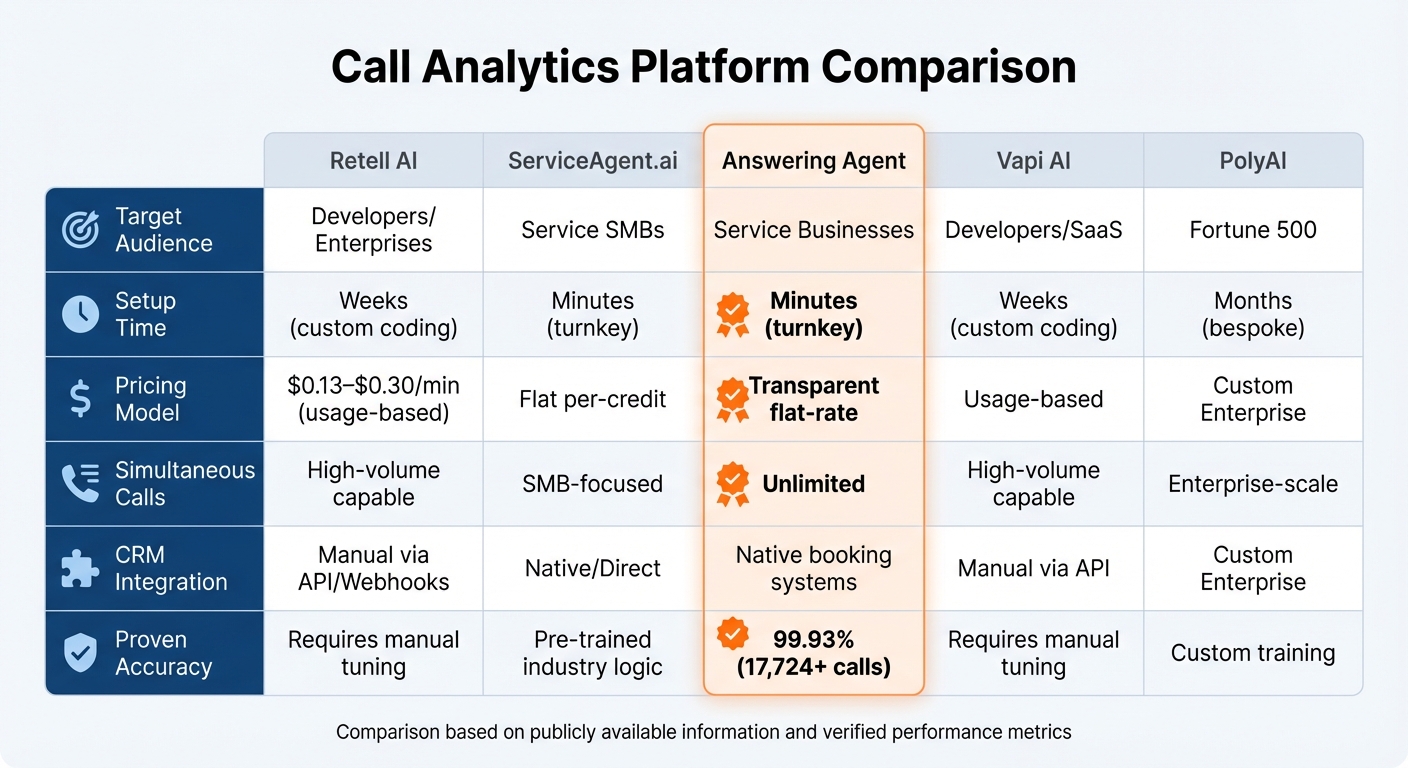
Call Analytics Platform Comparison: Features, Pricing, and Setup Time

Call Analytics Platform Comparison: Features, Pricing, and Setup Time

Feature Comparison Table

The call analytics market is filled with platforms catering to different business needs. Developer-first tools like Retell AI and Vapi AI offer extensive customization but require weeks of setup and coding. On the other hand, turnkey solutions such as ServiceAgent.ai are pre-configured for specific industries - like HVAC, medical, and legal - and can integrate directly with CRMs like Housecall Pro or Jobber in just minutes. For large enterprises, platforms like PolyAI provide custom implementations that take months to deploy and often require long-term contracts.

Feature Retell AI ServiceAgent.ai Answering Agent Vapi AI PolyAI
Target Audience Developers/Enterprises Service SMBs Service Businesses Developers/SaaS Fortune 500
Setup Time Weeks (custom coding) Minutes (turnkey) Minutes (turnkey) Weeks (custom coding) Months (bespoke)
Pricing Model Stacked usage-based ($0.13–$0.30/min) Flat per-credit Transparent flat-rate Usage-based Custom Enterprise
Simultaneous Calls High-volume capable SMB-focused Unlimited High-volume capable Enterprise-scale
CRM Integration Manual via API/Webhooks Native/Direct Native booking systems Manual via API Custom Enterprise
Proven Accuracy Requires manual tuning Pre-trained industry logic 99.93% (17,724+ calls) Requires manual tuning Custom training

For pricing, Retell AI operates on a stacked usage-based model, costing $0.13–$0.30 per minute, while ServiceAgent.ai offers a flat per-credit fee structure.

This table underscores how these platforms balance customization, setup speed, and pricing to meet diverse business needs.

Answering Agent's Advantages

When compared to its competitors, Answering Agent stands out with impressive operational metrics. While other platforms may boast sub-second response times, Answering Agent delivers 99.93% accuracy across more than 17,724 calls, coupled with an exceptionally low 0.07% hallucination rate. These numbers are crucial for service businesses, where errors like scheduling mistakes or incorrect pricing can directly affect revenue.

Scalability is another key strength. Answering Agent’s ability to manage unlimited simultaneous calls eliminates the bottlenecks often seen during peak times, like busy Monday mornings or emergency situations. Its 24/7 availability ensures no call goes unanswered, avoiding busy signals or dropped calls.

For businesses without dedicated engineering teams, Answering Agent offers an easy, turnkey solution that delivers enterprise-level performance without the hefty costs of traditional receptionist services. Plus, its transparent pricing avoids the layered fees typically associated with developer-focused platforms, making it an efficient and cost-effective choice for service businesses.

Conclusion

The performance data and tool comparisons earlier highlight how call analytics can become a game-changer for business success. Here’s a recap of the most important insights.

Key Takeaways for Service Businesses

Call analytics turns AI systems into self-improving tools that grow smarter with each interaction. By analyzing every call, businesses can quickly identify and resolve issues that might otherwise take weeks to surface. The cost savings are undeniable: AI customer service interactions range between $0.50–$0.70, compared to $6–$8 for human agents. Even better, businesses see an average first-year ROI of 41%, which can exceed 124% by year three.

This approach drives operational efficiency. Among small and medium-sized businesses (SMBs) using AI voice agents, 97% report measurable revenue growth. A major factor? Capturing after-hours calls and responding to leads within five minutes - making teams 21 times more likely to qualify those leads. For home service businesses, where a missed call can mean losing $1,200 in potential revenue, this responsiveness directly impacts profitability.

Take Answering Agent as an example. With a 99.93% accuracy rate and 6,820 accepted offers, it has consistently converted calls into bookings and revenue around the clock. All this is achieved without the $30,000–$60,000 annual expense of hiring human receptionists vs. AI.

Next Steps

Start by measuring your inbound call conversion rate over the next 90 days. This will help you establish a baseline for tracking progress. From there, implement a four-step feedback loop: collect data, categorize it, analyze trends, and take action.

If you’re ready to move beyond manual call tracking, Answering Agent provides an all-in-one solution. It offers enterprise-grade analytics with no need for coding or complex setups. Features like unlimited simultaneous calls, seamless booking system integrations, and flat-rate pricing make it ideal for service businesses that need to answer every call - and learn from each one. These steps can elevate your customer experience and drive your business forward.

FAQs

What is an AI feedback loop in call analytics?

An AI feedback loop in call analytics refers to a process where AI systems continuously learn and improve by analyzing customer interactions. By examining call data - like sentiment, recurring patterns, and call outcomes - the AI fine-tunes its abilities, including response accuracy, call routing, and overall service quality. This ongoing learning cycle allows businesses to boost customer satisfaction, minimize missed calls, and streamline operations by leveraging real-time insights from every interaction.

What should I track across telephony, ASR, LLM, and TTS?

Tracking key metrics at each layer is crucial for maintaining performance and quality in AI-driven customer interactions. Here’s what to monitor:

  • Telephony: Keep an eye on call volume, call duration, and success rates to ensure smooth communication.
  • ASR (Automatic Speech Recognition): Focus on metrics like Word Error Rate (WER) and confidence scores to evaluate how accurately the system transcribes speech.
  • LLMs (Large Language Models): Measure task success, response relevance, and sentiment analysis to ensure the system delivers meaningful and appropriate responses.
  • TTS (Text-to-Speech): Assess synthesis quality, naturalness, and latency to guarantee the output sounds clear and human-like.

These metrics provide valuable insights, helping you pinpoint issues and refine the overall customer experience.

How do I start using call analytics to improve lead conversion?

To boost lead conversion using call analytics, begin by collecting essential call data - think source, timing, duration, and conversation details. These metrics can help you spot trends tied to successful conversions.

Leverage AI-powered tools to dive deeper into calls, analyzing elements like sentiment, stress levels, and engagement. This gives you instant insights into how leads respond during interactions. From there, integrate these findings into your lead scoring system, allowing you to prioritize high-potential leads.

Lastly, use AI-driven feedback loops to continuously refine your approach, ensuring your strategies evolve and improve conversion rates over time.

Related Blog Posts

Answering Agent

Author

Answering Agent

Answering Agent