How Faster Response Times Boost Customer Retention

Speed determines customer loyalty: fast responses cut churn, boost conversions, and AI makes near-instant replies possible.

How Faster Response Times Boost Customer Retention

When customers reach out, they expect fast responses - within 10 minutes for 82% of them. Slow replies don’t just cost a sale; they harm long-term loyalty. In fact, 78% of customers buy from the first business to respond, and 60% will leave after one bad experience, often due to delays. Businesses that respond in under 5 minutes enjoy higher satisfaction, repeat purchases, and revenue, while those taking over 4 hours see churn rates soar to 55%.

AI-powered tools like Answering Agent solve this by answering calls in under 5 seconds, handling unlimited inquiries 24/7, and ensuring no lead is missed. Companies using AI have seen faster resolutions, increased conversions, and improved the customer experience while reducing costs. The message is clear: fast response times are key to retaining customers and driving growth.

The Importance Of Response Time 👀

How Response Times Affect Customer Retention
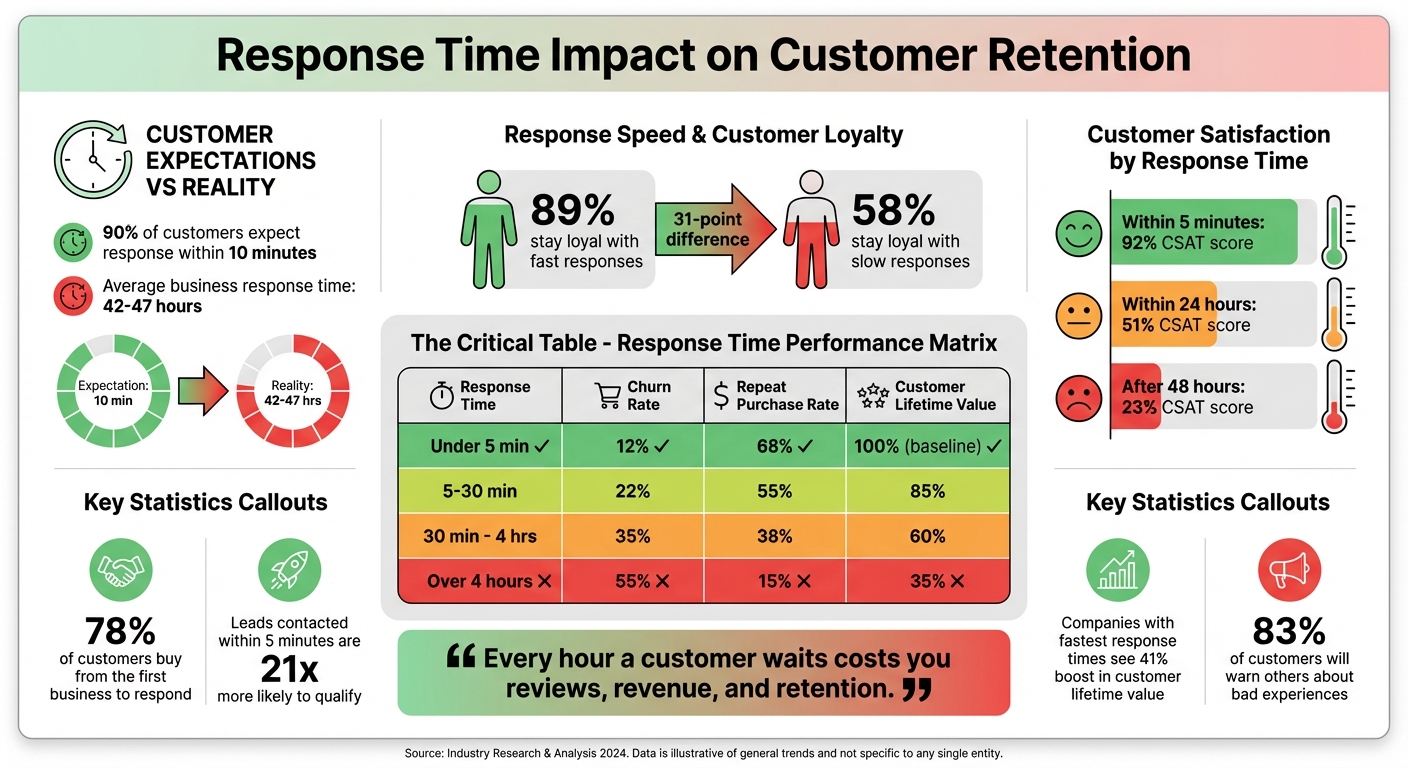
How Response Time Impacts Customer Retention Rates and Revenue

How Response Time Impacts Customer Retention Rates and Revenue

The link between how quickly a business responds and customer loyalty isn’t just a theory - it’s backed by numbers. Research shows that 89% of customers remain loyal to brands that respond quickly, while only 58% stick around after slow responses. That’s a striking 31-point difference, all because of response speed.

What Customers Expect for Response Speed

Here’s the reality: customers want answers fast. In fact, 90% of them say an immediate response - within 10 minutes - is critical. But here’s the problem: most businesses take a staggering 42 to 47 hours to respond. This delay occurs during a crucial period when customers are at their peak buying intent. The longer the wait, the more that intent fades.

Quick responses make a massive difference in customer satisfaction. For instance, responding within 5 minutes results in a 92% customer satisfaction (CSAT) score. Wait 24 hours, and that score plummets to 51%. After 48 hours? It’s just 23%. Mobile users, who make up 71% of inquiries, are even more demanding - they expect responses 23% faster than desktop users.

Failing to meet these expectations doesn’t just disappoint customers - it actively damages trust, making retention much harder.

How Slow Responses Hurt Retention

Slow responses don’t just cost individual sales - they can damage your long-term relationship with customers. Companies with the fastest response times see a 41% boost in customer lifetime value (CLV) compared to slower competitors. The financial impact doesn’t stop there. Customers forced to wait more than 4 hours are 4.5 times more likely to leave a negative review, and 83% will warn others about their bad experience.

The numbers below show how response speed directly influences customer retention:

Response Time Churn Rate Repeat Purchase Rate Avg. Customer Lifetime Value
Under 5 minutes 12% 68% 100%
5–30 minutes 22% 55% 85%
30 min – 4 hours 35% 38% 60%
Over 4 hours 55% 15% 35%

"Every hour a customer waits costs you reviews, revenue, and retention." – Gabe Campbell, AI Genesis

The takeaway is clear: slow responses don’t just hurt your bottom line - they chip away at the trust customers have in your brand. Even if you eventually resolve their issue flawlessly, the initial delay can leave a lasting negative impression. Customers become more price-sensitive and are far more likely to explore other options. Solutions like AI-powered tools, such as Answering Agent, can help businesses meet these high expectations and protect customer loyalty.

How AI Technology Improves Response Times

AI has drastically changed how quickly businesses can respond to customer inquiries. While human teams typically take around 7 hours for a first response, AI-powered systems can deliver responses in under 23 seconds - a massive 97% reduction in wait time. This kind of speed allows businesses to engage customers right when their interest is at its peak.

How AI Reduces First Response Times

AI eliminates many of the delays that slow down human teams. Using Natural Language Processing (NLP), AI can instantly analyze incoming requests, determining their intent, urgency, and even the customer’s sentiment. It then classifies and routes requests to the right department in just seconds.

AI phone receptionists, for example, respond in less than 2 seconds, providing immediate assistance for the 28.5% of calls that come in after hours or on weekends. A great example of this is RTR Vehicles, which implemented an AI agent in 2026. The result? They resolved 92% of inquiries in under 30 seconds, saved $15,000 per month, and increased pre-sale conversions - showing how faster response times can build long-term customer trust.

But AI doesn’t stop at basic call handling. It can work across multiple tools to handle tasks like processing returns, checking order statuses, or booking appointments without human intervention. For more complex issues, AI assists human agents by drafting response templates and pulling up relevant knowledge base articles. This kind of support helps agents resolve issues 47% faster. These capabilities not only improve response times but also enhance overall efficiency.

Business Benefits of Faster AI Responses

This speed translates into clear business advantages. For instance, leads contacted within 5 minutes are 8 times more likely to convert compared to those contacted after 30 minutes. Additionally, 78% of customers end up buying from the first business that responds. Faster responses also lead to higher customer satisfaction, which strengthens loyalty and retention.

AI systems are also highly scalable, handling unlimited calls and inquiries simultaneously. This ensures consistent response times, even during peak demand periods. And they’re cost-effective - each AI interaction costs about $0.50, compared to $6–$8 for human-handled interactions, making AI more cost-effective than human receptionists. For service-oriented businesses, tools like Answering Agent provide 24/7 phone support with 99.93% accuracy, ensuring no inquiry is missed. This not only supports conversions but also helps maintain long-term customer relationships.

Answering Agent: AI Phone Answering for Service Businesses
Answering Agent

Answering Agent ensures you never lose revenue due to missed calls. With instant, 24/7 AI phone answering, it responds in under 5 seconds, handles unlimited simultaneous calls, and captures the 28.5% of calls that come in after hours when human staff are unavailable.

Accuracy and Call Handling Performance

Answering Agent has handled 17,724+ scored calls with 99.93% accuracy, maintaining a minimal 0.07% error rate. This precision helps prevent service mistakes - like misquoted prices or forgotten details - that often push 52% of customers to competitors. The system not only qualifies leads by assessing their needs and urgency but also logs all details directly into your CRM.

Unlike traditional receptionists who can only manage one call at a time, Answering Agent handles unlimited calls simultaneously. This eliminates busy signals during peak times, ensuring every lead gets immediate attention. Considering that 51.5% of callers use urgent terms like "emergency" or "ASAP", this instant responsiveness is crucial.

These performance metrics set the stage for features designed to keep customers engaged and satisfied.

Features That Support Customer Retention

The AI answers within the 1-2 ring "sweet spot" that keeps caller satisfaction high - at 90-95% - and avoids the dreaded 4-ring delay, where conversion rates drop by 10-25%. It efficiently books appointments, captures lead details, and engages in conversations averaging 15 turns, creating a natural and interactive experience.

Its 24/7 availability ensures no opportunity is missed. Research shows that 34.8% of after-hours callers are ready to make a purchase. Additionally, Answering Agent seamlessly manages multilingual calls, handling Spanish (8.0% of calls) and French (1.7%) without requiring specialized staff. At just $199/month for unlimited calls, it offers a cost-effective solution - saving 87-97% compared to the expense of a full-time human receptionist - all while delivering faster, more dependable service.

Results for Service Businesses

The results speak for themselves. Answering Agent has generated 20,375 offers, with 6,820 of those converting into accepted deals. Its instant AI responses lead to a 66.7% meeting booking rate, more than doubling the 30% rate achieved with human follow-ups. Since 78% of customers choose to buy from the first business that responds, this speed advantage directly boosts revenue.

Research Data: How Speed Affects Retention and Revenue

Conversion Rates From First Responses

Recent research highlights just how much faster response times can reshape conversion rates and customer retention. For instance, responding just one minute faster can increase conversion rates by an astonishing 391% compared to waiting two minutes. Businesses that respond within five minutes are 21 times more likely to qualify a lead compared to those waiting 30 minutes. However, after the five-minute mark, the odds of contacting a lead drop drastically - tenfold, to be exact. Companies that consistently respond within five minutes generate eight times more revenue per lead than those taking anywhere from 5 to 60 minutes.

Take this example: a home service company in 2024 reduced its response times from 4 hours to under 5 minutes. The results? Monthly web lead revenue jumped from $6,000 to $11,600. Their conversion rate climbed from 15% to 29%, translating into an additional $67,200 in annual revenue. This example clearly shows how shaving down response times can directly impact both short-term conversions and long-term revenue growth.

Retention and Revenue Improvements

Quick responses don’t just boost conversions - they also play a major role in keeping customers loyal. When customers receive responses in under five minutes, they tend to stick around: churn rates drop to just 12%, and repeat purchase rates soar to 68%. Compare that to customers who wait over 4 hours for a response - 55% churn and only 15% make repeat purchases.

Consider a 12-provider medical practice in Ohio as another example. In 2024, they lost around $950,000 annually due to approximately 20 missed calls per day. More than half of those callers didn’t bother trying to reconnect, showing how costly slow response times can be.

Conclusion

Research highlights a simple truth: speed matters. A staggering 78% of customers choose the first business that responds, and responding within five minutes makes you 21 times more likely to qualify a lead. Yet, while customers expect answers within 10 minutes, most businesses take a frustrating 42 to 47 hours to reply.

This gap in response time is where technology steps in. Tools like Answering Agent are changing the game by answering calls in under two seconds, handling unlimited simultaneous calls, and maintaining an impressive 99.93% accuracy rate. By letting AI handle routine calls, businesses can ensure no lead is left waiting while their teams focus on delivering top-notch service.

Take RTR Vehicles, for instance. They've saved $15,000 every month and resolved 92% of inquiries in under 30 seconds. Answering Agent offers these same benefits across industries, from medical practices to home services, ensuring every call becomes an opportunity to retain customers and drive growth.

As industry experts put it:

"78% of customers buy from the first business that responds. Not the cheapest. Not the one with the best reviews. Not the most experienced. The first one to pick up the phone." - NextPhone

The businesses that thrive in the coming years will prioritize meeting customer expectations. AI-powered solutions make this achievable at a fraction of the cost of traditional staffing, turning rapid response times into a key driver of loyalty and success.

FAQs

What response time should my business aim for?

Your business should strive to respond to inquiries within 5 minutes. Studies reveal that doing so can dramatically enhance lead qualification and customer satisfaction. In fact, you're 21 times more likely to qualify a lead with such promptness, and it also boosts customer retention. Leveraging fast response times - especially with the help of AI tools - can give service businesses a competitive edge and strengthen customer loyalty.

How does slow response time increase churn?

Slow response times can push customers away by making them feel overlooked. This often leads to negative reviews, decreased satisfaction, and a higher chance they'll turn to competitors. When delays stretch into hours or even days, the odds of keeping those customers drop sharply. Quick replies are key to building trust and keeping loyalty intact.

Can AI answering improve retention without hurting quality?

AI-powered answering systems can improve customer retention while maintaining high-quality service. These systems achieve impressive customer satisfaction rates, typically ranging from 85% to 92%, and often rival or surpass human receptionists in terms of reliability. By offering instant, consistent responses, they minimize missed calls and elevate the overall customer experience. This ensures businesses can keep strong, reliable connections with their clients.

Related Blog Posts

Try it yourself

See how AI handles calls for your business

Enter your business name and we'll build a personalized AI receptionist demo in under 2 minutes. Talk to it right in your browser.

No signup required · Free to try · Works for any business

Answering Agent