How AI Stops Missed Calls in Legal Services

24/7 AI phone intake captures missed legal calls, qualifies leads, and books consultations to boost firm revenue.

How AI Stops Missed Calls in Legal Services

Missed calls cost law firms millions annually, with 25–40% of calls going unanswered. AI answering services solve this by providing 24/7 AI call handling, ensuring every inquiry is addressed instantly. These systems use natural language processing to gather case details, qualify leads, and even schedule consultations, all while integrating with practice management tools.

Key Takeaways:

  • Missed Calls = Lost Revenue: Each missed call costs firms about $1,200, with 78% of prospects hiring the first firm to respond.
  • AI Advantages: Handles unlimited simultaneous calls, responds instantly, and costs 90% less than hiring human receptionists.
  • Proven Results: Firms using AI have seen revenue increases of $500,000 or more annually by addressing after-hours inquiries.

AI answering systems are transforming legal services by ensuring no lead goes unanswered, improving client experience, and boosting firm profitability.

AI Intake Is Coming to Law Firms and It’s Changing Everything

How AI Answering Services Prevent Missed Calls
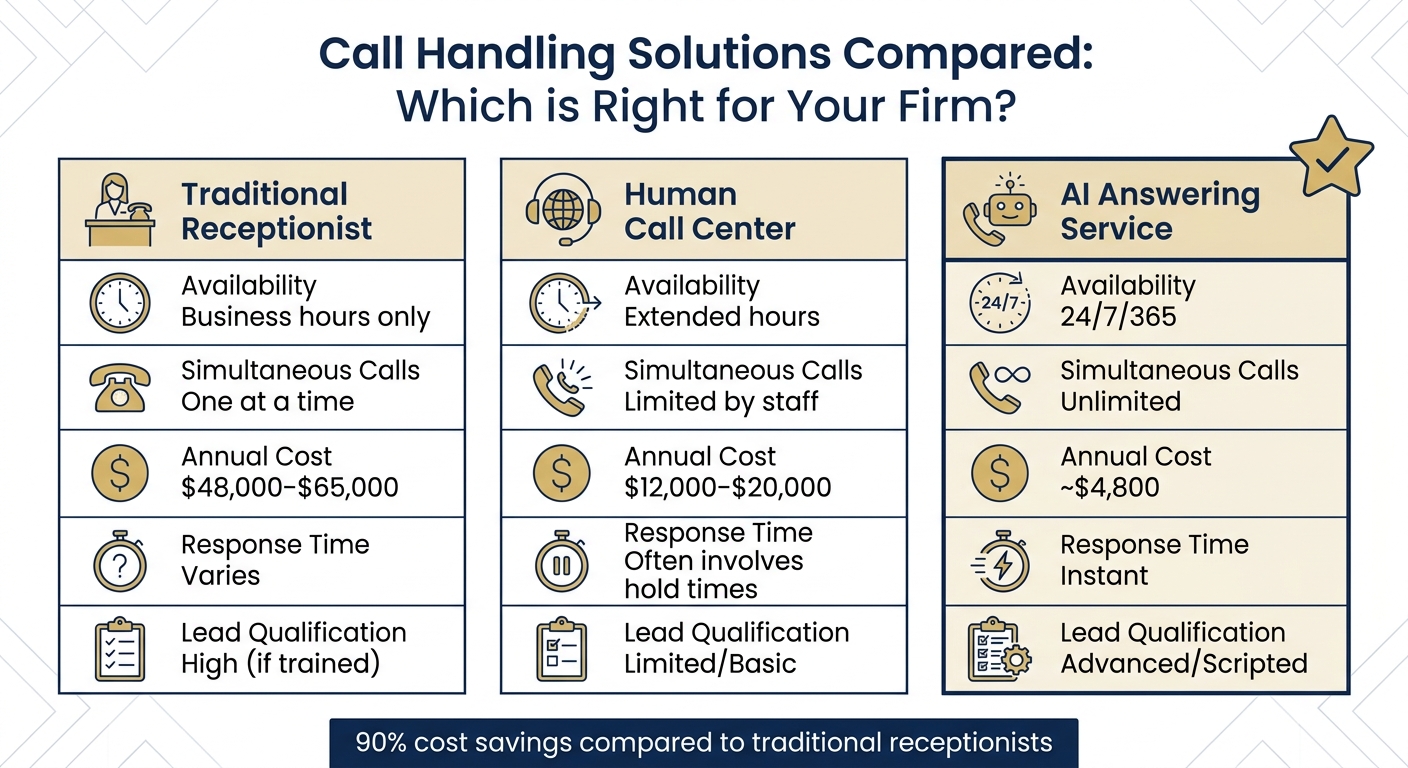
AI vs Traditional Receptionist Comparison for Law Firms

AI vs Traditional Receptionist Comparison for Law Firms

AI answering services bridge the gaps in communication that often lead law firms to lose potential clients. These systems respond to every call instantly - 24/7 - ensuring no opportunity is missed, even during the 23% to 31% of legal inquiries that come in after regular business hours. Unlike human receptionists, who can only manage one call at a time, AI can handle an unlimited number of simultaneous calls. Using natural language processing, the AI engages in professional, conversational interactions, gathers specific details - such as arrest information or injury severity - and qualifies leads in real time. It can even schedule consultations directly into your calendar. For example, Answering Agent boasts a 99.93% accuracy rate across thousands of calls, ensuring critical information is always captured correctly. Next, we’ll explore how these systems streamline intake and integrate with your practice management tools.

What AI Answering Services Do

AI phone systems take care of the entire intake process. They greet callers with a natural, conversational tone, ask tailored questions to gather case details, and assess whether the lead is worth pursuing. These systems integrate seamlessly with legal practice management software like Clio and MyCase, automatically logging every interaction and scheduling appointments without requiring staff involvement.

For urgent situations, such as active arrests needing immediate bail assistance, the system sends real-time alerts to on-call attorneys. Meanwhile, routine questions - like inquiries about office hours or case updates - are handled automatically, allowing your team to focus on tasks that directly contribute to revenue.

"Missed calls are missed cases. AI ensures that never happens again." – Charlie Toma, Co-founder & GTM, Teli.ai

To illustrate, a five-attorney criminal defense firm in Texas adopted an AI answering service in 2025 to handle late-night arrest calls. The system collected vital details like booking numbers and bail amounts, routing urgent cases to an attorney within 15 minutes. In its first year, the firm secured dozens of high-value cases that would have otherwise gone to voicemail, generating $500,000 in additional revenue.

By automating call intake and lead qualification, AI systems not only help firms capture every opportunity but also improve the overall client experience.

Why Law Firms Need AI Phone Systems

The legal field has unique demands, and AI systems are designed to meet them. Speed is critical - 67% of legal clients base their hiring decisions solely on how quickly they receive a response. Whether it’s a late-night arrest or an injury case, people need immediate help. AI provides this rapid response while maintaining the professionalism and empathy required for sensitive legal matters, ensuring firms don’t lose potential clients.

Cost is another compelling reason. A human receptionist costs between $48,000 and $65,000 per year (including benefits), while an AI answering service costs roughly $4,800 annually - a savings of about 90%. For this reduced cost, you get 24/7 coverage, unlimited call handling, and consistent quality, all while ensuring every call is answered.

Feature Traditional Receptionist Human Call Center AI Answering Service
Availability Business hours only Extended hours 24/7/365
Simultaneous Calls One at a time Limited by staff Unlimited
Annual Cost $48,000–$65,000 $12,000–$20,000 ~$4,800
Response Time Varies Often involves hold times Instant
Lead Qualification High (if trained) Limited/Basic Advanced/Scripted

How to Implement AI Phone Answering in Your Law Firm

Integrating AI phone answering into your law firm can help you maintain 24/7 call coverage without requiring technical expertise or major system changes. Follow these three steps to get started.

Step 1: Evaluate Your Call Patterns

To choose the right system, you first need to understand how your calls are currently handled. Look at the past 30–60 days of phone logs to assess how many calls go unanswered. Studies show that 60% of law firms miss incoming calls, and the numbers might be higher than you expect. Break down the data by time of day to see when calls are most often missed - after-hours calls often represent a significant portion of lost opportunities since many legal inquiries occur outside standard office hours.

Categorize calls by type. For instance, differentiate between potential client intakes and routine administrative inquiries like office hours or directions. Research reveals that 48% of calls to small and mid-sized firms involve non-billable administrative tasks.

Next, calculate the financial impact of missed calls. Multiply the number of unanswered calls by your average case value. For example, if your firm misses 10 calls a month and your average personal injury case is worth $8,000, you could be losing $240,000 annually, assuming a 25% conversion rate. In 2026, a personal injury firm with four attorneys analyzed 89 weekly inbound calls and found that 34% went to voicemail. Of those, 41% of prospects never followed up.

Once you have a detailed understanding of your call patterns, you’re ready to choose the right AI answering service.

Step 2: Choose an AI Answering Service

Look for a provider that offers 24/7/365 coverage and customizable intake flows tailored to your practice areas. For instance, Answering Agent uses scripts specifically designed for different legal specialties, ensuring that the right information is captured based on each caller’s needs. Use the insights from Step 1 to find a service that addresses your firm’s specific challenges, such as after-hours coverage or high call volumes.

Security is critical in legal work, so ensure the provider offers AES-256 encryption and complies with confidentiality standards required by state bar associations. Additionally, the AI should identify itself to callers to meet ethical disclosure requirements. Answering Agent, for example, has achieved 99.93% accuracy across over 17,700 scored calls, reliably capturing essential details like booking numbers, injury severity, or opposing party names.

Pricing for AI answering services ranges from $59 to $150 per month for basic options. More advanced platforms, like Answering Agent, provide unlimited simultaneous calls at a flat rate, which is far less than the $1,500 to $4,000 monthly cost of hiring a human receptionist.

Step 3: Connect AI to Your Current Tools

Most AI answering services integrate seamlessly with practice management software like Clio, MyCase, and PracticePanther. These integrations allow the AI to sync intake data - such as caller names, contact details, and case descriptions - directly into your system as new contacts or matters. The AI can even schedule consultations during the initial call, eliminating the back-and-forth of phone tag.

If native integrations aren’t available, middleware like Zapier can bridge the gap. For example, Answering Agent connects with popular legal tools to ensure every lead is automatically added to your workflow. It can also flag potential conflicts of interest by capturing and routing names for conflict checks before scheduling consultations.

Set up protocols for urgent situations. You can configure the AI to recognize keywords like "arrested", "served", or "custody" and immediately alert on-call attorneys via SMS or direct transfer. This ensures emergencies are addressed promptly while routine inquiries are handled automatically.

How Answering Agent Works for Law Firms
Answering Agent

When a call comes through, Answering Agent ensures it gets routed to the right legal specialist based on the caller's needs. It begins with a professional greeting, clearly identifies itself as AI to adhere to ethical standards, and conducts a structured intake process with empathy. Its ability to handle every call ensures that law firms maintain immediate connections with potential clients - an essential aspect in legal settings where urgency often matters.

For personal injury cases, it asks about key details like the incident date, type of injury, treatment history, liable parties, insurance information, and police reports. For family law inquiries, it gathers specifics about custody situations, divorce timelines, and details on the opposing party. Importantly, the system is programmed to never give legal advice. Instead, it focuses on collecting information and scheduling consultations.

Once a lead is qualified, Answering Agent takes the next steps by booking consultations based on real-time calendar availability. It also syncs all case details with CRMs like Clio, MyCase, or Filevine and can trigger automated follow-ups when needed.

Results Law Firms Get with Answering Agent

Answering Agent has proven its effectiveness by managing over 17,724 calls with an impressive 99.93% accuracy rate. It has delivered 20,375 pitches, leading to 6,820 acceptances. This translates into a conversion rate of 40–55% for qualified appointments and 60–80% engagement for after-hours calls.

The financial benefits are clear. With 37% to 45% of legal inquiries happening outside normal business hours, Answering Agent helps firms capture leads that might otherwise be lost to voicemail or competitors. Responding within five minutes makes it 100 times more likely to connect with a lead compared to waiting 30 minutes. For example, in July 2025, a mid-sized personal injury firm gained 22 new weekend and evening leads through AI, with 12 converting into paying clients. This added over $100,000 in potential case value.

"Eve's AI Intake Specialist is pivotal for us. It's a practical way to ensure every potential client gets a prompt response, day or night, helping us identify and secure the right cases more consistently." - Manny Starr, Managing Partner at Frontier Law Center

These results highlight the system's ability to deliver measurable outcomes, setting the stage for further performance tracking and improvements in the next discussion.

How to Track and Improve AI Performance

Metrics to Monitor

The success of your AI answering service hinges on the metrics you track. Start with response time - aim for under 60 seconds. Why? Because 67% of legal clients make decisions based on how quickly firms respond to their inquiries. Another key metric is your consultation booking rate, as this directly impacts your bottom line. And don’t overlook your conversion rate - the percentage of initial inquiries that turn into signed engagement letters. For context, the average in the legal industry is around 2.6%.

Metric to Monitor Target Benchmark Why It Matters
Response Time < 60 seconds 67% of legal clients prioritize speed when choosing a firm
Missed Call Rate < 5% The industry average is 28%; every missed call represents lost revenue
Lead Capture Rate 90%+ 80% of callers hang up if they reach voicemail
Consultation Booking 25%+ increase AI can schedule consultations directly into calendars 24/7

Tracking these benchmarks allows you to pinpoint where your AI system is thriving and where it needs work.

It’s also crucial to monitor call volume patterns throughout the day. With 37% to 45% of inquiries happening after business hours, your 24/7 AI coverage must be optimized to capture these leads. Additionally, assess referral source accuracy to identify which marketing channels are driving results. Keep an eye on your qualified lead percentage to measure how many callers meet your firm’s criteria, such as jurisdiction, case type, or insurance coverage.

How to Improve Your AI System

Once you’ve identified performance gaps, take steps to fine-tune your AI system to maximize its effectiveness.

Start by auditing call recordings weekly to identify unexpected issues. For example, in March 2026, a personal injury firm tackled a 34% missed call rate by deploying an AI receptionist. They reviewed their call flow and added practice-specific intake questions, which cut missed calls to just four per week. This change also boosted pre-qualified consultations by six per week. Within the first month, the firm signed two additional cases worth $18,000 each, thanks to after-hours calls captured by the AI.

Next, refine your intake scripts using real conversion data. If calls are ending without bookings, consider adding qualifying questions early on to keep prospects engaged. Use your dashboard to filter call types and identify where potential clients are dropping off.

Finally, test your system regularly. Make calls at different times - during lunch, after hours, and on weekends - to ensure the AI handles routing and escalations as expected. Regular adjustments and testing are key to keeping your system sharp.

Conclusion

This article highlighted how quick, AI-driven responses can be a game-changer for capturing legal leads. Missed calls cost an average law firm around $7 million in lost revenue each year. The solution? AI answering services. These tools eliminate voicemail, capture between 37–45% of after-hours inquiries, and provide instant responses to every caller. Considering that 67% of legal clients decide on a firm based on how quickly they respond, being the first to answer isn't just helpful - it can be the deciding factor in securing a case.

Real-world examples underscore this point. A Texas criminal defense firm added $500,000 in annual revenue by using AI to handle late-night calls. Similarly, a personal injury firm secured two additional cases worth $18,000 each in its first month simply by answering after-hours calls. These results aren't exceptions - they show what happens when potential clients are met with immediate responses instead of voicemail.

Answering Agent sets the standard with impressive performance: 99.93% accuracy over 17,724+ scored calls and a minuscule 0.07% hallucination rate. It can handle unlimited simultaneous calls, schedule appointments directly in your calendar, and costs far less than hiring a human receptionist. With 6,820 accepted offers from 20,375 pitches, Answering Agent doesn't just answer calls - it turns them into consultations.

By implementing the steps outlined earlier, your firm can achieve these same results and ensure no lead is ever lost to voicemail. As AgentZap aptly puts it:

"The firm that answers first gets the case. It's that simple".

Don’t let voicemail cost you clients - AI answering services like Answering Agent provide the 24/7 availability, instant responses, and tailored intake solutions your firm needs to stay ahead.

FAQs

Will callers know they’re speaking to AI?

Callers often have no idea they’re talking to AI. These systems are crafted to respond with a natural, conversational tone that mimics human interaction. They’re also programmed to avoid revealing their artificial nature. For example, in industries like legal services, advanced AI ensures smooth, professional communication, making the experience feel just like speaking with a human receptionist.

AI takes on tasks such as answering calls, qualifying leads, and scheduling consultations, steering clear of offering legal opinions or advice. By avoiding recommendations, it ensures compliance with regulations governing legal practice. This setup enables law firms to manage client inquiries effectively while adhering to ethical standards.

How do I roll this out without disrupting my current intake?

To integrate AI answering services into your intake process smoothly, take it step by step. Start by deploying it during off-hours or to handle overflow calls - this ensures you’re not missing important opportunities. Set up the AI to screen and qualify leads effectively, while routing urgent calls directly to your team. Keep an eye on how it’s performing, tweak its settings as needed, and provide your staff with training to make sure the AI works alongside them seamlessly. This approach boosts responsiveness while keeping your current workflow intact.

Related Blog Posts

Try it yourself

See how AI handles calls for your business

Enter your business name and we'll build a personalized AI receptionist demo in under 2 minutes. Talk to it right in your browser.

No signup required · Free to try · Works for any business

Answering Agent