AI vs. Traditional Legal Answering Services

Compare AI and human legal answering services on cost, speed, accuracy, and after-hours coverage for law firms.

AI vs. Traditional Legal Answering Services

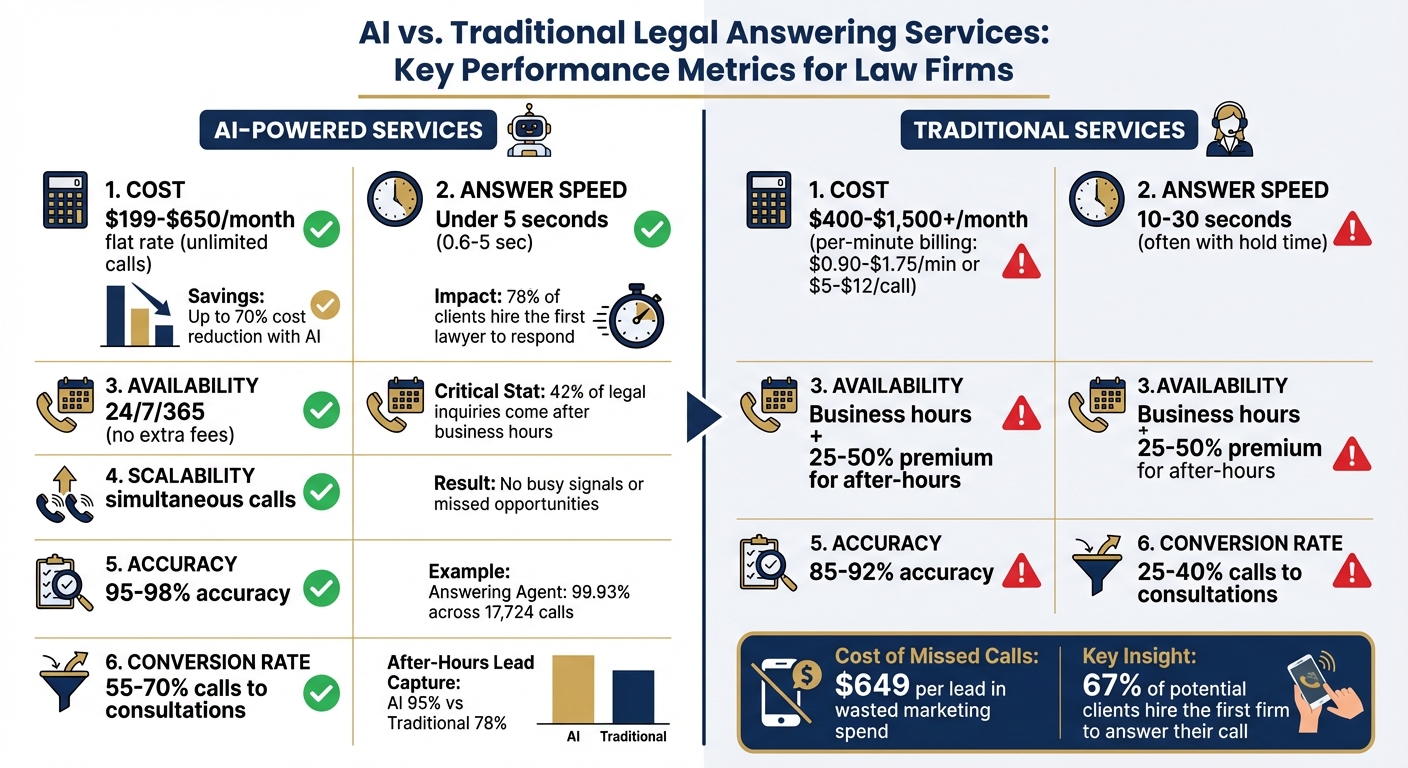
Missed calls can cost law firms $649 per lead in wasted marketing spend. With 42% of legal inquiries coming after business hours, firms need reliable call handling solutions. AI-powered answering services are faster, more scalable, and cost-effective compared to human-staffed options. Here’s the breakdown:

  • Cost: AI services charge flat monthly rates ($199–$650) for unlimited calls, saving up to 70% compared to per-minute or per-call fees of $5–$12 charged by human services.
  • Speed: AI answers in under 5 seconds, while human operators take 10–30 seconds, impacting client acquisition since 78% of clients hire the first lawyer to respond.
  • Scalability: AI handles unlimited simultaneous calls, unlike human agents who are limited to one call at a time, reducing missed opportunities during peak hours.
  • After-Hours Coverage: AI operates 24/7 without extra fees, while human services often charge 25–50% more for nights, weekends, and holidays.

For firms looking to cut costs and boost efficiency, AI solutions like Answering Agent provide consistent, fast, and reliable service, while human operators are better for emotionally sensitive cases. A hybrid approach may combine the strengths of both.

AI vs Traditional Legal Answering Services: Cost, Speed & Performance Comparison

AI vs Traditional Legal Answering Services: Cost, Speed & Performance Comparison

AI Answering Service for Lawyers (Full Setup + Sample Call)

Traditional legal answering services depend on human agents to manage calls for law firms. These agents use scripts provided by the firm to screen callers, collect client details, and pass messages along to attorneys. When a call comes in, it’s routed to an available agent who follows the firm’s specific instructions to handle the conversation.

Agents typically ask specific questions to identify the caller’s needs, check for potential conflicts of interest, and determine if the firm can take on the case. For scheduling, they use the firm’s calendar to set appointments. Some services, like Smith.ai, use a hybrid model where AI supports live agents with tasks like data entry and updating CRM systems, while others, like Ruby, rely entirely on human agents.

Ruby’s scale is impressive - it captures over 1.6 million leads annually and manages more than 1.1 million conversations every month. However, even with this level of human involvement, this model has its share of challenges, as outlined below.

Main Features and Drawbacks

Traditional answering services come with both strengths and weaknesses. One of their biggest strengths is the human touch. This is vital in areas like family law, criminal defense, or personal injury, where clients often face emotionally charged situations. As Vox Synthesis puts it, "Clients in crisis need compassion, not efficiency." Human agents excel in handling complex or sensitive scenarios that don’t fit into rigid intake systems, such as disputes involving multiple parties or intricate estate planning.

That said, the model struggles with scalability. Human agents can only handle one call at a time, which often leads to hold times of 10–30 seconds during busy periods. Service quality can also vary depending on an agent’s experience or stress levels. Another issue is cost. Many services bill by the minute, with a 30-second minimum, which means law firms can end up paying for wrong numbers, robocalls, or spam. Ruby, for example, faced a $12 million class action settlement in 2021 over undisclosed billing practices.

After-hours coverage adds another layer of complexity. Reduced staffing during these periods often leads to longer wait times, and firms are frequently charged premiums of 25–50%. On holidays, rates can spike to 1.5–2 times the normal cost.

These challenges highlight the need for solutions like AI call handling for law firms that are both more scalable and cost-effective - topics explored further in the following sections.

AI-powered legal answering services bring speed and efficiency that traditional methods can't match. By replacing human agents with advanced automation, these systems leverage Natural Language Processing (NLP) and machine learning to handle unlimited calls at once. Unlike human agents, who are limited to one call at a time, AI eliminates busy signals, hold times, and missed opportunities - even on your firm’s busiest days.

These systems answer calls within just 1–2 rings, which is crucial because 67% of potential clients choose the first law firm to answer their call. This instant response ensures that while competitors leave callers waiting, your firm is already building connections from the very first ring.

AI legal receptionists also operate 24/7/365 without extra charges, covering after-hours inquiries seamlessly. Considering that 31%–42% of legal leads come in outside standard business hours, this around-the-clock availability is a game-changer. Beyond simply answering calls, these services qualify leads using tailored intake scripts, schedule consultations by syncing with calendars like Clio, MyCase, or Google, and even collect consultation fees using integrated payment processors such as Stripe.

How AI Technology Handles Calls

Modern AI legal receptionists deliver responses that sound natural and conversational. Using advanced NLP, they understand caller intent, respond empathetically to emotional cues, and adapt to the flow of the conversation. In fact, 91% of callers don’t realize they’re speaking with AI, and 94% report satisfaction with the intake experience.

These systems are also equipped to handle practice-specific inquiries. Whether it’s explaining the statute of limitations for personal injury cases, providing insurance details for accident claims, or identifying urgency in criminal defense matters, AI receptionists can manage it all. When critical keywords like “arrest,” “jail,” or “deadline” are detected, the system can trigger immediate warm transfers to an attorney’s mobile device. Some services even accommodate collect calls from jails[5,8]. These advanced features allow platforms like Answering Agent to elevate how legal calls are managed.

What Makes Answering Agent Different

Answering Agent

Answering Agent boasts 99.93% accuracy across 17,724 calls, ensuring precise client data capture. Its ability to handle unlimited simultaneous calls - at a flat monthly rate - overcomes the scalability challenges of traditional services. Whether your firm receives 10 calls or 100 during a busy afternoon, every call is answered without delay. The platform’s track record includes 20,375 offers with 6,820 acceptances, showcasing its ability to convert inquiries into real opportunities.

Cost is another area where Answering Agent shines. Traditional services often charge $400 to $1,500+ per month using a per-minute billing model. In contrast, Answering Agent provides 24/7/365 coverage with customizable scripts, seamless appointment booking, and efficient lead capture at 50%–70% less cost. Plus, there are no extra fees for wrong numbers, robocalls, or after-hours coverage, making it a predictable and affordable solution for firms of all sizes.

Cost Comparison: AI vs. Traditional Services

When it comes to speed, scalability, and cost, AI-powered services have a clear edge over traditional human-staffed options. Traditional services often charge between $400 and $1,500+ per month, using billing models based on per-minute or per-call usage. For instance, Ruby's pricing starts at $245 per month for 50 minutes (around 16–17 calls) and climbs to $1,725 per month for 500 minutes, with overage fees ranging from $3.39 to $4.90 per minute. Similarly, Smith.ai begins at $292.50 per month for 30 calls, with additional charges of $8 to $11 per call for exceeding the plan limits.

AI-powered services slash these costs significantly - often by 50–75% - while offering broader coverage. For example, Answering Agent provides flat-rate pricing at $400 per month for unlimited calls with 24/7/365 availability. Other AI options, like NextPhone, charge $199 per month for unlimited calls, while Klariqo offers plans ranging from $99 to $249 per month, depending on usage.

Pricing Breakdown by Service Type

Traditional services often come with added fees, including setup charges ($50–$200), after-hours premiums (15–30%), and holiday surcharges (up to double the regular rate). Even spam and robocalls can rack up costs unless firms invest in expensive filtering tools. For example, a law firm handling 150 calls per month might pay approximately $705 per month with Ruby's standard plan or $825 per month with Smith.ai, factoring in overage fees.

In contrast, AI-powered services provide transparent pricing without surprise fees. Answering Agent, for instance, offers 24/7/365 service at a flat $400 per month, ensuring no hidden costs. One family law firm, after switching to an AI solution, reduced monthly expenses from $650 to $399 within 90 days and saw a 36% increase in new clients. For firms managing around 150 calls monthly, this can translate to annual savings exceeding $6,600.

Maryam Sameer of LegalClerk.ai highlights the impact of AI:

"AI often cuts expenses by 65–80% while ensuring 24/7 availability compared to traditional legal reception."

Unanswered calls are costly - each one represents about $649 in wasted marketing spend. Plus, 67% of potential clients hire the first firm that answers their call. By ensuring constant availability, AI services not only save money but also protect revenue, making them a smart choice for firms looking to optimize both costs and client acquisition. These cost advantages pave the way for further comparisons in performance.

Call Handling, Intake, and Scheduling Capabilities

Speed matters when it comes to acquiring legal clients. AI receptionists answer calls in as little as 0.6 to 5 seconds (usually within 1–2 rings), while traditional services often take between 10 and 90 seconds, frequently placing callers on hold during busy times. This speed difference is crucial, especially since 78% of legal clients hire the first firm to respond to their inquiry.

The intake process highlights even bigger differences. AI systems adapt dynamically, asking practice-specific follow-up questions tailored to the field (like statute of limitations, insurance minimums, or case types). On the other hand, traditional services rely on rigid scripts, unable to adjust to the nuances of particular cases.

Scheduling is another area where AI shines. AI solutions directly integrate with calendars such as Clio, Calendly, and Google, enabling consultations to be booked during the initial call. Traditional services, however, usually take a message for a callback, leading to delays and lost leads. Consider this example: In February 2026, a 3-attorney personal injury firm replaced their in-house receptionist with Answering Agent. Their lead response time dropped from 4 hours to just 2 minutes, and within three months, they saw a 35% increase in new client acquisitions.

Side-by-Side Capability Comparison

Capability Traditional Service AI Solution (Answering Agent)
Answer Speed 10–90 seconds; may include hold Instant (0.6–5 seconds)
Simultaneous Calls Limited by staff count Unlimited capacity
Scheduling Method Takes message for callback Real-time calendar booking
Lead Qualification Fixed scripts only Dynamic, practice-specific questions
CRM Integration Manual entry or delayed sync Real-time automatic sync (8 seconds)
Setup Time 2–4 weeks for training 15–30 minutes automated

The benefits are clear in real-world scenarios. Take Martinez & Associates in Chicago, for instance. Before implementing Answering Agent in 2025, the firm was missing 43% of its 120 weekly calls. After switching, they achieved a 100% answer rate and booked 47 additional consultations per month, resulting in 28 new signed cases monthly worth approximately $980,000 in case value. Their managing partner shared:

"We were bleeding cases to competitors. Now we answer every call in under 2 seconds, even when we're all in court".

AI also ensures near-perfect data capture, syncing CRM records in real time with flawless accuracy - unlike traditional services that rely on manual transcription. For firms handling 42% of leads outside standard business hours, this 24/7 reliability gives them a significant edge over traditional services, which often falter during nights and weekends. These advantages make AI-powered solutions a game-changer for legal practices (and other AI receptionist services for small businesses) looking to maximize efficiency and boost revenue through automated lead capture.

Accuracy, Conversion Rates, and After-Hours Performance

AI-powered systems aren't just cost-effective and scalable - they also outperform traditional services in key performance metrics. The numbers tell the story. AI systems achieve an impressive 95%–98% accuracy when capturing caller information, compared to the 85%–92% accuracy of traditional services. This matters because errors in caller details can derail effective lead follow-up.

That said, traditional services still hold an advantage in processing complex legal terminology, with human operators achieving 34% higher accuracy in this area. However, AI has made significant progress, now correctly answering 94% of common business questions, a leap from 76% in 2021.

When it comes to conversion rates, the gap widens. AI services convert 55%–70% of calls into consultations, far outpacing the 25%–40% conversion rate of traditional services. Why? Speed is a major factor. AI systems respond in under 5 seconds, while traditional services take 20–45 seconds. This is critical because 67% of potential legal clients choose the first firm to answer their call. In fact, every second of delay can lower conversion rates by 1–2%, and callers waiting over 30 seconds are 40% more likely to hang up.

After-hours performance is another area where AI shines. With 73% of customer calls happening outside the usual 9–5 workday and 42% of legal leads coming after hours, prompt responses during these times are crucial. AI captures 95% of after-hours leads, compared to 78% for traditional services and just 35% for voicemail. Legal tech journalist Robert Ambrogi sums it up well:

"The data confirms what we've suspected for years: the firms that win aren't necessarily the best lawyers - they're the ones who answer the phone".

Performance Data Comparison

Metric AI Service (Answering Agent) Traditional Service
General Accuracy 95%–98% 85%–92%
Lead Conversion Rate 55%–70% 25%–40%
After-Hours Lead Capture 95% 78%
Answer Rate 99.9% 65%–70%
Answer Speed Under 5 seconds 20–45 seconds
Cost Per Qualified Lead 40–50% lower Baseline

Answering Agent exemplifies these advantages with hard data: 99.93% accuracy across 17,724 scored calls and a mere 0.07% hallucination rate. The platform has delivered 20,375 offers, with 6,820 accepted, showcasing its ability to perform consistently - even during after-hours or peak times. These metrics underscore why AI-driven solutions are redefining efficiency and reliability in this space.

Pros and Cons of Each Approach

Every legal practice has its own call management needs, and deciding between AI-powered services and traditional answering solutions depends largely on your firm's priorities. Each option brings its own set of strengths and challenges that shape how client calls are managed.

Traditional services shine when human connection and empathy take center stage. In areas like family law, personal injury, or criminal defense, a real person answering the phone can make a big difference in building trust and converting leads. Human operators excel at handling complex situations and demonstrating emotional nuance. However, these benefits come with some downsides. Costs can be unpredictable, with pricing often based on per-minute or per-call usage. Scalability is another issue - only one call can be handled at a time, leading to delays during peak periods. Additionally, the quality of service can vary depending on the operator's mood or level of training. These limitations often push firms to explore alternative solutions.

AI-powered services, on the other hand, offer round-the-clock availability and lightning-fast response times (typically under five seconds). They can handle unlimited simultaneous calls, eliminating busy signals and ensuring no client is left waiting. Cost efficiency is a major advantage, with flat-rate pricing that is often 50–75% cheaper than traditional services. AI systems can also integrate directly with legal CRMs like Clio and Lawmatics, streamlining tasks like scheduling and reducing manual errors. However, AI has its own set of challenges. It lacks the emotional depth needed for sensitive client interactions and may struggle with heavy background noise or strong accents. While setup requires some technical configuration, many systems are operational within 15–30 minutes.

Strengths and Weaknesses Summary

Feature Traditional Service AI Service (Answering Agent)
Best For High-emotion cases needing empathy Routine intake, after-hours, high volume
Cost Structure $0.90–$1.75/min or $5–$12/call $99–$699/month flat rate
Scalability One call at a time; holds during peaks Unlimited simultaneous calls
Availability Business hours (after-hours extra 15–50%) 24/7/365 included in base price
Response Speed 10–30+ seconds Under 5 seconds
Consistency Varies by operator mood and training Identical performance every call
Empathy Level High; offers genuine human connection Limited; best for routine questions
Setup Time 1–4 weeks (operator training) 15 minutes to 2 weeks

While the personal touch of traditional services is essential in certain scenarios, the efficiency and scalability of AI make it an attractive option for modern legal practices. Many firms are now opting for a hybrid approach: AI handles routine calls, after-hours inquiries, and high call volumes, while human staff focus on complex or emotionally charged cases. This strategy combines the speed and cost savings of AI with the nuanced judgment of human operators, creating a well-rounded solution.

As Smith.ai aptly puts it:

"The humans are the hero. The AI is the sidekick".

Scaling Your Law Firm's Call Management

As your law firm grows, so does the volume of client calls - but traditional call management services come with a catch: rising costs. These services often charge per minute ($0.90–$1.75) or per call ($5–$12), meaning your expenses climb alongside your call volume. This setup forces firms into a tough spot: either absorb higher costs or risk missing crucial client calls during busy periods. Fortunately, there's a way to sidestep this dilemma entirely.

AI-powered solutions offer a game-changing alternative. Platforms like Answering Agent charge a flat monthly fee, no matter how many calls you handle. Whether you receive 50 calls or 500, your costs remain steady. This predictability removes the financial strain of growth. Take Martinez & Associates as an example. In 2025, this 3-attorney firm was missing 51 calls per week. After adopting an AI-powered system, they answered every single call, booked 47 additional consultations each month, and secured 28 new cases. The result? An estimated $11.76 million in extra annual revenue.

This story highlights how AI doesn't just cut costs - it also boosts your capacity to manage more calls, ensuring every client inquiry is addressed without delay.

How AI Enables Growth Without Added Costs

AI systems are built to scale effortlessly, handling unlimited calls at once. While a human receptionist can manage around 20–30 calls per hour, AI can process over 1,000 calls per hour - delivering immediate responses to every caller. Forget busy signals, hold music, or missed opportunities.

This capability is more critical than many firms realize. Studies show that 67% of potential clients hire the first law firm to answer their call, and 42% of legal inquiries happen outside standard business hours. Traditional services often charge extra for after-hours support and may reduce staffing during nights and weekends. In contrast, AI solutions provide 24/7/365 coverage - without additional fees.

One managing partner at Martinez & Associates shared their experience:

"We were bleeding cases to competitors. Now we answer every call in under 2 seconds, even when we're all in court... We've signed almost $12 million in cases that we would have lost to faster-answering competitors."

This kind of speed and reliability transforms call management from a bottleneck into a competitive advantage. It empowers your firm to grow confidently - whether you're expanding into new practice areas, ramping up marketing efforts, or opening additional offices - knowing your phone system can keep up with your ambitions.

Why Answering Agent Is the Better Choice for Law Firms

When you break down the numbers, Answering Agent offers benefits that traditional services simply can't keep up with. For starters, the platform answers calls in an impressive 0.4 seconds, completely avoiding the typical 10–30 second hold times that often drive potential clients to competitors[4,21]. With a 99.93% accuracy rate across 17,724 scored calls, it ensures consistent and reliable data capture - something human operators often struggle with due to transcription errors or inconsistencies. These lightning-fast response times set the stage for a smooth and efficient call management process.

The real advantage of Answering Agent shines during the call itself. It doesn’t just take messages - it actively works to streamline your operations. While traditional services rely on callbacks and manual processes, Answering Agent books consultations directly into your calendar (whether you use Clio, MyCase, or Google Calendar) while the caller is still on the line. It also qualifies leads based on your practice areas, performs basic conflict checks, and handles multilingual intake. Contrast this with traditional services, which often stop at note-taking, leading to delays and missed opportunities.

The platform’s value isn’t just theoretical - it’s proven. Take Thompson & Partners as an example. Before switching to AI, the firm paid skilled legal staff $60,000 annually to handle phone calls. After implementing Answering Agent, those employees shifted to billable work while the system took over client intake. The result? A significant financial boost. As their managing partner put it:

"We were paying skilled legal staff $60,000/year to answer phones. Now they do billable work and [AI] handles intake. That one change added over $600,000 to our bottom line."

Answering Agent also ensures no call goes unanswered, even during peak hours. Unlike traditional services that may redirect overflow calls to voicemail or result in busy signals, the platform handles unlimited simultaneous calls. This is critical when 67% of potential clients choose the first firm that answers their call. With Answering Agent, you get true 24/7/365 coverage - no holiday surcharges, no reduced staffing, just consistent availability.

In addition to scalability and reliability, Answering Agent offers automatic call recordings and full transcriptions, adding an extra layer of security and accountability. And setup is quick - taking just 48 hours to 2 weeks, compared to the 4–6 weeks often needed for enterprise-level human services[21,6]. For law firms focused on turning every lead into revenue, Answering Agent transforms your phone system from a cost burden into a powerful driver of growth.

Conclusion: Selecting the Right Answering Service

When comparing AI-powered and traditional answering services, the differences in cost, speed, and scalability are hard to ignore. Traditional services often come with variable premium fees, while AI solutions like Answering Agent offer a flat rate of $199–$400 per month for unlimited calls. This matters because 67% of potential clients choose the first firm to answer their call. With AI responding in under 5 seconds versus traditional hold times of 10–30 seconds, the impact on revenue is clear.

Missing calls can be a costly mistake. If 42% of client calls go unanswered, a law firm could lose between $180,000 and $400,000 annually. This issue becomes even more pressing when you consider that 42% of legal leads come in after business hours, and 72% of callers won’t leave a voicemail. AI systems eliminate these gaps by handling unlimited simultaneous calls without busy signals - something traditional services, limited by staffing, struggle to achieve.

AI doesn't just save money; it improves efficiency. Features like real-time calendar integration mean consultations can be booked while the caller is still on the line, avoiding the delays of callbacks. Unlike human operators, AI consistently follows intake protocols without errors caused by mood swings, transcription mistakes, or training lapses.

For businesses where every second counts and cost predictability is essential, AI solutions like Answering Agent stand out. Traditional services often charge 15–30% more for after-hours coverage, while AI offers 24/7/365 availability at no extra charge. As call volumes grow with increased marketing, AI scales effortlessly without additional fees or capacity issues.

If you’re looking to capture every lead and reduce call management expenses by up to 75%, Answering Agent is a proven choice. With 99.93% accuracy across 17,724 scored calls and a setup time of just 48 hours to 2 weeks, it’s a solution that starts delivering results almost immediately.

FAQs

Is AI answering HIPAA- and confidentiality-safe for law firms?

AI-powered legal answering services can be a secure option for handling sensitive information, provided they are built to comply with strict privacy and security requirements. Features like encryption, access controls, and detailed activity logs are essential to maintain confidentiality. Services like Answering Agent focus on secure call handling while adhering to privacy regulations. However, not all AI solutions automatically meet these standards. Law firms should confirm that the provider complies with recognized certifications such as SOC 2 or ISO 27001 to ensure robust data protection and confidentiality.

When should my firm use a hybrid of AI and human intake?

A law firm can achieve the perfect balance between efficiency and personalized service by combining AI and human intake processes. AI excels at managing routine, high-volume calls around the clock, offering 99.93% accuracy. This means no potential leads slip through the cracks, even outside of regular business hours.

On the other hand, for more complex or sensitive cases - where empathy, understanding, and nuanced judgment are critical - human agents step in to provide the necessary personal connection. This hybrid approach ensures every client feels valued while maximizing coverage and reducing the risk of missed opportunities.

How hard is it to integrate AI answering with my calendar and CRM?

Integrating AI answering services with tools like your calendar and CRM is designed to be straightforward. Platforms such as Answering Agent are built to work smoothly with widely-used systems, allowing for automated scheduling, lead capture, and data handling. The process usually involves setting up APIs or using pre-made connectors, which doesn't demand extensive technical skills. Plus, with support from the service provider, even small businesses without dedicated IT teams can handle these integrations and simplify their workflows.

Related Blog Posts

Answering Agent