AI Concierge for Small Hotels: ROI Breakdown

Analyze costs, revenue gains, and payback for AI concierge solutions that reduce front-desk expenses and recover missed bookings.

AI Concierge for Small Hotels: ROI Breakdown

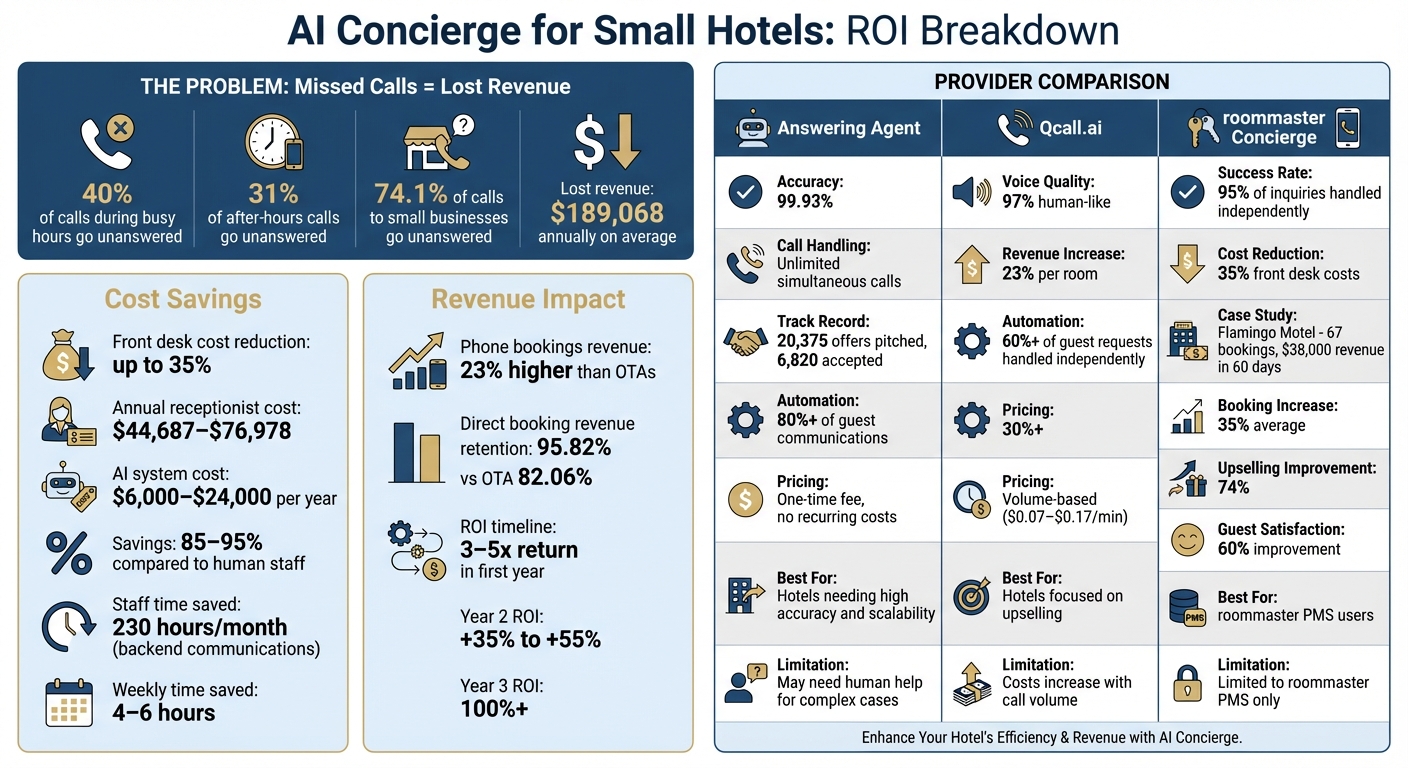
Missed calls are costing small hotels thousands in lost bookings. AI concierge systems can solve this problem while cutting costs and increasing revenue. Here's what you need to know:

  • Missed Opportunities: 40% of calls during busy hours and 31% after-hours go unanswered, leading to lost bookings.
  • Cost Savings: AI systems reduce front desk costs by up to 35% and eliminate the need for night-shift staff.
  • Revenue Boost: Phone bookings bring in 23% higher revenue compared to online travel agencies (OTAs).
  • Fast ROI: Many hotels see a 3–5x return on investment within the first year.

Three AI concierge options stand out: Answering Agent, Qcall.ai, and roommaster Concierge. Each offers unique features like PMS integration, 24/7 availability, and cost-effective solutions for handling guest inquiries and bookings.

Quick Comparison:

Provider Key Strengths Limitations
Answering Agent Handles unlimited calls; 99.93% accuracy; no recurring fees May need human help for complex cases
Qcall.ai 97% human-like voice; excels at upselling Costs increase with call volume
roommaster Concierge Best for roommaster PMS users; quick setup Limited to roommaster PMS users

AI concierge systems not only save money but also recover lost revenue by ensuring no call or booking opportunity is missed.

AI Concierge ROI Comparison for Small Hotels: Cost Savings and Revenue Impact

AI Concierge ROI Comparison for Small Hotels: Cost Savings and Revenue Impact

1. Answering Agent

Answering Agent

Upfront Costs

Answering Agent operates on a one-time project fee, with the total cost depending on the complexity of custom workflows and PMS (Property Management System) integration. For cloud-based systems like Cloudbeds and Mews, setup is straightforward and less expensive. However, integrating with older, on-premise systems can increase costs. The best part? You get full ownership of the Python source code, meaning no vendor lock-in or recurring subscription fees.

Long-Term Cost Savings

Once implemented, the only ongoing expense is the low-cost AWS Lambda hosting. Compare that to hiring a receptionist at $15–$25 per hour, which can cost between $44,687 and $76,978 annually. Answering Agent automates over 80% of guest communications, saving up to 230 backend hours per month and cutting costs by up to 30%. Plus, it doesn’t just save money - it actively helps grow your revenue.

Revenue Growth Impact

By integrating directly with your PMS, Answering Agent ensures no booking opportunity slips through the cracks. It provides real-time availability and automates reservations. Even better, it responds to inquiries within 5 minutes instead of 30, which can significantly improve conversion rates.

Accuracy and Call Handling

The system has handled 17,724 calls with an impressive 99.93% accuracy rate (just a 0.07% hallucination rate). It has also delivered 20,375 offers, with 6,820 successfully accepted. Unlike standard chatbots that rely on canned responses, Answering Agent dynamically pulls data from the PMS to provide personalized room and amenity details. Plus, it can manage unlimited calls at the same time.

2. Qcall.ai

Qcall.ai

Upfront Costs

Qcall.ai operates on a one-time fee model, eliminating ongoing per-agent subscription fees. The upfront cost varies based on the complexity of your Property Management System (PMS) integration and the number of custom workflows required. For modern PMS platforms, integration tends to be straightforward. However, older systems like Oracle OPERA demand more intricate integration efforts, which can increase initial expenses. While these upfront costs may seem high, they lay the groundwork for substantial savings over time.

Long-Term Cost Savings

This solution significantly reduces costs tied to staffing, including recruitment, training, and employee benefits. Considering the average receptionist’s tenure is only 2.5 years and replacing them costs approximately $4,700, Qcall.ai offers a cost-effective alternative. Plus, with its 24/7 availability, it eliminates the need for round-the-clock human coverage, slashing operational expenses.

Revenue Growth Impact

Beyond cost savings, Qcall.ai helps boost revenue by capturing bookings at any time of day, ensuring potential guests aren’t lost to competitors. Its seamless PMS integration provides real-time availability updates and booking management. Impressively, the AI can independently handle over 60% of guest requests, freeing your staff to focus on more complex, high-value tasks. This continuous, efficient service not only improves guest satisfaction but also contributes to measurable revenue increases.

6 BEST AI Agents for Hotels 2026 (+ PROOF)

3. roommaster Concierge

roommaster Concierge

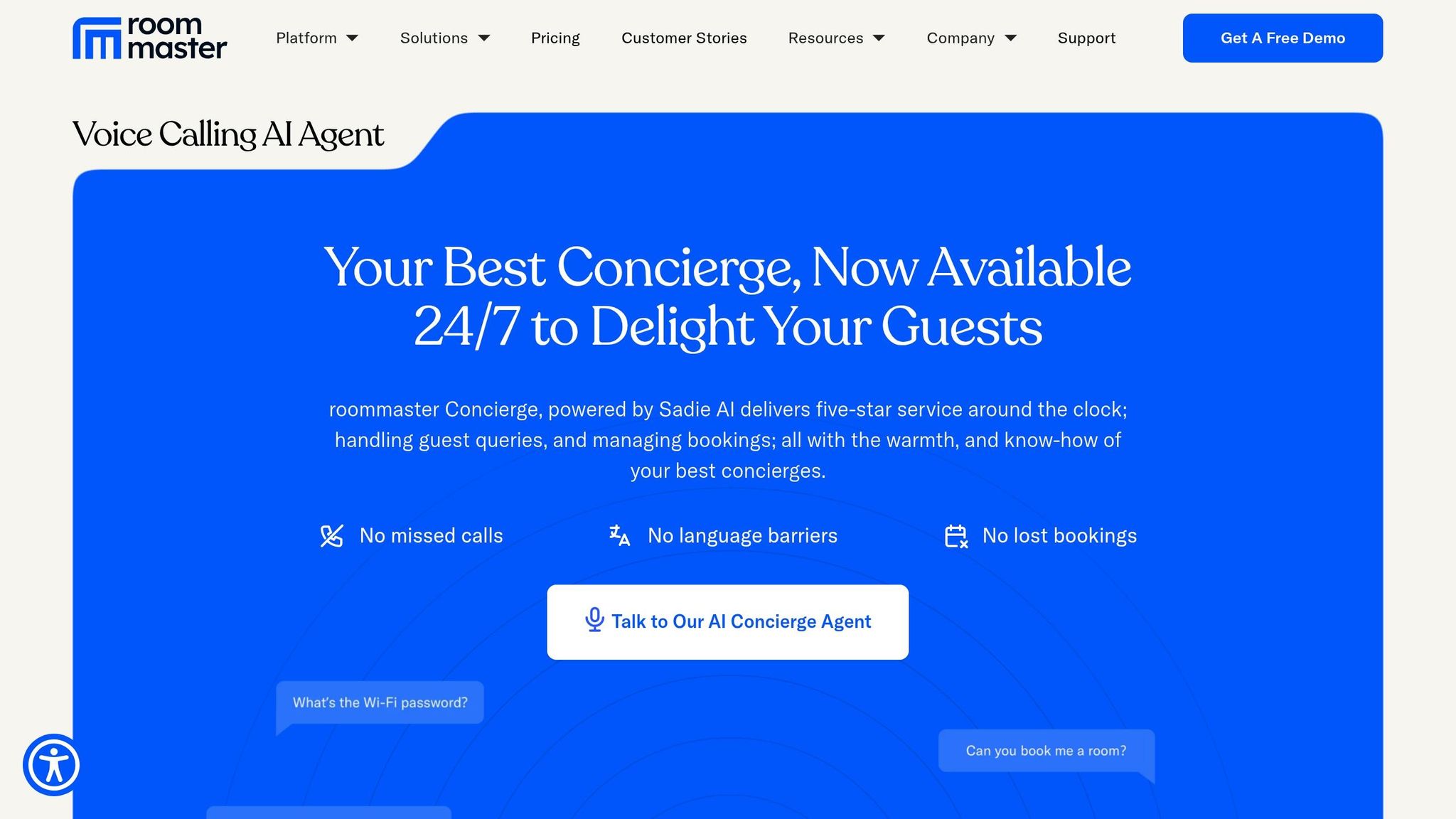
roommaster Concierge is crafted specifically for roommaster PMS users, offering a streamlined and efficient solution designed to meet their unique needs.

Upfront Costs

roommaster Concierge provides a one-month free trial with no obligation, allowing small hotels to explore the system without financial risk. The implementation process is quick, taking just 3 to 5 business days to become fully operational. During this time, a dedicated team handles the migration of reservations, guest profiles, and historical data, ensuring a smooth transition. Because the system is built specifically for roommaster PMS, it eliminates the hassle of juggling multiple dashboards or logins, making it simple and intuitive to use.

Long-Term Cost Savings

The system automates routine tasks like providing Wi-Fi passwords, checkout times, and breakfast hours, reducing front desk costs by 35%. On top of that, hotels save 4 to 6 hours of staff time weekly - an important advantage in an industry where labor costs make up 30–35% of revenue and staff turnover rates are as high as 73.8%. With 24/7 coverage, the AI eliminates the need for overnight staffing, and its seamless integration with the PMS resolves the "swivel chair problem" by centralizing operations.

Revenue Growth Impact

The financial benefits are clear. In 2025, the Flamingo Motel gained 67 additional bookings and over $38,000 in extra revenue within just 60 days. Hotels using roommaster Concierge report an average 35% increase in bookings and a 74% improvement in upselling success. General Manager Susie Conway of the Flamingo Motel shared:

"Many of our late-night calls went unanswered… By the time we arrived in the morning, guests had already booked elsewhere. With roommaster Concierge, we never miss a reservation."

Direct phone bookings retain about 95.82% of guest-paid revenue, compared to only 82.06% through online travel agencies, and they typically achieve a 23% higher average daily rate. This demonstrates how the system not only prevents missed opportunities but also boosts profitability.

Accuracy and Call Handling

roommaster Concierge successfully manages around 95% of typical guest inquiries and bookings independently. Instant responses to calls address the issue of missing over 40% of peak-time inquiries. This efficiency leads to a 60% improvement in guest satisfaction, thanks to faster and more accurate service. As General Manager Susie Conway explained:

"The biggest win is that my time and my staff's time can be spent with guests directly, while roommaster Concierge works in the background delivering excellent service."

Pros and Cons

This section evaluates the ROI of each solution by weighing their advantages against potential drawbacks.

Each provider has its own strengths and trade-offs. Answering Agent stands out with an impressive 99.93% call accuracy and the ability to handle unlimited simultaneous calls. This makes it a reliable option during peak booking times when multiple guests are reaching out. Its track record is solid, with 20,375 pitches resulting in 6,820 accepted offers, showcasing its revenue-generating potential. Additionally, it offers 24/7 availability and transparent pricing, all at a fraction of the cost of a full-time human receptionist. However, as an AI-driven service, it might need human intervention for more complex guest requests.

Qcall.ai shines in upselling, thanks to its 97% human-like voice quality and its ability to increase revenue per room by 23% through smart offer placements. It’s particularly effective for hotels dealing with high call volumes. That said, its pricing model, which scales with call volume, can lead to higher costs during busy seasons or major marketing pushes.

roommaster Concierge is built specifically for hotels using the roommaster property management system (PMS). Its seamless integration with the PMS simplifies operations, recovers revenue from missed calls, and handles routine bookings around the clock. However, its utility is limited to properties already using the roommaster PMS, making it less versatile for hotels on different systems.

Provider Pros Cons
Answering Agent Handles unlimited simultaneous calls; 24/7 availability; transparent pricing; proven revenue impact (6,820 offers accepted out of 20,375 pitched) May require human intervention for complex guest needs
Qcall.ai 97% human-like voice quality; boosts revenue per room by 23%; excels at upselling; ideal for high call volumes Costs scale with call volume, which can become expensive during peak periods
roommaster Concierge Integrates directly with roommaster PMS; reduces operational friction; recovers missed revenue; 24/7 routine booking management Limited to hotels using the roommaster PMS

These comparisons provide a clear view of how each solution can contribute to revenue growth and operational efficiency.

When comparing costs, the financial benefits of AI solutions become evident. When comparing AI vs human receptionist costs, a full-time staff member costs between $52,800 and $71,000 annually, while AI services range from $6,000 to $24,000 per year - resulting in savings of 85–95%. This is especially important when considering that 74.1% of calls to small businesses go unanswered, potentially costing an average business $189,068 annually in lost revenue. By carefully weighing the pros and cons, small hotels can pinpoint the AI concierge service that best aligns with their financial and operational goals.

Conclusion

This analysis highlights how AI concierge systems are reshaping costs and boosting revenue for small hotels. Among the options, Answering Agent stands out as the top choice, offering 99.93% accuracy and a high rate of offer acceptance. Its ability to handle unlimited simultaneous calls ensures no bookings are lost during busy periods, when 20–30% of calls often go unanswered. Plus, its pricing is far lower than maintaining a traditional receptionist.

While Answering Agent prioritizes efficiency, Qcall.ai shines in upselling. If driving additional revenue is your goal, Qcall.ai is a strong contender, delivering a 23% increase in revenue per room with a voice quality that mimics human interaction at 97%. However, its volume-based pricing - ranging from $0.17/min to $0.07/min for higher usage - can get costly during peak times.

For hotels already using the roommaster PMS ecosystem, roommaster Concierge is a natural fit. With a 35% reduction in front desk operational costs, it offers a streamlined solution, though its limited compatibility with other systems might deter hotels outside the roommaster ecosystem.

Each system brings unique strengths to the table, but the ROI data positions Answering Agent as the most practical choice for many small hotels. ROI typically turns positive by Year 2, ranging from +35% to +55%, and can surpass 100% by Year 3. Starting with high-volume, straightforward inquiries ensures quick returns, with room to scale as confidence grows.

For most small hotel operators, Answering Agent delivers the ideal mix of accuracy, unlimited scalability, and cost savings, making it a powerful tool for driving both operational efficiency and revenue growth.

FAQs

How do I calculate ROI for an AI concierge at my hotel?

To figure out the ROI of an AI concierge, you’ll need to weigh the upfront costs against the potential savings and revenue it could bring over time. Here’s how you can approach it:

  • Estimate setup costs: Look at the expenses involved in integrating the AI system with your hotel’s existing infrastructure. This could include software, hardware, and any necessary training.
  • Calculate staffing savings: Factor in how much you’ll save by having 24/7 AI support handle tasks that would typically require additional staff.
  • Evaluate revenue growth: Consider how improved guest satisfaction and operational efficiency might lead to increased bookings, repeat stays, or upselling opportunities.

By using ROI models, you can determine whether the long-term gains justify the initial investment.

What PMS integrations are required for real-time phone bookings?

To make real-time phone bookings possible, your Property Management System (PMS) needs to connect seamlessly with the AI concierge or phone system. This integration ensures the AI has direct access to booking details and can update them instantly in systems like Cloudbeds or Mews.

With this setup, the AI can manage tasks such as checking room availability or readiness without manual intervention, streamlining the entire process.

When should calls transfer from AI to a human staff member?

When dealing with complex issues that call for empathy, tailored assistance, or decision-making beyond what AI can handle, calls should be transferred to a human team member. This applies in situations where escalation protocols are triggered or when a caller explicitly asks to speak with a person. These measures ensure that while AI handles routine tasks efficiently, human staff step in to provide the best possible service in more nuanced scenarios.

Related Blog Posts

Answering Agent

Author

Answering Agent

Answering Agent