A missed call usually costs you the customer, not just the call. Most callers who reach voicemail don't leave a message and don't call back. They call the next business on the list. The fix is simple to state: answer every call, including the ones that arrive after hours or at the same moment as three others, and turn each one into a booking, a qualified lead, or a routed task.
This post covers how missed calls damage retention, what an AI answering service changes, and how to measure whether it's working. To start with the dollar side, see what missed calls cost a business in revenue.
How Missed Calls Hurt Customer Retention
Revenue Loss from Missed Calls
Every unanswered call wastes the ad spend, SEO work, or referral that produced it. If you miss 30% of calls, you throw away roughly 30% of the leads your marketing paid for.
The bigger cost is lifetime value. A caller who books once might return for years, so a missed first call loses every visit after it. That's why capturing every lead raises revenue more than per-call math suggests.
| Industry | Average Customer Lifetime Value | Estimated Cost Per Missed Call |
|---|---|---|
| Legal Services | $3,000–$15,000 per case | $500–$2,000 |
| Real Estate | $8,000–$25,000 per commission | $800–$3,000 |
| Dental Practice | $800–$1,200 per year | $200–$400 |
| Plumbing/HVAC | $300–$2,500 per job | $150–$600 |
| Auto Repair | $400–$1,500 per year | $100–$350 |
Customer Experience and Churn Rates
Existing customers read an unanswered call as a sign they don't matter. One bad experience is often enough to send someone to a competitor, and repeated ones almost guarantee it. New callers tend to hire whoever picks up first.
Speed matters most in time-sensitive work:
"Personal injury law is time-sensitive. Every hour delay in contacting a potential client reduces our chance of signing them by 15%. Missing that initial call meant losing the case entirely."
– Rebecca Morrison, Managing Partner
How AI Answering Services Fix the Retention Problem
24/7 Availability and Lead Capture
An AI answering service picks up every call at any hour, and it can take many calls at once. Callers don't hit busy signals or hold queues during peak hours.
Each call is logged with the time, the caller, and the reason for calling. The service can sync with your CRM and calendar to book appointments and send SMS confirmations. This matters because leads go cold fast. A callback an hour later converts far worse than an answer on the first ring.
Personalized Interactions at Scale
You train the system on your own business details: pricing, service area, hours, and what counts as a qualified lead. It answers routine questions directly and hands the rest to the right person. The caller skips the phone menu, and the fiftieth call of the day gets the same answer as the first.
Operational Efficiency and Cost Savings
A full-time receptionist costs around $3,100 a month for 40 hours a week. Traditional answering services run $500–$800 a month, plus overage fees per call. AI services with unlimited 24/7 coverage cost much less. For the full comparison, see AI vs. human receptionist costs.
Hiring more staff doesn't solve the problem, because calls arrive at night, on weekends, and in bursts no schedule can cover. Let the AI handle appointment booking, lead qualification, and first-touch follow-up. Your staff then spend their time on the conversations that actually keep customers.
Missed Calls vs Answering Agent: Direct Comparison
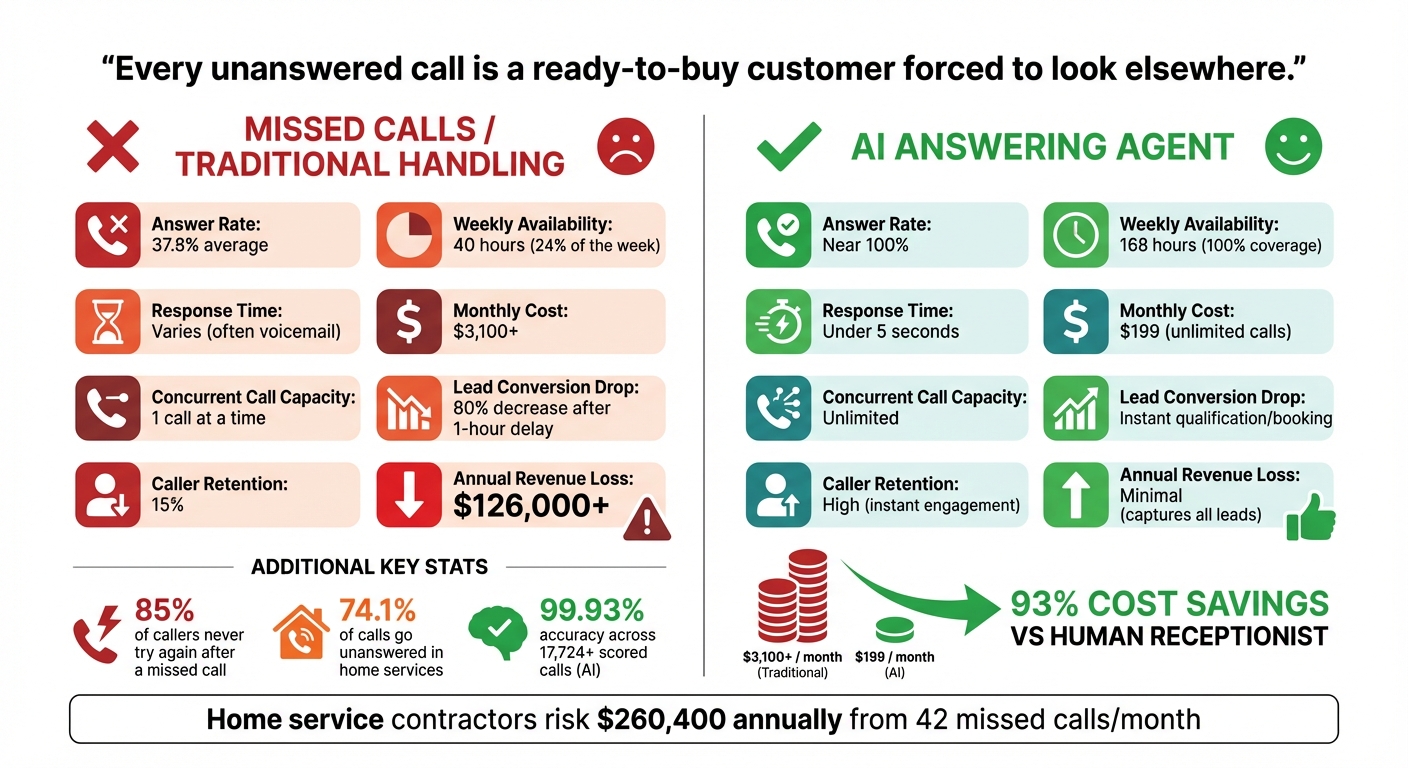
Answering Agent has held 99.93% accuracy across more than 17,724 scored calls. The table compares it with a typical in-house setup.
| Metric | Missed Calls / Traditional Handling | Answering Agent |
|---|---|---|
| Weekly Availability | 40 hours (24% of the week) | 168 hours |
| Concurrent Calls | 1 at a time | Unlimited |
| Response | Often voicemail | Answered immediately |
| Follow-up | Callback later, if at all | Qualifies or books during the call |
| Monthly Cost | $3,100+ for one receptionist | $199 (unlimited calls) |
Answering Agent Performance Across Service Industries
Car Washes: Boosting Lead Capture and Offer Acceptance
Car wash calls come in bursts: weekend mornings, sunny days after a storm, the first days of a membership promo. When the phone stays busy during those bursts, callers who might have joined a membership give up. Handling simultaneous calls keeps those callers on the line and lets the agent offer the membership while they're still interested.
Law Firms: Around-the-Clock Client Engagement
Legal prospects often call after hours, and whoever answers first usually signs them. A fully automated agent answers at 11 p.m. with the same context as at 11 a.m. It also avoids the dropped details that can happen in AI-to-human handoffs at traditional answering services.
Home Services and Medical Practices: Driving Repeat Business
Contractors and medical practices lose 27% to 42% of potential bookings during busy periods. Home service callers with emergencies call the next company. Patients who can't get through switch providers. Answering right away and booking accurately keeps both coming back.
Staffing Agencies: Managing High Call Volumes Efficiently
Staffing agencies take heavy call volume from candidates and clients at once, more than a front desk can keep up with. Unlimited concurrent calls remove that bottleneck, so high-intent callers are handled while they're still available.
Measured Retention Improvements with Answering Agent
Track three numbers before and after launch: your missed-call rate, how many callers reach a booking or a qualified handoff, and repeat-customer rate over the next quarter. If the first two improve and the third follows, the service is protecting revenue.
Pay the closest attention to peak hours and after-hours windows, because that's where missed calls cluster. A system that handles unlimited concurrent calls should bring those windows close to zero misses.
Conclusion
Missed calls send customers to competitors, and voicemail rarely wins them back. An AI answering service covers the hours and call spikes your staff can't, books or qualifies callers on the spot, and costs far less than adding headcount. Use the formula in the FAQ below to estimate your losses, then calculate the return against a monthly subscription.
FAQs
How can I calculate the revenue I lose from missed calls?
Use Missed Calls × Close Rate × Average Customer Value = Lost Revenue. For a yearly figure, use Monthly Missed Calls × Average Call Value × 12 × 85%. The 85% is the share of missed callers who don't call back.
What should an AI answering service handle beyond taking messages?
It should answer calls 24/7, schedule appointments, capture and qualify leads, and route calls to the right person, with no limit on simultaneous calls.
How do I set up an AI phone agent without disrupting my current staff?
- Map your calls. Find your peak hours and the call types that eat staff time.
- Pick a service with 24/7 coverage and accurate call handling.
- Connect and customize. Link it to your calendar and CRM, then script answers to your common questions.
- Run a trial. Fix the gaps and show staff how handoffs reach them.
Related Blog Posts
Book a walkthrough
See it handle your calls.
Book 20 minutes, or hear a sample call first.