Zero Hold Times: AI Solutions for Medical Practices

Instant AI phone answering eliminates hold times, integrates with EHRs, handles scheduling and refills 24/7, and cuts costs while improving patient satisfaction.

Zero Hold Times: AI Solutions for Medical Practices

Tired of long hold times at medical practices? AI phone systems eliminate them entirely. Here’s how:

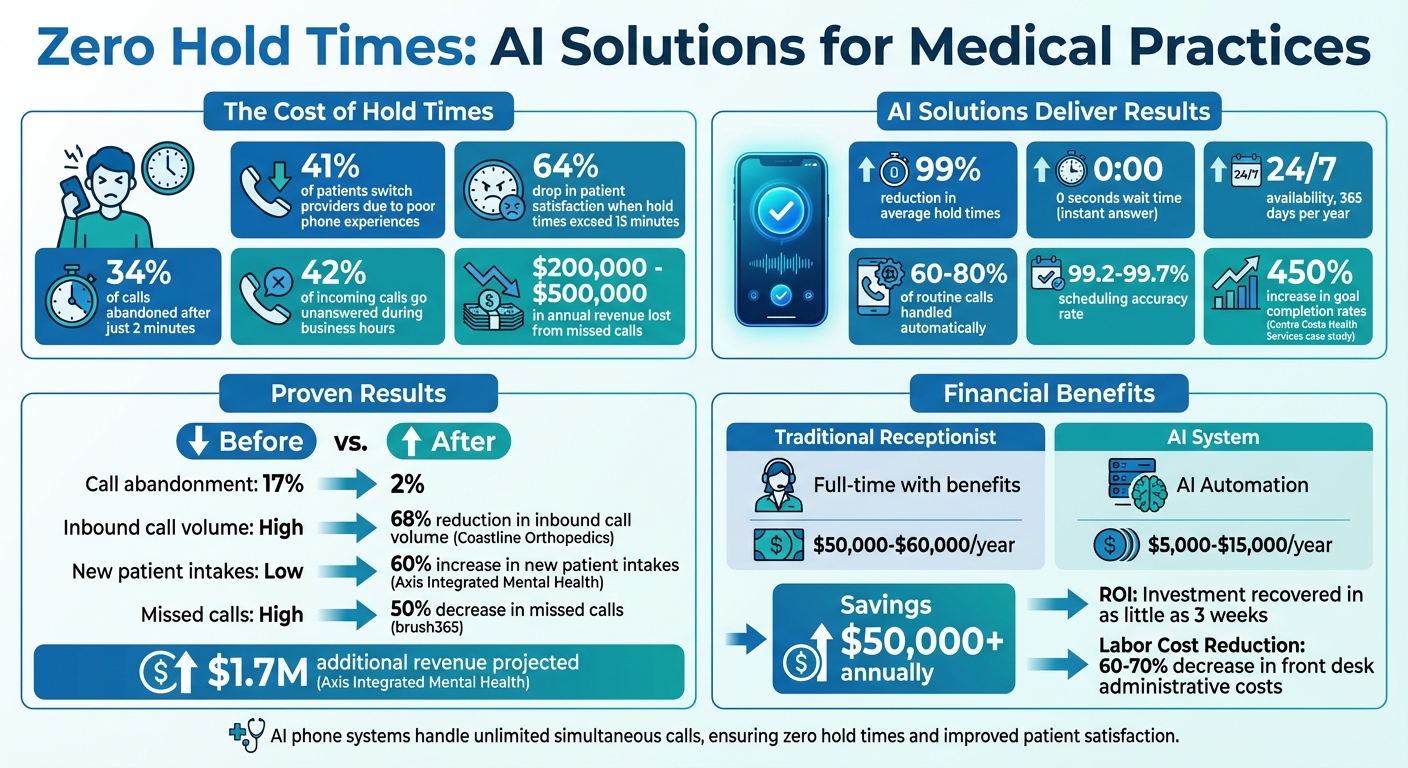
  • AI answers calls instantly, handling unlimited simultaneous calls.
  • 60% of callers hang up after waiting a minute - AI prevents this loss.
  • Practices using AI report reduced call abandonment (e.g., from 17% to 2%) and increased revenue.
  • AI systems manage accessible healthcare scheduling, prescription refills, and patient inquiries 24/7.
  • Integration with EHRs ensures real-time appointment booking and data accuracy.
  • Costs are significantly lower than hiring full-time staff, with potential savings of $50,000+ annually.

Why it matters: Patients expect fast service, and missed calls cost practices thousands in revenue. AI systems, like Answering Agent, provide instant, natural, and reliable interactions, improving patient satisfaction and operational efficiency. By automating routine tasks, staff can focus on delivering better care.

AI Phone Systems Impact on Medical Practices: Key Statistics and Cost Savings

AI Phone Systems Impact on Medical Practices: Key Statistics and Cost Savings

Problems with Traditional Phone Systems in Healthcare

How Long Hold Times Hurt Patient Satisfaction

When patients call a medical practice, the wait time on the phone often leaves a lasting impression. Long hold times can make patients feel that inefficiency on the phone reflects the overall quality of care they’ll receive. In healthcare, where calls often involve urgent concerns, even brief delays can feel unbearable, chipping away at trust and confidence in the provider .

The numbers paint a clear picture of the problem. Around 41% of patients have switched providers because of poor phone experiences. Patient satisfaction plummets by 64% when hold times exceed 15 minutes, and 34% of calls are abandoned after just two minutes . With mobile devices accounting for 78% of healthcare calls, patients hang up even faster - 35% sooner, to be exact. They expect the same level of responsiveness they get from companies like Amazon or Uber, and anything less feels outdated and frustrating.

These frustrations are only the tip of the iceberg. Behind the scenes, manual call handling adds layers of inefficiency that ripple across the entire practice.

Why Manual Call Handling Creates Inefficiencies

Manual call handling doesn’t just test patient patience - it also stretches administrative teams thin. While long hold times erode trust, the process of manually managing calls creates a bottleneck for staff. One employee can handle only one call at a time, and during high-demand periods like Monday mornings, call volumes skyrocket while staffing levels stay the same . As a result, nearly 42% of incoming calls during business hours go unanswered.

And then there’s the dreaded phone tag. Staff leave voicemails for patients, who call back only to hit another voicemail. This back-and-forth can delay resolutions for days. Virginia Burberry, Director of Clinical Education at Family Practice Associates of Lexington, described how this burden impacts both staff and patients:

"Reaching those patients in a timely manner has been ultimately life-changing for our support staff. They're no longer overwhelmed with phone calls."

The consequences don’t end there. Healthcare call center workforce management is a major challenge, with annual staff turnover rates exceeding 25%, with replacement costs reaching about $250,000. Constant multitasking compounds the problem. Employees juggle phone calls with other duties like checking in patients or assisting nurses, leading to rushed conversations, scheduling mistakes, and data entry errors. These inefficiencies not only strain staff but also detract from tasks that could directly improve patient care .

AI Phone Answering Service For Healthcare Practices | Complete With Results After Implementation

How AI Phone Systems Remove Hold Times

AI phone systems offer an immediate solution to one of the most frustrating aspects of traditional phone systems: hold times. These systems can handle hundreds of calls at the same time, thanks to scalable, cloud-based technology. So, if 50 patients call simultaneously, every single call gets answered instantly - no busy signals, no hold music, no delays. This level of efficiency ensures constant accessibility, day or night.

In contrast, traditional systems often leave callers waiting for 3–5 minutes. With AI, that wait time drops to zero. Dr. Michael R., a family practice physician, shared his experience:

"Our front desk was drowning in calls. Now AI handles scheduling and refill requests... Hold times went from 4 minutes to zero."

And it’s not just during business hours. AI systems work 24/7, every single day of the year. Even during nights, weekends, and holidays - times when 20% to 35% of calls typically go unanswered - patients get immediate assistance. Whether someone calls at 11:00 PM on a Saturday or 11:00 AM on a Tuesday, they receive the same prompt attention, eliminating the need for voicemails or waiting until the next business day.

24/7 Availability and Unlimited Call Capacity

The secret to zero hold times lies in the continuous, round-the-clock availability of AI systems. Unlike a receptionist who can handle only one call at a time, AI systems can manage hundreds of conversations simultaneously without compromising quality. This is made possible by parallel processing technology.

During busy periods, AI systems also offer call-to-text deflection, enabling one staff member to handle multiple patient inquiries - sometimes as many as 5 to 20 at once. This approach has proven effective, with some practices seeing a reduction of over one-third in inbound call volumes.

The impact is measurable. AI phone systems can cut average hold times by nearly 99%. For practices where 20% to 35% of calls go unanswered during peak hours, this technology ensures every patient inquiry is addressed. For example, Contra Costa Health Services reported a 450% increase in goal completion rates after adopting AI phone systems, along with a significant drop in call traffic.

Natural Conversations and Custom Scripts

What truly sets modern AI systems apart is their ability to create natural, human-like interactions. Beyond instant responses and unlimited capacity, these systems use advanced Natural Language Processing (NLP) and Large Language Models (LLMs) to engage with patients in a way that feels conversational. Instead of navigating clunky, menu-based systems, a patient can simply say, "I need to see the doctor about my knee pain", and the AI understands.

Jennifer Walsh, Practice Manager at Riverside Dental Practice, highlighted this seamless experience:

"Patients don't realize it's AI until we tell them. Some don't believe us even then. The conversational quality is that natural."

Medical practices can also tailor AI interactions to suit their needs. Whether it’s scheduling appointments, refilling prescriptions, verifying insurance, or triaging patient concerns while maintaining HIPAA compliance, AI systems can be customized to follow specific protocols.

The technology is impressively fast, synthesizing voice responses in under 500 milliseconds. This near-instant response time, combined with the ability to maintain context throughout a conversation, significantly reduces voicemail abandonment. Considering that 85% of patients hang up when they reach voicemail, this feature is a game-changer. By eliminating delays and offering smooth, responsive interactions, AI systems enhance patient care from the very first call.

Core Features of AI Answering Services for Medical Practices

AI-powered answering services tackle some of the biggest challenges medical practices face by streamlining appointment scheduling, capturing patient data efficiently, and cutting operational costs. These features are designed to enhance patient interactions while boosting practice efficiency.

Appointment Scheduling and Calendar Integration

AI systems seamlessly connect with EHRs and practice management platforms using real-time APIs. This allows them to access live provider availability and book appointments instantly, whether it’s a quick 15-minute follow-up or a longer 45-minute new patient consultation. During the scheduling process, the AI can even perform clinical triage, flagging urgent symptoms that need same-day attention or emergency escalation to 911 or on-call staff.

Thanks to natural language processing, these systems understand conversational requests like, "I need to see someone for my knee pain", bypassing the frustration of rigid phone menus. This approach resolves up to 70% of scheduling calls without needing a human receptionist.

Michelle Field, VP of Operations at brush365, shared how impactful this has been:

"Being within Dentistry and having Zo as part of our tech stack has been game changing. We saw a 50% decrease in missed calls. These calls are now turning into appointments."

The technology integrates with major EHR platforms like Epic, Athenahealth, Cerner, AllScripts, eClinicalWorks, NextGen, ModMed, and DrChrono. Most systems can be set up in just 48 to 72 hours using information from the practice's existing website. By automating appointment bookings, these systems eliminate delays that often frustrate patients.

Patient Information Capture and Data Management

AI answering services don’t just schedule appointments - they also gather and document key patient information directly into the EHR, reducing manual errors and saving time. This automated intake process helps patients complete necessary steps before arriving, cutting down on paperwork and waiting room delays.

The system also performs real-time insurance verification, capturing policy details during the call and flagging any prior-authorization issues before the appointment is confirmed. These systems can handle 60% to 80% of routine calls - like scheduling, prescription refills, and answering FAQs - without human involvement.

With scheduling accuracy rates between 99.2% and 99.7%, these systems use advanced patient matching algorithms to avoid duplicate records. All interactions are HIPAA compliant, following a strict HIPAA compliance checklist, with measures like end-to-end encryption, audit trails, and Business Associate Agreements (BAAs) in place to ensure data security. This level of automation ensures patients get immediate responses, even when staff are unavailable.

Beyond improving workflow, these features provide financial advantages that practices can’t ignore.

Cost Savings and Return on Investment

On average, medical practices miss 42% of incoming calls during business hours, leading to annual losses of $200,000 to $500,000. AI answering systems, which cost between $5,000 and $15,000 annually, are a fraction of the $50,000 to $60,000 it costs to employ a full-time receptionist with benefits. These systems can also cut front desk administrative labor costs by 60% to 70%.

Liesel Perez, Cofounder of Axis Integrated Mental Health, highlighted the financial impact:

"New patient intakes increased by 60% - translating to a projected $1.7M additional revenue."

With 67% of patients saying they’d switch providers after a poor phone experience, eliminating hold times and missed calls is not just about efficiency - it’s about retaining patients and protecting revenue streams.

Answering Agent: Top Choice for Medical Practices
Answering Agent

Answering Agent stands out as a top-tier AI phone system tailored for medical practices. With a stellar 99.93% accuracy rate across 17,724 scored calls and an impressively low 0.07% hallucination rate, it delivers reliable performance alongside features designed to fit seamlessly into any practice's workflow.

Accuracy and Performance Data

Answering Agent can handle unlimited simultaneous calls, effectively eliminating bottlenecks during peak hours like the busy 8–10 AM window. Every call is answered instantly - no hold music, no busy signals, and no missed opportunities. This immediate response capability directly supports better patient experiences and ensures practices capture more revenue by addressing patient needs without delay.

On top of this, the platform’s flexible scripting capabilities enhance patient interactions, ensuring accuracy and efficiency in every call.

Custom Scripts and Natural Voice Interactions

The platform’s customizable scripts align with each practice’s unique triage protocols, ensuring that critical symptoms - like chest pain or neurological concerns - are flagged and escalated in real time according to clinical guidelines. For instance, a patient can simply say, "I need to reschedule my appointment for next week", and the AI will understand and process the request seamlessly.

Answering Agent’s natural voice interactions mimic the tone and flow of live staff conversations, creating a smooth and frustration-free experience for patients. Rebecca Owens, a Nurse Supervisor, shared her experience:

"We thought patients would resist talking to AI, but honestly, it's not been an issue. AI answers routine questions, collects medical histories, and frees up my nurses for clinical work instead of phone duty."

These conversational features not only enhance patient satisfaction but also allow medical staff to focus on clinical priorities.

Clear Pricing and Flexible Plans

Answering Agent offers transparent and scalable pricing to meet the needs of various practices. Basic plans start at $49/month, while Pro and Business plans range from $97 to $150/month, including unlimited agents, outbound calling, and advanced EHR integrations. For high-volume practices, usage-based pricing starts at just $0.05 to $0.07 per minute.

When compared to the $50,000–$60,000 annual cost of employing a full-time receptionist with benefits, Answering Agent provides a cost-effective alternative, automatically managing 60–80% of routine calls. This not only reduces operational expenses but also ensures practices remain financially efficient. Plus, with integrations for major EHR systems like Epic, Athenahealth, and Cerner, most practices can complete setup in just 48 to 72 hours.

How to Implement AI Phone Answering in Your Practice

Switching to an AI phone system doesn’t require a major overhaul. In fact, most practices complete the transition within four to six weeks from purchase to full implementation. The trick is to break the process into smaller, manageable steps rather than attempting an overnight transformation. Start by analyzing your current call patterns to spot opportunities for automation.

Audit two weeks of calls to uncover trends like peak call times (often 8–10 AM), common patient questions, and which requests are routine versus urgent. For example, one practice discovered a chance to automate many routine calls. Virginia Burberry, a Director of Clinical Education, used these insights to streamline processes like sharing lab results and handling referrals, cutting down on inefficient "phone tag".

Once you’ve identified areas to automate, set up triage protocols in the AI system. Program it to recognize "red flag" keywords - such as chest pain or trouble breathing - that require immediate transfer to staff or 911 instructions. Then, integrate the system with your EHR, whether it’s Epic, Athenahealth, or Cerner, so that appointments sync automatically without manual input. This integration step usually takes about one to two weeks. Once these processes are in place, you’re ready to roll out the system.

Start small with a phased launch. Begin by using the AI for after-hours calls or to handle overflow during busy morning hours. Solutions like Answering Agent make this easy with scalable and quick deployment options. Coastline Orthopedics followed this approach and saw a 68% drop in inbound call volume, saving over four hours per person each day. As Tiffany Burke, an independent consultant and Athenahealth expert, explains:

"The entities that are the most successful are the entities that actually embrace innovation".

Finally, adjust staff performance metrics. If AI is now managing 60–80% of routine calls, your team shouldn’t be judged solely on call volume anymore. Instead, focus on metrics like patient satisfaction during in-person visits and the ability to resolve complex issues. This shift not only helps staff adapt but also supports long-term success.

Conclusion: AI Phone Systems for Medical Practices

Long hold times no longer have to be a frustrating norm in healthcare. AI phone systems like Answering Agent ensure calls are answered instantly, even during the busiest hours. Unlike traditional phone systems that often lead to missed revenue opportunities and dissatisfied patients, AI technology removes these hurdles entirely.

The financial benefits are clear. Take Oakwood Medical Centre, for example - they recouped their investment in just three weeks by capturing 12 to 15 after-hours appointments per week that would have otherwise gone to voicemail. These advantages combine to improve patient experiences and streamline operations.

By eliminating hold times, medical practices not only enhance patient satisfaction but also create more efficient workflows. AI systems provide round-the-clock availability and enable natural, conversational interactions, elevating the overall quality of care. Answering Agent stands out with its transparent pricing and ability to handle unlimited calls simultaneously, making it an excellent option for healthcare providers.

This shift to AI isn’t just about adopting new technology - it’s about keeping up with patient expectations shaped by services like Amazon and Uber. By integrating AI phone systems, practices can reduce staff stress, improve patient satisfaction, and recover revenue that might otherwise be lost. As Dr. Michael R. from a family practice shared:

"Our front desk was drowning in calls. Now AI handles scheduling and refill requests, and our staff can actually focus on patients. Hold times went from 4 minutes to zero."

FAQs

Will an AI phone system work with my EHR?

Yes, AI phone systems can work seamlessly with electronic health records (EHRs) to improve call handling and patient management. For instance, tools like Practice EHR's AI Agent and HIPAA-compliant services such as Answering Agent show how these integrations can simplify operations. By linking directly with EHRs, these systems help healthcare contact centers run more efficiently and provide better service to patients.

How does AI handle urgent or emergency symptoms?

AI systems are designed to follow triage protocols, allowing them to quickly evaluate how serious a patient's condition is during calls. They can identify critical symptoms - such as chest pain or trouble breathing - and immediately alert medical staff to those cases. By separating emergencies from routine questions, AI gathers essential information, prioritizes urgent situations, and speeds up response times. This not only helps improve patient care but also cuts down on hold times.

How quickly can my practice go live with AI answering?

Your practice can often begin using AI answering systems within a matter of days to a few weeks. The timeline depends on factors such as setup, integration, and training requirements. Some providers even note that deployment can take just a few days, enabling you to start seeing benefits like shorter hold times and better efficiency almost immediately.

Related Blog Posts

Answering Agent