
AI call scripts are transforming healthcare communication by automating up to 80% of routine tasks like appointment scheduling, prescription refills, and test result delivery. These systems reduce call volumes, save time for staff, and improve patient satisfaction. Key benefits include 24/7 availability, HIPAA-compliant identity verification, and integration with electronic health records (EHR) for real-time updates. Practices using AI report fewer no-shows, shorter wait times, and significant cost savings. Here's what you need to know:
- Appointment Scheduling: AI offers real-time calendar integration, reduces double-bookings by 45%, and cuts no-shows by 30%.
- Prescription Refills: Handles routine requests, reduces hold times from 8 minutes to 41 seconds, and saves clinics thousands annually.
- Test Results: Balances efficiency and privacy with secure, neutral communication and escalation for critical results.
- Reminders: Reduces no-show rates by up to 90% with personalized, timely reminders.
- Emergency Protocols: Ensures safety with immediate 911 prompts and structured escalation paths.
- Customization: Tailored scripts meet specific practice needs while maintaining patient privacy and seamless human handoffs.
With nearly human-like voice quality and advanced natural language processing, AI call scripts streamline operations, save money, and enhance patient experiences.
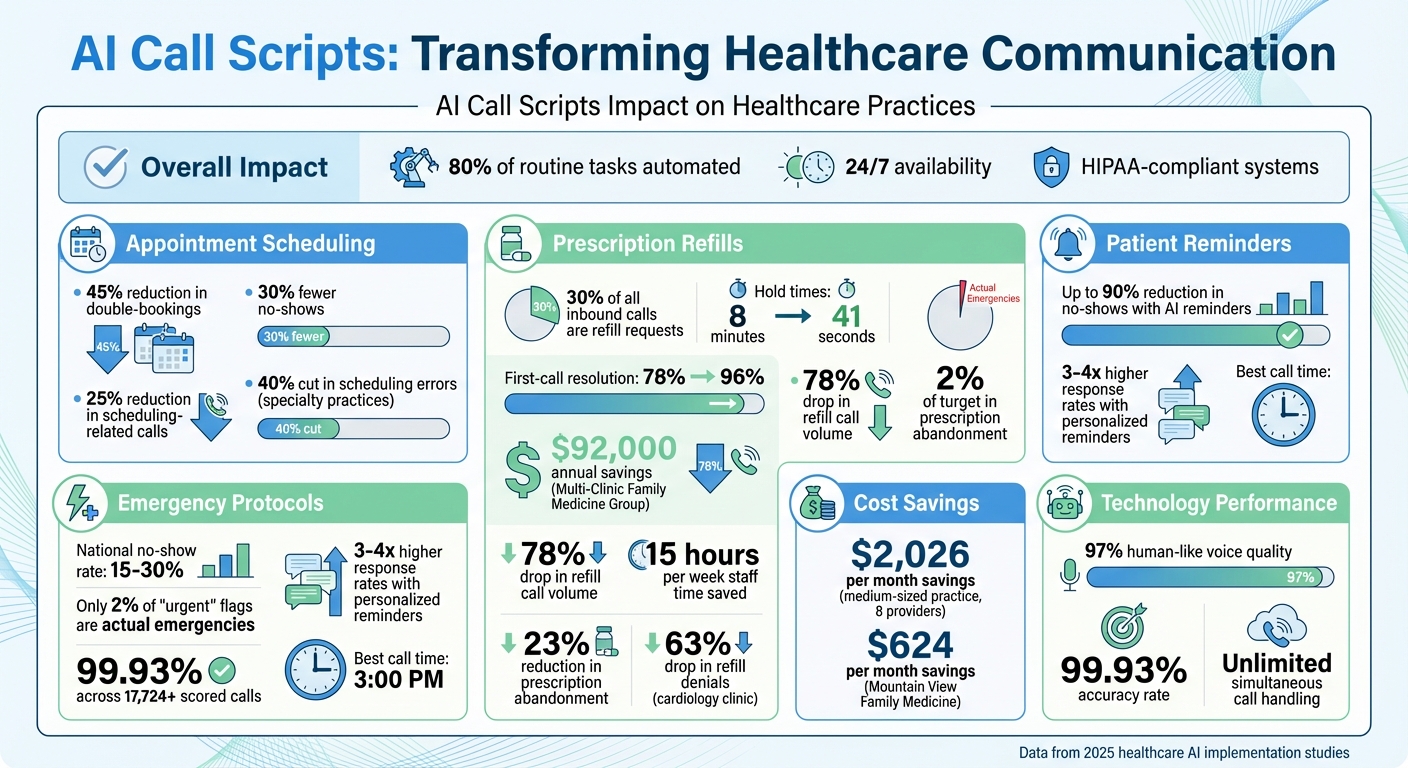
AI Call Scripts Benefits: Key Statistics and Cost Savings for Healthcare Practices
1. Appointment Scheduling
24/7 AI Scheduling with Real-Time Calendar Integration
AI-powered call scripts are revolutionizing appointment scheduling by offering 24/7 availability and handling multiple calls simultaneously. These systems sync directly with practice management tools like EMIS and SystmOne, as well as digital calendars such as Google Calendar or Outlook. The real-time integration ensures no double-bookings by automatically blocking unavailable slots when cancellations occur, providing a smooth and efficient scheduling process.
The process begins with a professional greeting and a HIPAA-compliant identity check (using the patient’s full name and date of birth) before moving on to scheduling specifics. The AI then gathers essential details like the reason for the visit, insurance information, and contact details. Instead of open-ended questions like "When would you like to come in?", the script offers 2–3 specific time slots (e.g., "Tuesday at 10:00 AM" or "Wednesday at 2:30 PM") to make the process quick and straightforward. Each call wraps up with a summary of the appointment details - date, time, provider, and location - followed by a confirmation sent via text or email.
"A thoughtfully designed phone script for scheduling medical appointments serves as the foundation for efficient patient scheduling and positive first impressions." - Callin.io
Practices that adopt AI scheduling systems report up to 30% fewer no-shows and a 45% reduction in double-bookings. These systems are designed to be highly accurate, ensuring patients never encounter busy signals or voicemail.
Specialty practices can take this a step further by customizing scripts to include field-specific triage questions for areas like dermatology or orthopedics. This approach can cut scheduling errors by up to 40%. Additionally, the script encourages patients to register for the patient portal during the call, which can reduce future scheduling-related calls by 25%. Tailoring the process to meet specific needs enhances patient communication and ensures a proactive approach to care.
sbb-itb-abfc69c
2. Prescription Refills
Automating Routine Refills with Real-Time EHR Verification
Did you know that nearly 30% of all inbound calls to primary care offices are tied to prescription refill requests? AI call scripts are changing the game by taking over routine refill tasks, offering 24/7 availability for patients to make requests. These systems work hand-in-hand with AI scheduling tools, cutting wait times and improving communication. To ensure compliance with HIPAA, patients provide their full name and date of birth before the system connects to the EHR for real-time verification of refill details, dosage, and pharmacy information.
This process not only speeds things up but also reduces errors. For example, instead of simply asking, "Is this the correct medication?" the AI script prompts patients to rephrase the medication name. Once the information is confirmed, the system processes the refill and sends an SMS with pickup details. More complex cases, like controlled substance requests or expired prescriptions, are seamlessly handed off to clinical staff. The AI even provides a full transcript of the call, so patients don’t have to repeat themselves.
The results speak for themselves. In June 2025, a Multi-Clinic Family Medicine Group in Texas implemented an AI solution integrated with Athenahealth EHR. This system managed around 600 weekly refill calls, reducing average hold times from 8 minutes to just 41 seconds. First-call resolution jumped from 78% to 96%, and the clinic saved $92,000 annually. Similarly, Mountain View Family Medicine in Colorado used QCall.ai to handle its high volume of refill requests. Within six months, refill call volume dropped by 78%, staff saved 15 hours per week, and the clinic saved $624 per month.
AI doesn’t stop at routine refills - it also helps prevent prescription abandonment. By proactively sending AI appointment reminders for overdue medications, these systems have been shown to cut abandonment rates by up to 23%. At a specialty cardiology clinic in Florida, the AI voice agent takes it a step further. During refill calls, it checks if patients are overdue for lab tests, like the INR lab required for warfarin. If needed, the system books the lab appointment right then and there, leading to a 63% drop in refill denials.
"I love that I can call any time to refill my diabetes medication. The voice system sounds so natural – I almost forgot it wasn't a real person!"
– Patient, Mountain View Family Medicine
3. Test Results Delivery
Balancing Automation with HIPAA Compliance and Patient Sensitivity
Delivering test results over the phone requires a careful balance between efficiency and strict privacy standards. AI call scripts address this challenge by implementing a two-step verification process to confirm the patient's identity before sharing any Protected Health Information (PHI). These standard HIPAA identity checks ensure that sensitive information is only disclosed to the right person, meeting compliance requirements while maintaining the quick response patients expect.
To further safeguard privacy, the scripts use neutral language when communicating. Instead of explicitly stating, "calling about your abnormal cholesterol test", the AI might say, "calling regarding your recent visit" or "an update is available". This approach minimizes the risk of exposing sensitive details, especially when leaving voicemails or speaking to someone other than the patient.
AI systems are designed to handle test results based on their nature. For normal results, the AI provides the information directly after verifying the patient’s identity. However, for abnormal or critical results, the system automatically escalates the matter to a clinical professional or notifies an on-call provider. This ensures patients receive the right level of care and attention, particularly during more urgent situations.
"A warm tone isn't just about sounding nice; it's about conveying competence and care. When patients feel heard and respected from the very first word, they are more likely to trust your practice."
– MyAIFrontDesk
Technical safeguards also play a crucial role. AI platforms must incorporate end-to-end encryption, multi-factor authentication, and maintain detailed audit logs of every interaction. Vendors managing these systems are required to sign a Business Associate Agreement (BAA), legally affirming their HIPAA responsibilities. Even patient response transcriptions are treated as PHI, encrypted to the same standard as the original audio. With these secure processes in place, AI systems not only protect patient privacy but also enhance the efficiency of other interactions.
4. Patient Reminders
Reducing No-Shows Through Strategic AI Reminder Calls
AI-powered reminder calls play a key role in reducing no-shows and improving patient engagement. With the national no-show rate for healthcare appointments hovering between 15% and 30%, implementing AI reminders can bring that number down by as much as 90%. The success of these reminders depends on well-crafted scripts and carefully planned timing.
An effective AI reminder script should include several key details: the practice name, patient name, appointment date and time, provider name, any necessary preparation instructions, interactive prompts for confirmation or rescheduling, and a callback number with an opt-out option. Personalized reminders are especially impactful, achieving response rates 3–4 times higher than generic ones.
Timing is another critical factor. Research suggests that voice call reminders sent at 3:00 PM yield the highest pickup rates. A multi-touch approach works best: send an email 7 days before the appointment, follow up with a voice call 3 days prior, and finish with a text message 24 hours in advance. This layered strategy increases the likelihood of patient confirmation.
To stay HIPAA-compliant, reminders should use neutral language and avoid sharing sensitive details. For example, instead of mentioning specific departments, use phrases like "your upcoming appointment" or "an appointment with Dr. Smith". Similarly, voicemail messages should only include the practice name, callback number, and a general reference to the appointment - never diagnoses or test results.
Interactive prompts, such as "Press 1 to confirm, 2 to cancel, 3 to reschedule", streamline the process by automating responses and reducing the burden on staff. For practices handling high call volumes, platforms like Answering Agent can manage unlimited simultaneous reminder calls with 99.93% accuracy across over 17,724 scored calls. This ensures every patient receives their reminder without overwhelming the phone system.
5. Emergency Protocols
Structuring AI Scripts to Handle Medical Crises Safely
When it comes to emergencies, immediate safety must always come first. The initial prompt in any AI script should clearly state: "If this is a medical emergency, hang up and dial 911". This message should appear before any menu options or identity verification steps to ensure that potentially life-threatening situations are addressed without delay.
To handle emergencies effectively, AI scripts should rely on structured triage questions to gauge the urgency of the situation. These questions should focus on symptoms, their duration, and how they’ve progressed. For critical issues like chest pain or active bleeding, the script must include predefined escalation paths. As Keith Chambers, Owner of Medical Call Service, emphasizes:
"If a patient is calling with a high-priority concern - like chest pain, active bleeding, or symptoms of stroke - your agents need to know exactly what to do and who to contact. There should be no guesswork".
An urgency confirmation step can help differentiate true emergencies from routine concerns. For instance, the AI might say: "If your condition is urgent, press 2 to connect with an on-call provider". This approach ensures that urgent cases are escalated quickly, reducing provider alert times to under 4 minutes. Interestingly, while only 2% of calls flagged as "urgent" by patients turn out to be actual emergencies, these steps are crucial for ensuring timely responses.
Because emergencies involve sensitive information, HIPAA compliance is non-negotiable. AI platforms must employ end-to-end encryption, adhere to SOC 2 standards, and operate under a Business Associate Agreement (BAA). Before any clinical details are discussed, verifying the caller's identity is essential. Platforms like Answering Agent are designed to maintain accuracy and ensure that emergency protocols are properly executed, even during high call volumes.
Emergency protocols also require regular maintenance. Scripts should be reviewed quarterly to update escalation contacts and office hours. Additionally, there must always be an option for callers to connect with a human operator if the AI cannot resolve their issue or if the situation worsens. Balancing efficiency and security is key to managing these critical interactions effectively.
6. Customization and Escalation
Adjusting AI Scripts for Your Practice and Knowing When to Involve Humans
Customizing AI scripts to match the needs of your specific medical practice can turn basic automation into a tool that builds trust with patients. For instance, an oncology practice might need scripts tailored for chemotherapy refills and lab appointments, while a dermatology office could focus on follow-ups for cosmetic procedures and acne prescriptions. Advanced AI systems, powered by large language models, can interpret natural speech. For example, when a patient says, "I'm out of my blood pressure pills", the system understands the intent without needing rigid menu options. This kind of tailored functionality, much like scheduling and prescription refill workflows, operates with strong security measures at its core.
To maintain HIPAA compliance, implement layered authentication methods, such as verifying caller details (e.g., date of birth, ZIP code) and securing conversations with end-to-end encryption, automated redaction, and zero-retention policies. Platforms like Answering Agent meet these rigorous security standards while achieving an impressive 99.93% accuracy rate across thousands of calls. This ensures that even highly customized scripts prioritize patient privacy.
Beyond secure customization, intelligent escalation is key to addressing more complex patient needs. When necessary, calls should be routed to a human operator. For example, if confidence scoring drops below a set threshold or if authentication fails, the system should immediately escalate to a live agent. In cases involving controlled substances or other sensitive issues, a warm transfer that includes the full transcript can prevent patients from having to repeat themselves. As Keith Chambers of Medical Call Service emphasizes:
"One of the most critical components of any medical answering script is the escalation process... There should be no guesswork."
Regular updates to your AI scripts are essential. Conduct quarterly reviews to ensure scripts stay aligned with current office schedules, clinical protocols, and provider availability. During the early stages of implementation or when practice needs evolve, always offer patients the option to speak with a human. This ongoing refinement brings the entire AI-driven patient interaction process full circle, ensuring both efficiency and a personal touch.
I Built an AI Receptionist for a Healthcare Practice
Conclusion
AI call scripts tackle the challenges of high call volumes and routine patient requests by automating up to 80% of tasks like prescription refills and appointment scheduling. This allows clinical staff to focus on more complex aspects of patient care instead of being tied up with administrative phone duties. The financial benefits are clear: a medium-sized practice with eight providers can save roughly $2,026 per month by transitioning from manual refill processing to AI-powered solutions.
To maximize these operational benefits, it's essential to align the system with the specific needs of your practice. Customization is key. Scripts tailored to your specialty - whether it's oncology, dermatology, or family medicine - not only reflect your practice's unique voice but also help build patient trust. Equally important is ensuring compliance, with HIPAA-compliant systems that feature end-to-end encryption and zero-retention policies to safeguard sensitive health information while offering the 24/7 availability modern patients expect.
Seamless integration with your existing Electronic Health Records (EHR) and Practice Management Software is another critical factor. Real-time synchronization ensures that tasks like prescription requests, appointment scheduling, and patient verifications are handled smoothly without requiring manual input from staff.
Modern AI technology delivers nearly human-like voice quality - 97% to be exact - and uses Natural Language Processing to let patients speak naturally. For example, a patient can simply say, "I'm out of my blood pressure pills", without needing to navigate rigid menu options. For high-volume practices managing thousands of calls each month, platforms like Answering Agent provide impressive results: 99.93% accuracy across 17,724+ scored calls, unlimited simultaneous call handling, and transparent, scalable pricing.
All these features come together to improve how everyday patient scenarios are handled. Keith Chambers from Medical Call Service emphasizes:
"Scripts shouldn't feel rigid or robotic. When done right, they give your answering team structure while allowing them to respond with warmth and accuracy".
FAQs
What EHR systems can AI call scripts integrate with?
AI call scripts can work alongside different EHR systems through conversational AI platforms like Cognigy. These platforms are designed to integrate with systems such as Microsoft, Genesys, and NICE, allowing smooth operation for various healthcare tasks.
How does AI verify identity without exposing PHI on calls or voicemail?
AI plays a key role in identity verification while safeguarding Protected Health Information (PHI). It achieves this by confirming communication preferences and limiting the use of information to only what's absolutely necessary. Importantly, it avoids including sensitive details, such as medical diagnoses or test results. This careful approach ensures compliance with HIPAA regulations and prioritizes patient privacy.
When should an AI call be escalated to a human staff member?
When a customer interaction involves complex issues, heightened emotions, or unexpected circumstances, it's time to escalate the call. Additionally, if the caller's tone or sentiment shows signs of frustration or dissatisfaction, passing the case to a human representative can make a significant difference. Escalation in these scenarios ensures smoother resolution, keeps the customer happy, and helps maintain efficient operations.
Related Blog Posts
Book a walkthrough
See it handle your calls.
Book 20 minutes, or hear a sample call first.
Ready to see it handle your calls?
Book a walkthrough, or hear a short sample call first.
Related Articles
Healthcare AI Phone Systems: Cost Breakdown
Flat-rate HIPAA-ready AI phone systems cut healthcare call costs, boost response times, and reduce missed patient leads.
How Medical Practices Benefit from HIPAA-Compliant AI Systems
Secure HIPAA-compliant AI automates calls, scheduling, and EHR integration to reduce no-shows, save staff time, and protect PHI.
How NLP Handles Medical Jargon in Multiple Languages
Tokenization, multilingual models, ontologies, and translation pipelines that align medical terminology across languages for accurate clinical NLP.