AI Call Analytics: Reducing Call Times by 40%

AI call analytics cuts average handle time ~40%, boosts satisfaction, and lowers contact-center costs with automation and smart routing.

AI Call Analytics: Reducing Call Times by 40%

AI-powered call handling is transforming customer service by cutting call durations by 40% and improving efficiency without sacrificing satisfaction. Businesses are using AI to handle routine tasks, shorten wait times, and reduce operational costs. Here's how:

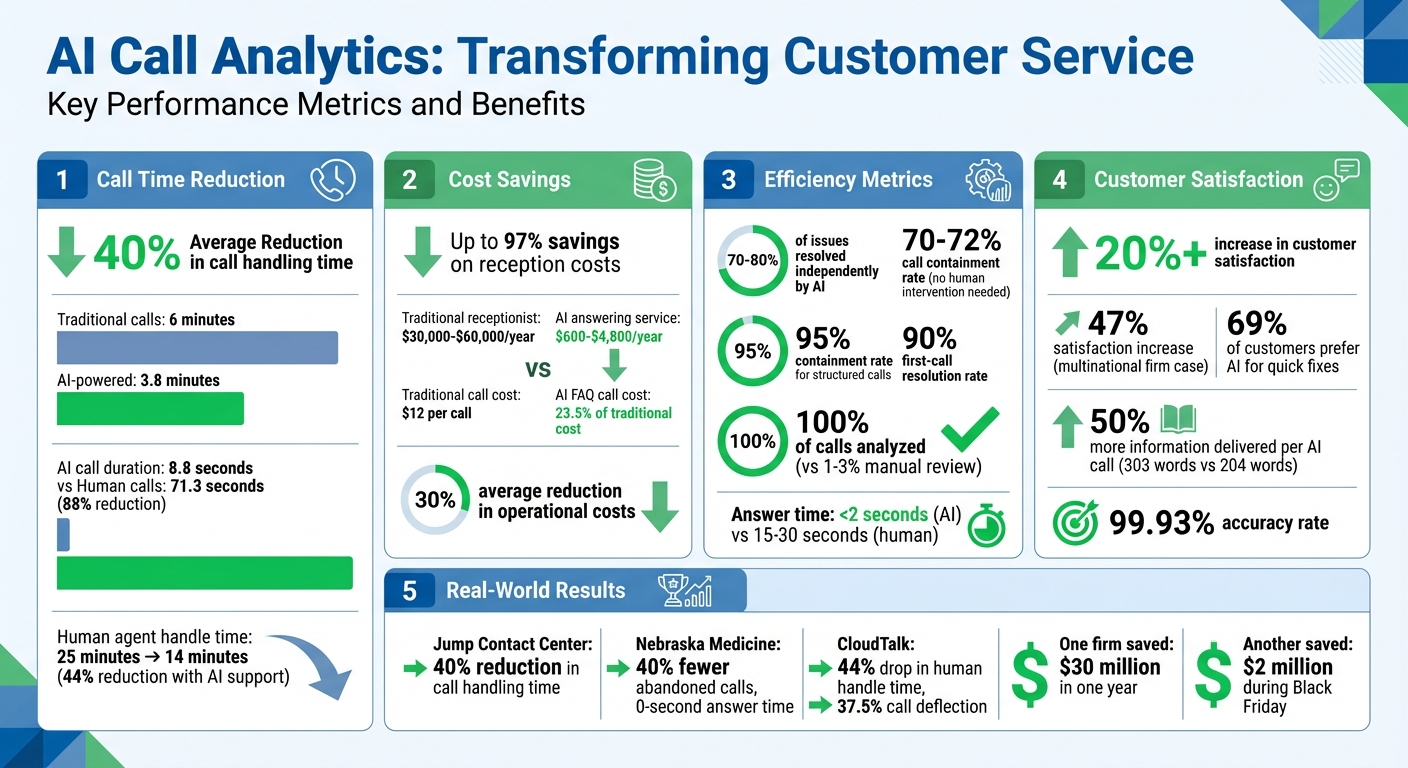
  • Faster Call Handling: AI reduces average call times from 6 minutes to 3.8 minutes by automating data retrieval, routing calls, and eliminating post-call tasks.
  • Cost Savings: Companies save up to 97% on reception costs with AI systems, which handle unlimited calls 24/7.
  • Higher Satisfaction: AI resolves 70–80% of issues independently, boosting customer satisfaction by over 20%.
  • Real-World Results: Businesses like Nebraska Medicine and CloudTalk have seen call times drop by up to 44%, with fewer abandoned calls and better service outcomes.

AI call analytics is no longer optional - it’s a smart investment for businesses looking to save time, cut costs, and keep customers happy.

AI Call Analytics Impact: 40% Reduction in Call Times and Cost Savings

AI Call Analytics Impact: 40% Reduction in Call Times and Cost Savings

How AI Makes Call Centers 100% More Efficient | Auto Quality Assurance

AI Techniques That Reduce Call Times

Cutting down call times involves using AI to eliminate delays and make interactions smoother and faster.

Instant Intent Recognition

AI can pick up on keywords, tone, and intent as conversations happen, giving instant insight into what the customer needs. For instance, if someone calls about a billing issue or needs a password reset, the system quickly identifies the problem and either resolves it immediately or provides the exact details required. Dialpad explains it like this:

AI transcribes calls live and identifies keywords, sentiment, and intent as conversations unfold.

This level of real-time understanding allows automation to handle about 70% of routine queries without needing human help. Tasks like checking an order status or confirming an appointment can be addressed instantly. Businesses using this method have seen impressive results, including containment rates of 95% and first-call resolution rates of 90% for structured calls. Automating even one common type of call can save up to 8 hours of work daily.

Smart Call Routing

Once AI identifies a caller’s intent, it ensures the call goes straight to the right person. If human assistance is necessary, AI routes the call to the most qualified agent or team by analyzing the caller’s needs. On top of that, the system pulls up relevant CRM data and knowledge base articles automatically, cutting down on the time agents spend searching for information and speeding up issue resolution.

Automated Authentication and Self-Service

Traditional identity verification processes used to take up valuable time at the start of calls. Now, AI can handle this in seconds using voice recognition or account data to confirm the caller’s identity before they even speak to a person. Once verified, customers can take care of straightforward tasks - like rescheduling an appointment or tracking a delivery - in under two minutes.

Interestingly, 69% of customers prefer AI-driven solutions for quick fixes, and AI chatbots can resolve 70–80% of customer issues without needing human involvement. For more complex or sensitive situations, AI ensures a smooth handoff to a live agent, complete with all the necessary context. This eliminates the frustration of repeating information and has led to a 37% drop in average handle time and a 20% boost in customer satisfaction. Systems like Answering Agent exemplify how these tools can deliver faster, more efficient service for businesses.

Case Studies and Results

These examples highlight how AI technology has transformed call centers by cutting call durations, improving call handling efficiency, and reducing costs.

Jump Contact Center: 40% Shorter Call Handling Time
Jump Contact Center

In March 2025, a national retail chain teamed up with Jump Contact Center to streamline routine inquiries such as order tracking, refunds, and product availability. By automating these tasks, the company reduced call handling time by 40%. This allowed human agents to dedicate their time to more complex issues, decreasing their workload by 30%. This achievement opened doors for further advancements tailored to specific industries.

Nebraska Medicine: 40% Fewer Abandoned Calls

Nebraska Medicine

In February 2026, Nebraska Medicine, a $2.5 billion academic medical system managing 2.5 million calls annually, introduced an AI platform in its Medical Communication Center. The AI system automated 70% of incoming patient calls, cutting abandoned calls by 40% and ensuring an immediate, 0-second answer time for automated calls. This was especially crucial for their multi-organ transplant center, where staff have only 15 minutes to contact patients when an organ becomes available. By handling routine switchboard inquiries, the AI helped prevent delays in life-saving procedures. These advancements demonstrate the potential for similar improvements in other critical sectors.

CloudTalk Government Services: 44% Drop in Human Handle Time
CloudTalk

In April 2026, a government services provider implemented CloudTalk's AI Voice Agent to manage routine calls about status checks and refund requests, which made up 60% of their call volume. The AI achieved a 37.5% call deflection rate. For calls requiring human intervention, the AI provided summaries before transferring them, enabling agents to address issues immediately. This reduced the average handle time for human agents from 25 minutes to 14 minutes - a 44% decrease. Meanwhile, AI-handled calls averaged just 1 minute and 26 seconds. As the Head of Strategy at CloudTalk Government Services put it:

"The real power of AI for us isn't deflection. It's the reduction in average handle time. When an agent picks up the phone and they already have a summary... that's what actually cuts our handle time by half."

Performance Metrics and Data

Metric Comparison Across Studies

Case studies highlight consistent trends in how AI reshapes call center operations. For instance, AI has been shown to cut call durations by 40%, with Average Handle Time (AHT) dropping by 20–30% across different implementations. Platforms equipped with real-time agent support achieved an average 27% reduction in AHT. First Call Resolution (FCR) also saw a boost, improving by 10–20 percentage points when AI systems were utilized. Additionally, AI systems independently resolved 70–72% of inbound calls without requiring human intervention.

Comparing call durations, AI-driven calls averaged just 8.8 seconds, a significant improvement over the 71.3 seconds typical for human calls - an 88% reduction. Despite the shorter duration, AI calls managed to deliver 50% more information, with an average of 303 words per interaction compared to 204 words for human calls. Accuracy was also on par, with confusion rates nearly identical between AI (0.4%) and human receptionists (0.42%).

Another major advantage lies in analytics. Traditional contact centers manually review only 1–3% of calls, while AI-powered systems analyze 100% of interactions automatically. This comprehensive review capability has tangible benefits - companies using conversation intelligence platforms reported a 53% increase in enterprise sales and a 66% faster turnaround for quality assurance reporting. Furthermore, over 70% of organizations noted higher customer satisfaction after deploying AI systems.

These improvements not only enhance customer experiences but also lead to measurable cost efficiencies.

Cost Savings and Efficiency Improvements

AI's impact goes beyond speed and accuracy - it delivers substantial financial benefits. Companies implementing AI technologies report an average 30% reduction in operational costs. To put this into perspective, traditional calls can cost as much as $12 each, while AI reduces FAQ call costs to just 23.5% of that amount.

For example, one multinational design and marketing firm saved over $30 million in just one year by deploying real-time AI monitoring across its global support centers. This move also increased customer satisfaction by 47% by identifying and addressing unwarranted refunds. Similarly, a buy-now-pay-later company leveraged AI Voice of the Customer insights to update its chatbot content ahead of Black Friday. This proactive approach mitigated a projected 150% surge in support calls, limiting the increase to just 6% and saving approximately $2 million.

AI answering services also offer dramatic cost reductions. These systems cost between $600 and $4,800 annually compared to $30,000–$60,000 for human receptionists - a potential savings of up to 97%. They answer calls in under 2 seconds (versus 15–30 seconds for humans) and can handle unlimited calls simultaneously, 24/7. This ensures that the 28.5% of calls received after hours and the 12.4% on weekends are always addressed.

Answering Agent: AI Call Handling for Service Businesses
Answering Agent

Answering Agent showcases how AI technology can streamline call management, offering features specifically designed for service-based businesses.

Core Features

Answering Agent provides round-the-clock AI-powered phone answering for a wide range of industries, including home services, medical practices, law firms, staffing agencies, and even car washes. Its system uses a natural, human-like voice to manage unlimited simultaneous calls, ensuring no customer is left waiting.

The platform automates tasks like appointment scheduling, lead collection, and answering customer questions. Unlike traditional receptionists who can only handle one call at a time, Answering Agent processes every call instantly, cutting down call durations by 40%. This speed and efficiency set it apart, allowing businesses to serve more customers in less time.

Accuracy and Performance

Answering Agent has processed over 17,724 scored calls with an impressive 99.93% accuracy rate - meaning it rarely makes mistakes, with only a 0.07% hallucination rate. This high level of precision ensures calls are handled correctly on the first attempt, minimizing the need for follow-ups.

In terms of results, the platform has pitched 20,375 offers, with 6,820 accepted, demonstrating its ability to convert inquiries into tangible outcomes. Additionally, businesses using Answering Agent benefit from significant cost savings compared to employing traditional receptionists.

Industry-Specific Applications

Answering Agent’s flexibility allows it to meet the unique needs of various industries:

  • Home services: Handles instant scheduling to streamline operations.
  • Medical practices: Manages patient intake and confirms appointments efficiently.
  • Law firms: Books consultations and answers basic client questions.
  • Staffing agencies: Screens candidates and schedules interviews seamlessly.
  • Car washes: Takes care of reservation requests and membership inquiries.

Each industry benefits from customized scripts designed to handle specific terminology and processes, ensuring smooth and accurate communication. This tailored approach highlights how AI can not only reduce call times but also improve overall productivity for service businesses.

Conclusion

AI call analytics is transforming the way businesses handle customer interactions, delivering impressive results like cutting call times by 40%, improving customer satisfaction, and significantly reducing costs. Success stories from organizations such as Jump Contact Center, Nebraska Medicine, and CloudTalk Government Services showcase consistent 40% reductions in call durations across various industries. These results highlight how AI systems can manage unlimited simultaneous calls at a fraction of the cost of traditional methods.

Solutions like Answering Agent exemplify the power of AI in this space. With data showing 99.93% accuracy across 17,724+ calls and 6,820 accepted offers from 20,375 pitches, it's clear that faster service doesn't mean sacrificing quality. Businesses adopting AI call analytics gain benefits like quicker resolutions, 24/7 availability, and improved accuracy - giving them a noticeable edge over competitors.

Industries such as home services, medical practices, law firms, staffing agencies, and even car washes are seeing the advantages. AI call handling allows staff to focus on more complex tasks, serves customers more efficiently, and reduces operational costs. As customer expectations for instant service continue to grow, AI call analytics is no longer optional - it’s a must-have for staying competitive in 2026 and beyond.

FAQs

How does AI cut call time without hurting customer satisfaction?

AI helps reduce call times by taking over repetitive tasks, adjusting speech speed for efficiency, and using intelligent call routing to connect customers to the right resources faster. These tools not only provide quick and accurate responses but also maintain natural, conversational interactions that keep customers satisfied. Plus, AI works 24/7, managing multiple calls at once without sacrificing response quality.

Which calls should stay with humans vs be handled by AI?

AI shines when it comes to handling routine, repetitive tasks. Things like answering basic questions, scheduling appointments, capturing leads, and offering round-the-clock support are right up its alley. It keeps costs down, manages an unlimited number of calls at once, and ensures no calls slip through the cracks - even during the busiest times.

On the other hand, human agents excel in situations that demand empathy, critical thinking, or a personal touch. Complex, emotional, or high-stakes issues are better handled by people who can adapt and connect on a deeper level. Often, the best solution is a mix of both: AI for efficiency and humans for expertise.

What data and systems do I need to start using AI call analytics?

To make the most of AI call analytics, you'll need a solid base of call data - preferably from actual customer interactions. This helps in spotting patterns and refining the system's accuracy over time. It's also crucial to integrate the AI with tools like telephony systems (such as VoIP) and CRM or scheduling software. This setup allows for automation of tasks like booking appointments, saving time and effort.

When choosing a solution, focus on key features like real-time call monitoring, transcription capabilities, and analytics tools. These can help streamline your operations and improve the overall customer experience.

Related Blog Posts

Answering Agent

Author

Answering Agent

Answering Agent