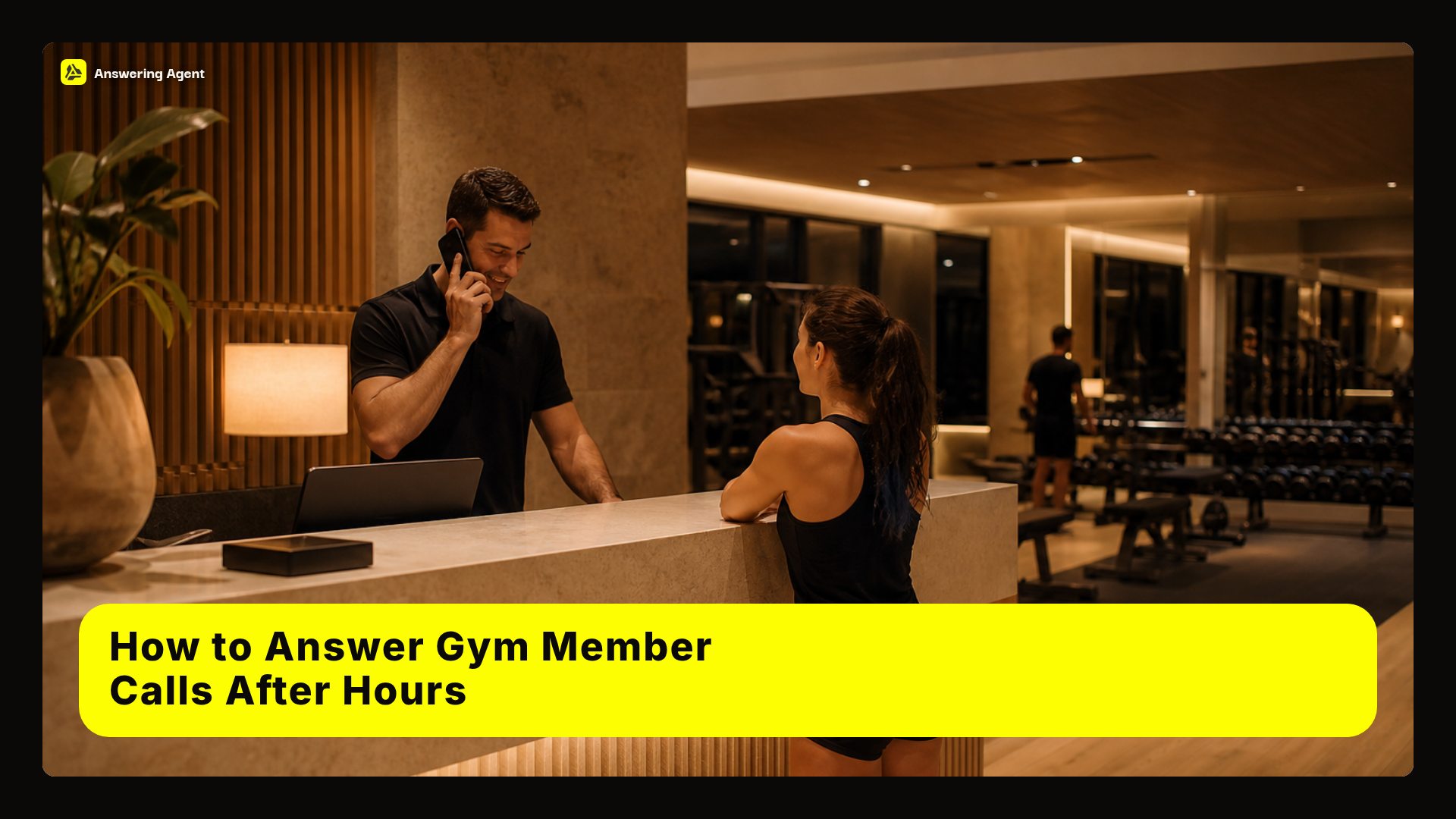
Answer the night call. Update the card or set the freeze while the member is still on the line. Leave a clean note for the morning desk.
If that works, the member gets in, the freeze is on the account, or the cancel is processed. Nobody on the floor has to act as the membership desk after it closes.
Why do gym members call after the front desk closes?
Members call at night because that is when they notice the membership is broken. They see an unexpected draft in the bank app after dinner. Their fob fails at the access door. They leave Monday and want a freeze before the billing date.
These problems can be fixed the same night. You can clear a failed draft tonight, and you can set a freeze before tomorrow's billing run. If the billing date is tomorrow, "call back in the morning" costs the member money and costs you their trust.
Class pack questions, guest questions, and account problems from members already on the floor are also routine front desk work. The only difference is the hour. That is the reason to cover the night line at gyms.
What should you actually do on those calls?
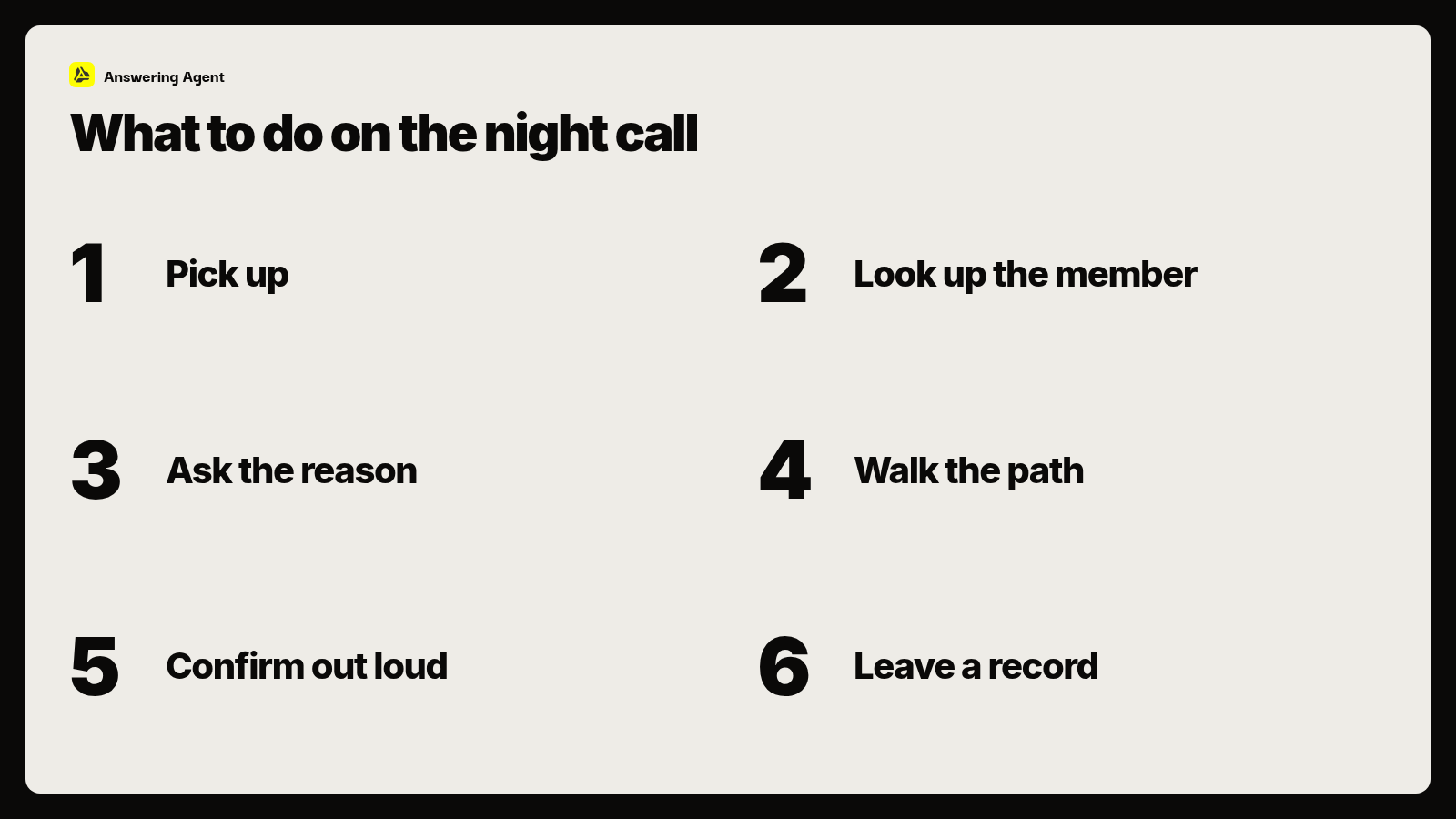
Most night calls are one of four jobs: a failed draft, a freeze, a class pack question, or a cancel. Work the call in this order:
- Find out what they actually need. "I cannot get in" usually means a failed draft. It rarely means a cancel.
- Look up the membership while they are on the line. A fob that should work tonight cannot wait for the morning desk.
- Ask the reason before you touch the account. Each of the four jobs has a different fix.
- Follow your approved rules. Once the card is updated after a failed draft, reactivate the account. If the reason is temporary, set a freeze. If they want off, take the cancel.
- Confirm out loud. Say the date. Say what happens to the fob. Say what the next draft will look like.
- Leave a record. The morning desk should find a clean note. They should not have to piece the call together from a voicemail.
Freeze, billing, or cancel: how do you tell them apart at night?
The member's words usually tell you which call it is. Ask one question to confirm before you change anything.
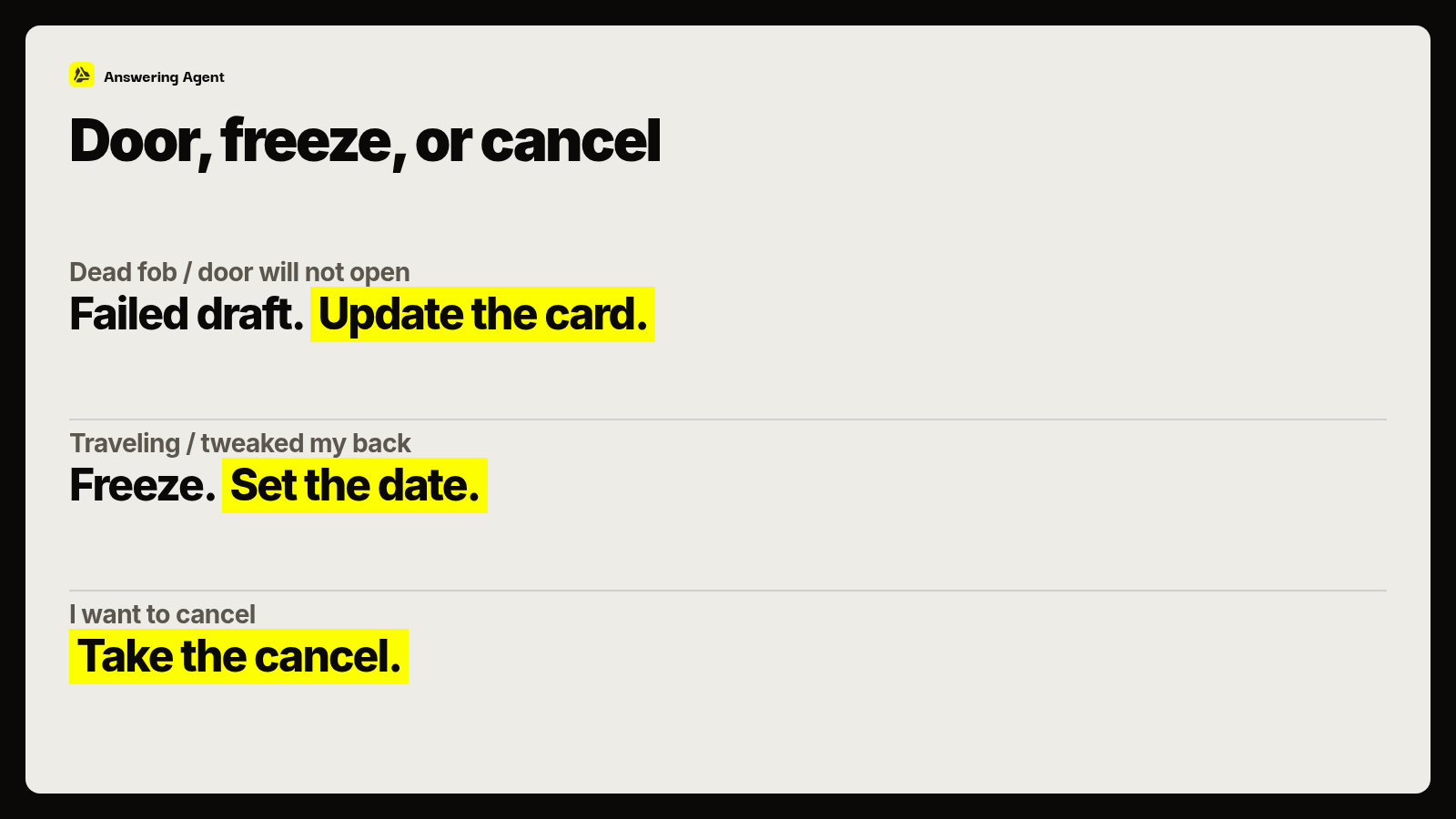
"My fob is dead" and "the door will not let me in" are usually billing calls. Check the last draft first. It usually declined, the system cut access, and the member does not know. Update the card and clear the draft, and the door works again.
"I'm traveling" and "I tweaked my back" are freeze calls. Set the freeze, say the restart date out loud, and note it on the account. Do not freeze a member whose card just declined. The freeze would hide the billing problem without fixing it.
For the full intake, use the gym membership freeze call playbook to confirm dates, billing, and fob access before changing the account.
"I want to cancel" means take the cancel. Ask the reason once, note it, and process it. Do not give a discount speech at 10pm to someone who has decided to leave. Members who leave cleanly are more likely to come back.
A leftover class pack has different rules from a membership freeze. Answer the class pack question under the class pack rules.
What happens when the floor is open and nobody is at the desk?
At 24-hour and early-open clubs, the floor stays open after the desk staff leave, and the desk phone rings with nobody to answer it. Members with a live fob walk in. The member with a failed draft stays outside.
The people in the building at night usually cannot help. The night cleaner should not touch member records. A trainer between sessions has not been trained on freezes or billing, so "call back tomorrow" is the only answer they can give.
Voicemail cannot open the door. The member leaves a message, drives home, and has the night to decide whether to stay for another billing cycle.
How is this different from voicemail or a night answering service?
Voicemail records the problem, and a message-taking service writes it down. Neither one fixes it. A night line is only useful if it can work the membership.
| Voicemail | Night message-taking | Night coverage that can work the membership | |
|---|---|---|---|
| Who answers | Nobody, a beep | An operator reading a script | A trained answerer working your playbook |
| What they can see | Nothing | A notepad | The member record and the last draft |
| Freeze vs billing vs cancel | Cannot tell them apart | Writes down whatever the caller says | Asks the reason, picks the right job |
| After the call | Message sits until morning | Callback slip for the morning desk | Freeze set, draft cleared, or cancel noted, with a record |
| When the desk is empty | Member gives up at the door | Member waits for a callback | Member gets an answer tonight |
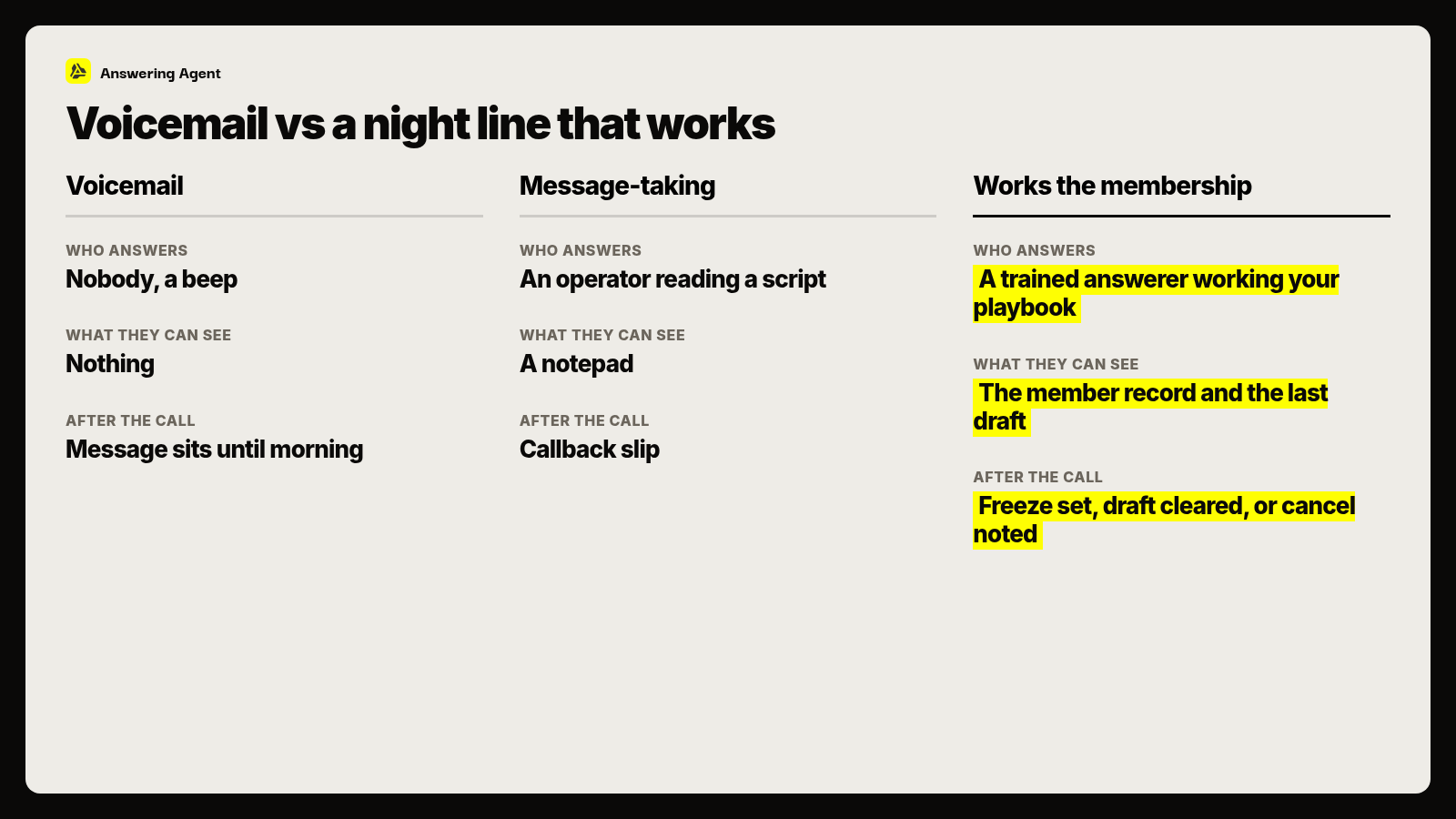
Traditional answering services were built to take a name and number and promise a callback. That works for a plumber's overflow line. It does not work for a member locked out of a building they pay for every month. Ask any night line provider one question: can it work the membership tonight?
What should you check before you let software take the night line?
Test software the way you would test a new front desk hire. It has to see the member record and tell a freeze from a failed draft from a cancel. It has to follow your rules and pass messy calls to a person.
Answering Agent is built for this. It has answered more than 350,000 calls for service businesses. For background on the category, read the definition post on AI answering services.
If your club also runs courts, these playbooks cover related calls: court booking calls, guest fee calls, and membership cancellation calls.
To test it, put it on the night line and call it yourself with a lockout, a freeze, and a cancel. Pass it only if it handles all three the way your best desk person would. Plans are on the pricing page.
FAQ
Can the night line actually reactivate a fob after a failed draft, or does it just take a message?
Yes, if your membership software allows it. With the systems connected, the agent can find the failed draft, take an updated card, and turn the fob back on during the call. Without a connection, it captures the account details and the reason so your desk can fix it first thing in the morning.
A member calls at 10pm saying they want to cancel. Should the agent offer a freeze instead?
Ask why first. A freeze fits travel or an injury. A failed draft is a billing problem, so a freeze is the wrong fix. If the reason fits, offer the freeze once. If they still want off, take the cancel and leave a clean record.
What should happen when someone is standing at the door and cannot get in?
Treat it as urgent. The agent should verify the member, check the fob status, and restore access if a failed draft or freeze caused the lockout. If access cannot be restored remotely, escalate to your on-call contact right away.
Does any of this work if we do not connect our membership software?
Yes, with fewer capabilities. Without a connection, the agent answers, follows your rules, and gives your desk a summary with the member's name, the account issue, and a callback number. With a connection, it can check drafts, freeze status, and class pack balances during the call. You can start without a connection and add one later. See how it fits a club at answeringagent.com/industries/gyms.
What happens when a caller genuinely needs a manager?
The agent forwards the call to whoever you designate, based on rules you set. You decide what escalates, such as a lockout or an angry billing dispute, and what waits for morning.
Our studio closes at 8. Is after-hours coverage only for 24-hour clubs?
No. A studio that closes at 8 still gets calls about class packs, failed drafts, freezes, and cancels after close. Those calls go to voicemail today. Coverage from close to open handles them during the call.
How do we try this without touching our published number?
Use conditional forwarding. Your published number stays the same, and calls roll to the agent only when nobody picks up or after closing time. You can turn it off in minutes. Start with nights and weekends, then expand once you trust the summaries.
What should a demo prove before we hand over the night line?
Call it like your crankiest member. Say your draft failed and your fob will not scan. Ask to cancel and see whether it asks why before offering a freeze. Ask about your class pack balance. Then check the summary in your inbox. Run these tests on a demo.
Book a walkthrough
See it handle your calls.
Book 20 minutes, or hear a sample call first.