Book the court from your approved availability, tell them whether they are getting open play or a reserved court, name the guest fee if someone is coming, and read the time back before they hang up. That is the whole call. When the caller hears "Court 4, Thursday, 6 to 7, one guest, fee due at check-in," you won.
For the full map of pickleball desk calls, including guest fees, door access, freezes, and cancellations, use the pickleball club phone calls desk guide.
Peak hour at a wash is the same energy. Yours is 6 pm at the desk. People are checking in, someone is asking about paddles, and the phone still rings for a court tonight. You have an app. They called anyway. This is the playbook for that call.
Why do people still call to book a pickleball court?
People call because calling is faster than the app when they want a court tonight. They call after the desk closes. They call because they are bringing a guest and do not know the fee. And they call because a member wants a reserved court, and the app keeps pushing them toward open play.
The app handles the easy version of this. Member, logged in, standard slot, done. The phone gets everything else. A non-member who does not have an account. A member whose booking window the app will not explain. A group of four where two are guests and nobody knows what that costs.
A court reservation is a small commitment with a hard start time. People want it confirmed out loud. That is why pickleball clubs still get booking calls no matter how good the software is.
Treat those calls as bookings. Every one of them is someone trying to give you a court hour.
What should you actually do on a court booking call?
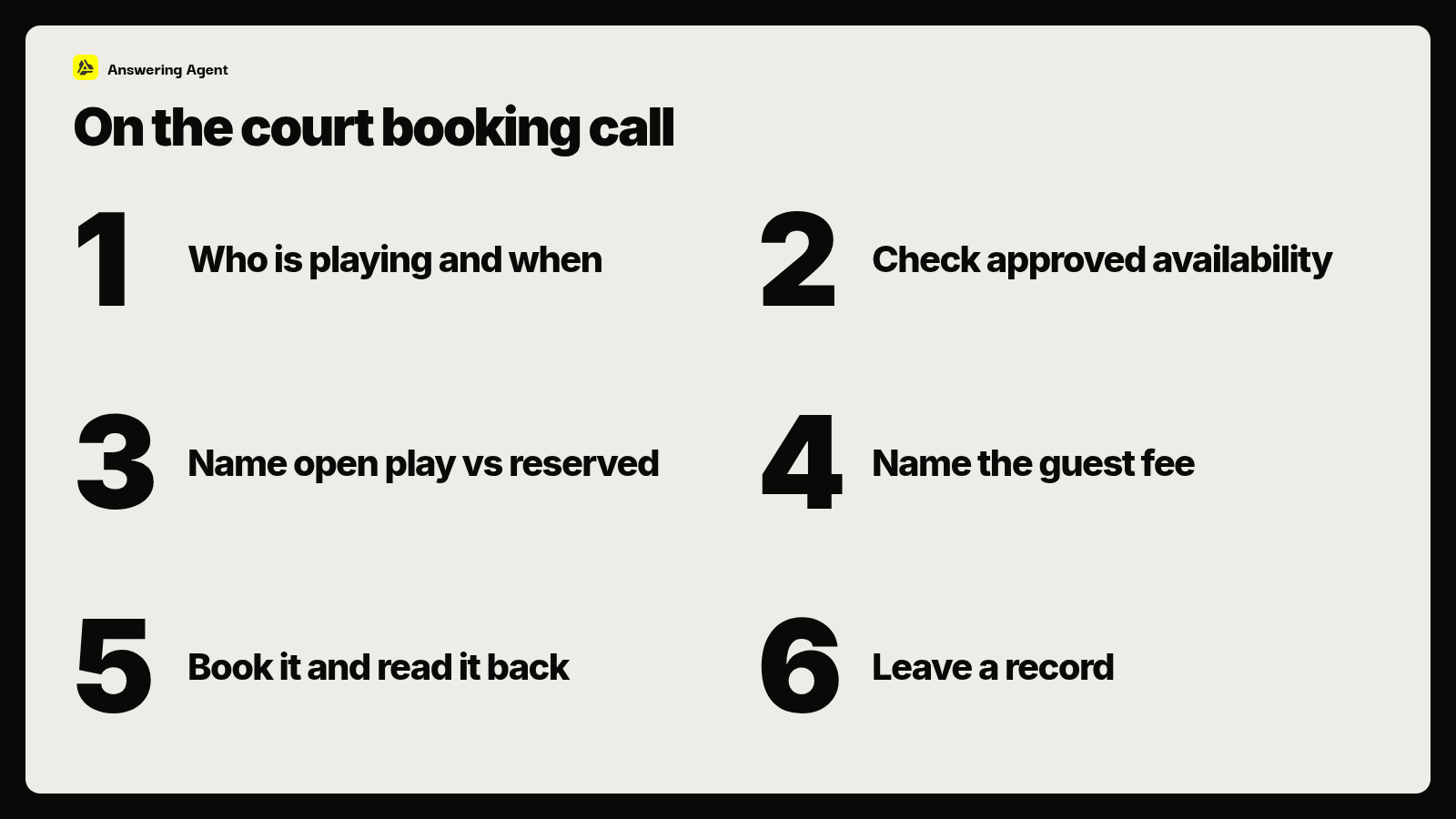
Treat it like a transaction. Find out who is playing and when. Check the availability you actually honor, because member windows and non-member windows are different. Name open play or reserved. Name the guest fee. Book it, read it back, and leave a record the next shift can see.
- Pick up and ask who is playing and when they want the court. Name, member or not, how many players, what time. Four facts, ten seconds.
- Check your approved availability. Members may book further out than non-members. Say that out loud so the caller understands why tonight is open but Saturday is not.
- Name open play versus a reserved court. Do not let them find out at the gate. Say which one they are getting and what it means.
- If a guest is coming, name the fee and who pays it before you confirm. The member covering it and the guest paying at the desk are different conversations. Have it now.
- Book the time and read it back. Court, date, start time. Ask them to repeat it. This feels silly. Do it anyway. People show up at the right court.
- Leave a record the next desk person can see. If the booking lives in one person's head, that hour gets double-booked. Put it on the sheet before the next ring.
Six steps, maybe ninety seconds. The read-back is the one people skip. Do not skip it.
Open play or a reserved court: how do you tell them apart?
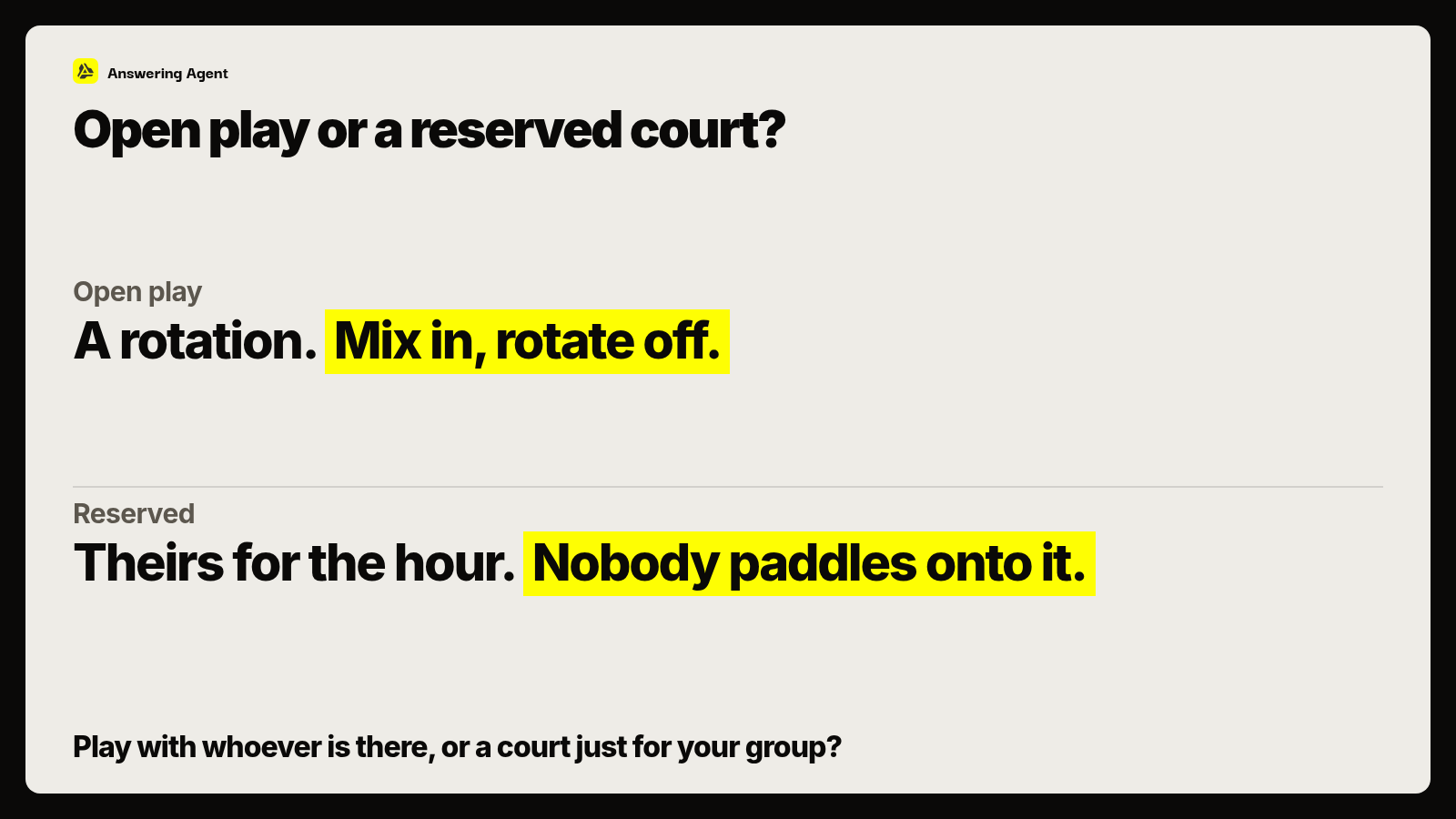
Open play is a rotation. Players paddle up, mix in, and rotate off. A reserved court belongs to one group for the hour, and nobody paddles onto it. The mistake happens when the desk books whatever is left instead of what the caller asked for, and both sides show up expecting different things.
Ask one question early: "Do you want to play with whoever is there, or do you want a court just for your group?" That sentence sorts almost every caller. A solo player who wants games goes to open play. Four friends who drove over together want a reserved court, and dropping them into a rotation will annoy them and everyone already in it.
Do not sell open play as if it were private. A caller who thinks they booked Court 2 for their foursome and walks into a paddle rack with twelve people waiting is going to be loud about it.
Membership changes the math too. Most clubs let members reserve further ahead, sometimes days further, and some keep prime evening slots member-only. Say that on the call. "As a member you could have booked this yesterday. As a non-member the earliest I can give you is tomorrow at 7." That is a fair sentence, and it quietly sells the membership without a pitch.
Can they bring a guest on that reservation?
Usually yes, and the fee is the whole conversation. Ask if anyone on the reservation is not a member. If so, name the guest fee and who pays it before you confirm the slot, not after. A guest who learns the fee at check-in feels ambushed, and your desk eats that argument at peak hour. When the call is mostly day-pass or open-play guest pricing, use the pickleball guest fee playbook.
Book the court on the call, then read the time back.
That line covers guests too. The read-back should include the guest: "Court 3, Friday at 6, three members plus one guest, guest fee due when you arrive." Now nobody is surprised.
Cover your house rules on the same call. If guests need to sign a waiver, say it now so they arrive five minutes early instead of holding up the check-in line. If your rule is that the member must be present with their guest, say that too. If the guest wants to drop in to open play instead, quote that rate, because drop-in and guest-on-a-reservation are often different prices at the same club.
An unpaid guest at 6 pm becomes a fight at the desk during your busiest hour. A thirty-second fee conversation on the phone is how you never have it.
How is this different from taking a voicemail?
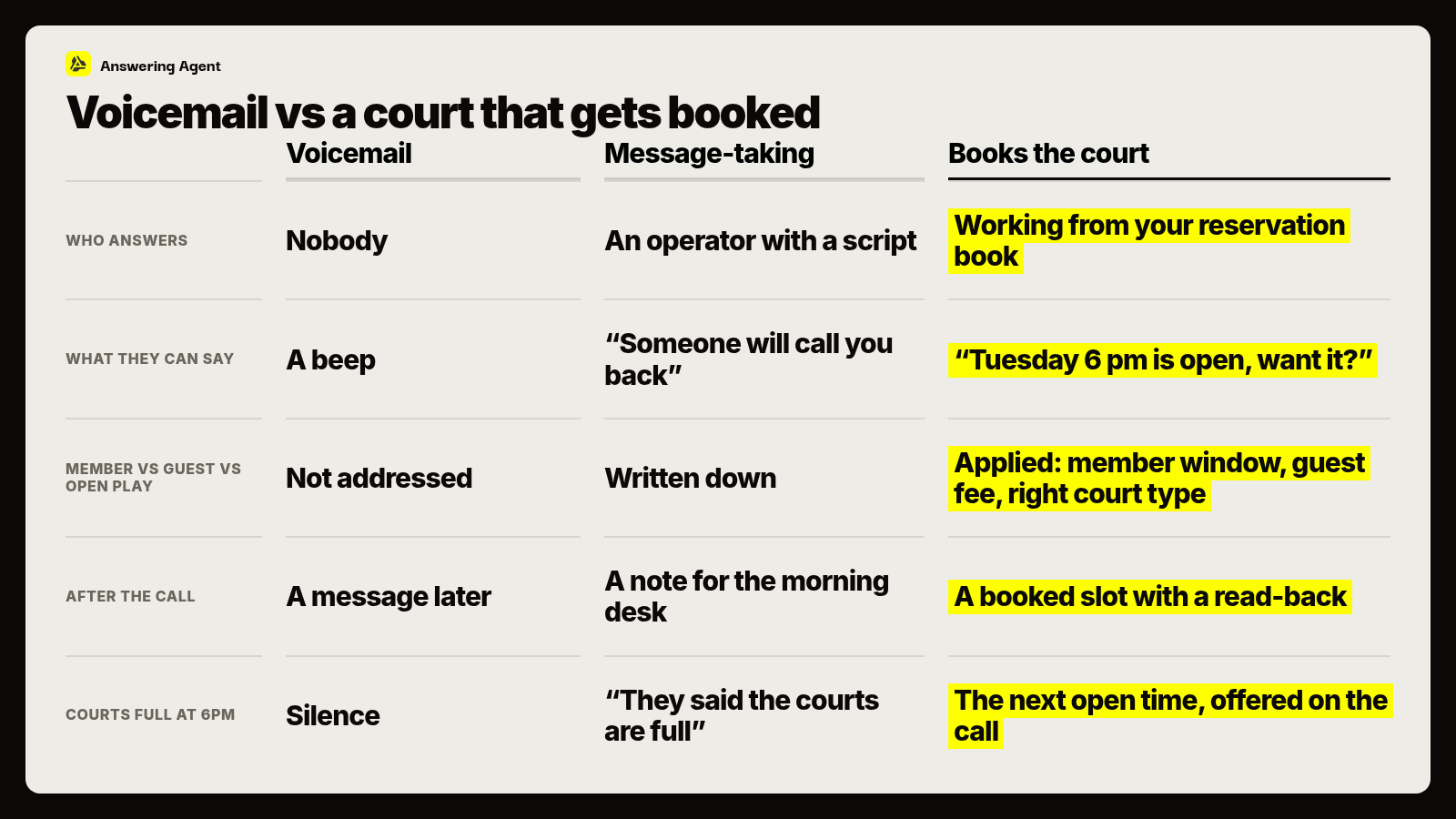
A voicemail records a request. A message-taking service repeats a request. Neither one puts a name on a court. The court booking call only ends two ways: the slot is booked, or the caller knows the next open time. Anything short of that is a callback, and callbacks lose to the club across town.
| Voicemail | Message-taking service | Coverage that can book the court | |
|---|---|---|---|
| Who answers | Nobody | An operator with a script | Something working from your reservation book |
| What they can say | A beep | "Someone will call you back" | "Tuesday 6 pm is open, want it?" |
| Member vs guest vs open play | Not addressed | Written down as words | Applied: member window, guest fee, right court type |
| After the call | A message to hear later | A note for the morning desk | A booked slot on the sheet with a read-back |
| When courts are full at 6pm | Silence | "They said the courts are full" | The next open time, offered on the call |
Old answering services were built to take a name and a number. That works for a plumber. It fails for a court, because the caller wants tonight, and by the time your morning desk calls back they already booked somewhere else or gave up.
So the only question that matters when you evaluate phone coverage is this: can it book the hour, or does it describe the request to whoever opens tomorrow? The first is a desk person. The second is a slower voicemail.
What should you check before software takes that call?
Ask a vendor the same questions you would ask a new desk hire. Can it read your booking sheet, or a copy of it you approve. Can it tell open play from a reserved court. Can it name the guest fee without guessing. And can it hand the weird calls to a human.
This is the part where I will name the tool. Answering Agent has been in the space for two years. Answering Agent has answered more than 350,000 calls for service businesses. The median phone call is about 75 seconds. That is a court booking's length.
About two out of three calls are handled start to finish without needing a human. About 1 in 10 phone calls get forwarded. That forwarding matters, because a billing mess or a freeze request is a different call and should reach a person. Night lockouts and freezes live in how to answer gym member calls after hours. When a member wants to end the plan itself, I use the pickleball membership cancellation playbook.
For pickleball club door, fob, or code problems after the desk closes, I use the pickleball after-hours and door access call guide.
The agent picks up and responds in about a second and a half. About 40% of contextual offers made during a call are accepted, based on the last twelve months.
When 6 pm is full, the next move is the next open court, named on the call. That offer only works if the coverage can book it, not describe it to the morning desk.
Read how AI phone answering works, look at pricing, and if you want the club-specific page, start at pickleball clubs. Same checklist if you also run athletic clubs. The test is always the same: can it finish the court call the way your best desk person would.
Look at pricing, put it on a test line, and call it yourself. Say "I need a court tonight at 6" and then "can I bring a guest." If it books the slot, names the fee, and reads the time back the way your best desk person would, your peak hour stops being a voicemail pile.
FAQ
Should members and drop-ins get the same booking window?
No, and your phone should know the difference. Most clubs let members book courts five to seven days out and hold drop-ins to same-day or 48 hours. The problem is when the desk quotes one window and the phone quotes another. Write the rule down once, member window and drop-in window, and make sure whoever answers reads from the same sheet. One rule, two audiences, zero arguments at the desk.
What do I say when someone no-shows a court they reserved by phone?
Say the same thing you would say if they booked online. A reservation is a reservation, and your no-show policy should not soften because the booking came in by phone. State the policy on the call itself, court held for ten minutes, then released to the walk-up list or open play. Members forgive a firm policy they heard up front. They do not forgive losing a court to an empty reservation.
We rent paddles. Should the phone bring that up or wait to be asked?
Bring it up. A first-time caller reserving a court often does not own a paddle, and finding that out at the desk slows check-in for everyone behind them. Have the phone offer the rental while the reservation is being made, paddle count, size, fee. Roughly 40% of in-call offers get accepted.
League night takes half our courts. How does the phone handle a private court request during it?
The phone needs the league calendar along with the court count. If Tuesday 6 to 8 is league on courts one through four, the answer to a private booking request is which courts remain and until what time, not a vague call back later. Load the league schedule as blocks, keep the remaining courts bookable, and quote guest fees if the caller is bringing a non-member onto that reserved court.
My desk person is checking in a line of players when the phone rings. Who takes the call?
Not the desk, at least not first. A check-in line is your busiest moment, and a booking call is a two-minute interruption that resets their focus. Route the call to something that can take the reservation, quote the window, and mention the paddle rental, then send a summary to the desk. About two out of three calls are handled start to finish without needing a human. The rest still reach a person, just not mid-line.
Does phone answering only help if it connects to our booking software?
No. Even without a connection, a phone that captures name, member status, court time, party size, and guest count gives your desk a bookable request instead of a mystery voicemail. With a connection, the reservation lands on the calendar during the call. Start where your setup allows. Club setup notes are on the pickleball clubs page. The captured details alone kill most of the callback tag.
Can I try this without touching the number members already have saved?
Yes, and that is the right way to test. Keep your published number, forward it on no-answer or after a few rings, and nothing changes for members who reach the desk. The coverage only catches what the desk misses. Run it for two weeks of Tuesdays, read the call summaries, then decide. You can set up a test at book a demo without changing anything members see.
What should a demo actually prove before I trust it with court bookings?
Call it yourself with your three hardest scenarios. Ask for a court during league night. Ask to bring two guests and see if the guest fee comes up. Ask a same-day drop-in question as a non-member. If it handles those, the easy calls take care of themselves. Also listen for pickup speed, because members hang up on slow phones. The agent picks up and responds in about a second and a half.
Book a walkthrough
See it handle your calls.
Book 20 minutes, or hear a sample call first.