
Give the caller a clear access decision and leave the morning desk a note it can use. That starts with identifying the caller, checking which access rules apply, and following the club's written instructions. Nobody invents a code or promises entry before checking permission.
When I work through these calls with pickleball club GMs, member-services teams, and front desk leads, I keep permission separate from troubleshooting. A closed desk does not necessarily mean a closed club. A failed fob does not tell us whether entry is allowed.
The caller should leave the conversation knowing whether they can enter and what happens next, even when the answer is that no authorized entry option is available.
What counts as an after-hours club access call?
An after-hours club access call asks whether someone can enter the pickleball club, or why an approved entry method is failing, while the desk is closed. Establish which access rules apply before giving instructions. Reserving a court and changing a membership belong in their own processes.
The caller might mention a fob, code, app, buzz request, or side gate. Those details help identify the problem. They do not establish permission to enter.
Ask who is calling, where they want to enter, and what they need. A member with a failing fob needs a different response from a guest asking someone to buzz them in. Someone checking whether the club has closed for weather needs the closure information before any credential troubleshooting.
I keep this process focused on the pickleball club door. If the caller wants a court, a guest-fee answer, or a cancellation, clarify whether there is also an unresolved access question before moving on.
Which access path should I choose before promising entry?
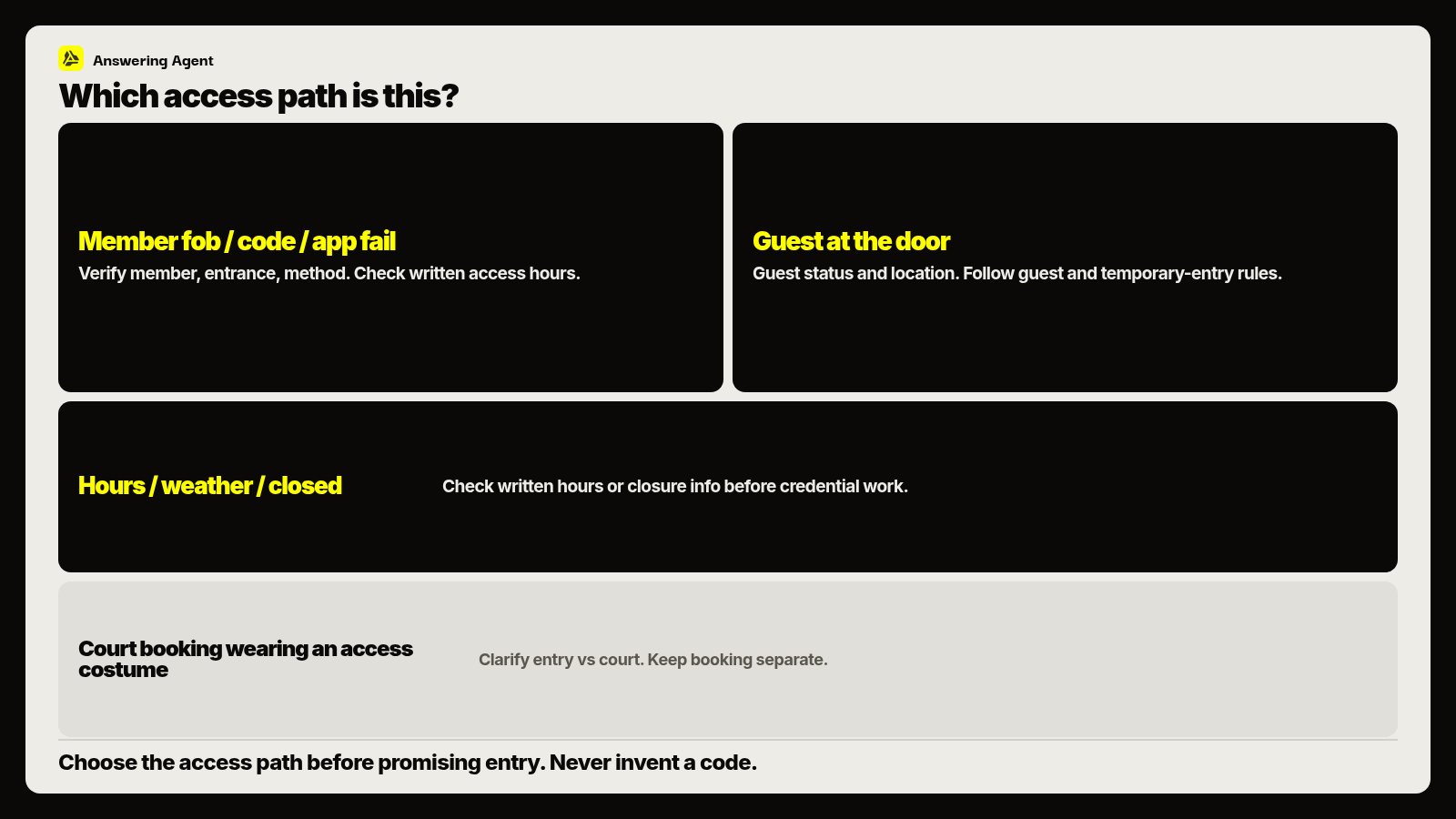
Sort the call into four paths before discussing entry. A member access failure needs a permission check and an approved response. A guest needs the guest-entry rule. A closure question needs written hours or closure information. A booking request follows the booking process, with any door question handled separately.
| Call path | What I establish | What controls the answer | What I avoid |
|---|---|---|---|
| Member fob, code, or app failure | Verified member status, door or side gate, entry method, and reported failure | Written access hours and the approved response for that access problem | Treating membership as permission to enter at any hour |
| Guest waiting at the door | Guest status, location, and the entry request | Written guest access and temporary-entry rules | Assuming a guest may follow a member inside |
| Hours, weather, or closed club | Whether the caller is asking about access hours or a closure | Written hours and approved closure information | Treating a closure as a credential problem |
| Court-booking ask that sounds like access | Whether the caller wants entry or somewhere to play | The club's booking process for the booking question | Promising door access because a court is wanted |
A useful question is, "Are you having trouble using your access method, checking whether entry is allowed, or asking about getting a court?"
Listen before choosing a path. A call may involve more than one request. There is no need to force it into the first row that sounds close; identify both requests and keep the permission decision clear.
How do I handle the call from first question to final confirmation?
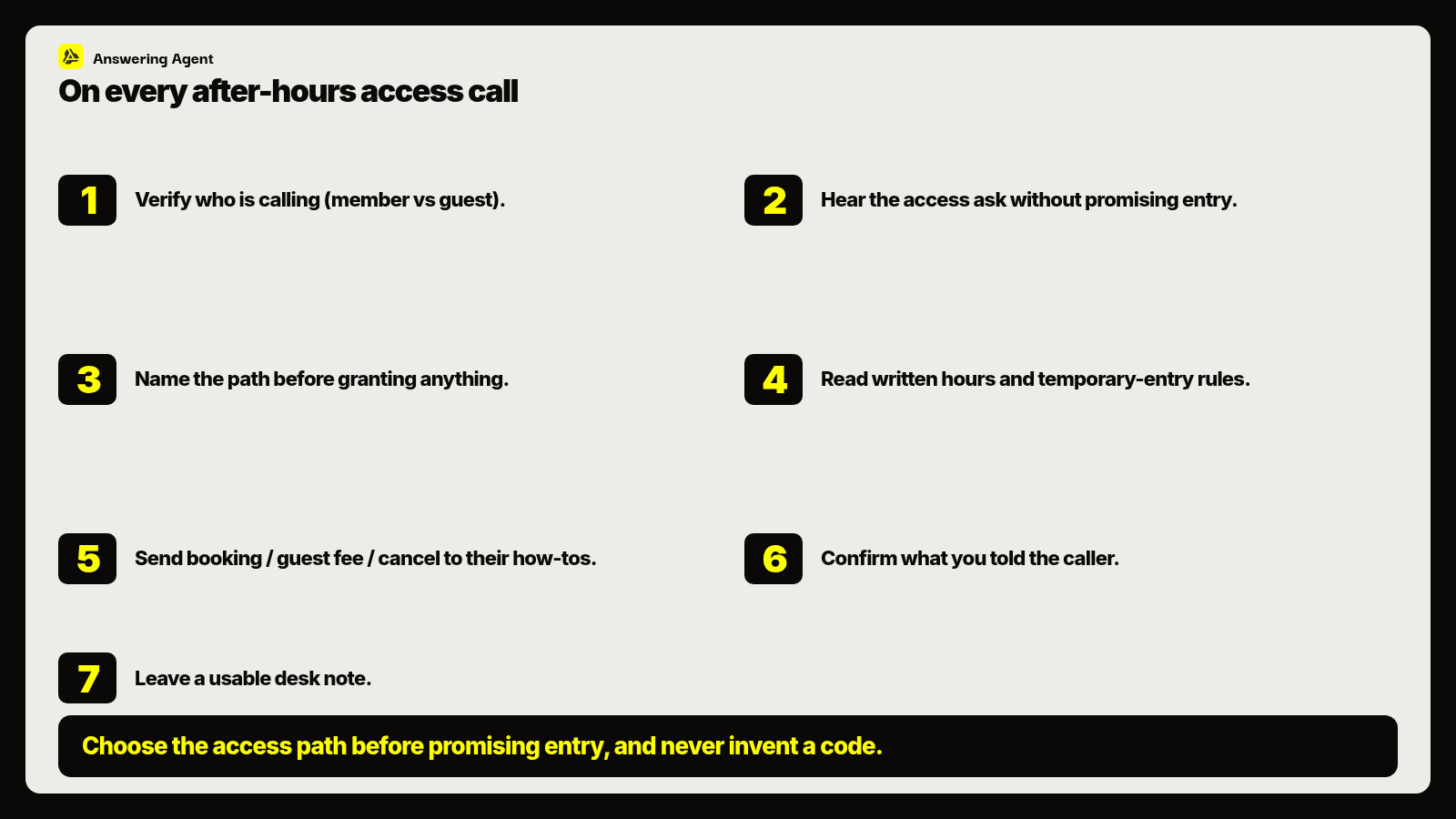
Use the same sequence across all four paths: verify the caller, understand the request, and consult the applicable written rules before taking an access action. Confirm the decision and document the outcome. When the rules do not authorize entry, explain the limit and use only an authorized next step.
"Choose the access path before promising entry, and never invent a code."
Verify who is calling
Get the caller's name and establish member or guest status using the club's approved verification process. Record anything that remains unverified. Someone saying they are a member does not finish the check, and a booking does not establish access rights. Keep identity verification separate from the entry decision.
Hear the access request without promising entry
Ask which door or side gate they mean, which entry method they are using, and what happened. Let them describe the fob, code, app, or buzz issue in their own words. "I will check the club's access instructions" is a commitment you can keep. "I will get you inside" may not be.
Choose the path before granting anything
Identify member access failure, guest entry, hours or closure, or a booking request. If the caller has two requests, name both. A guest can have a legitimate booking question while still needing a separate answer about permission to enter. Resolving one does not approve the other.
Read the written hours and temporary-entry rule
Check the rule for this caller, entrance, and time. Establish whether the desk is closed, the club is closed, or both. Follow the documented response. Never invent a code, suggest a security workaround, or improvise fob instructions. Use an authorized handoff when required. If no authorized action is available, say so.
Send other requests to their own process
Use the pickleball court-booking call guide for booking requests, the pickleball guest-fee call guide for fee questions, and the pickleball membership-cancellation call guide for cancellation requests. Include any unresolved door question in the handoff.
Confirm what you told the caller
Restate the access decision, the instruction given, and any authorized next step. Be clear about whether entry was granted. If the caller has not confirmed getting inside, do not record entry as successful. Check that the caller understands the answer before ending the call.
Leave the desk note before closing the work
Record the caller's name and status, the entrance, the path chosen, the applicable rule, and the action taken. Include what was not granted and what remains unresolved. The next person should be able to distinguish access follow-up from a separate member-services request, or see that no further action is needed.
Where should booking, guest-fee, and cancellation questions go?
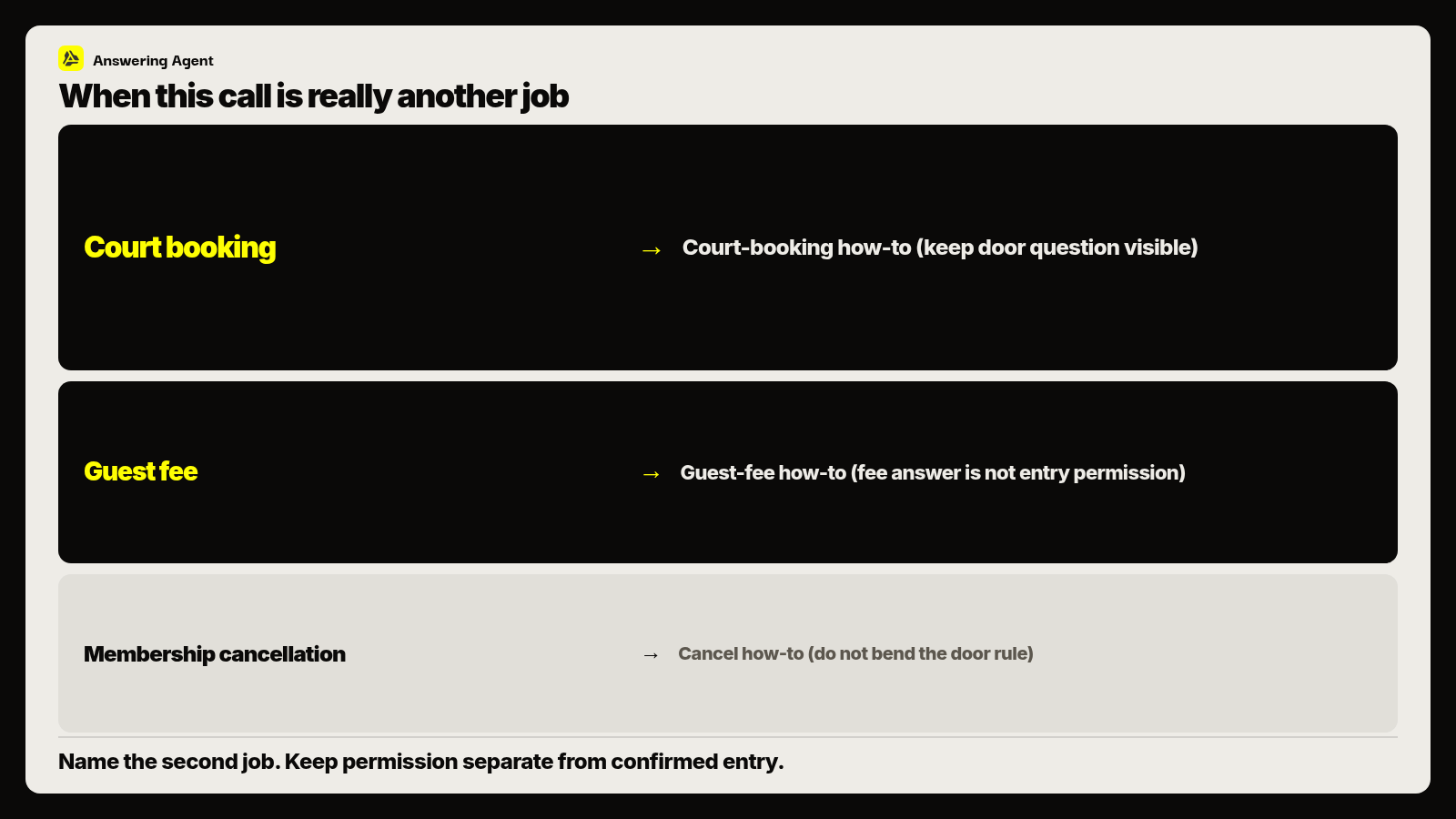
Move each request to its own process while keeping any unresolved door question visible. Court availability belongs with booking, guest charges belong with guest fees, and ending a membership belongs with cancellation. None of those requests establishes permission to enter the club after the desk closes.
"Can I get in to play?" can mean door permission or court availability. Clarify which answer the caller needs before explaining booking steps. If they need both, say so.
A guest waiting outside may ask about payment. Answering the fee question still leaves the after-hours guest-entry decision to the club's written rule. Record both answers rather than treating payment information as entry approval.
Access frustration can also turn into a membership-cancellation request. Follow the cancellation process without bending the entry rule. I would name that second request before switching processes so the morning desk can see what still needs attention.
What belongs in a desk note the morning team can use?
A usable access note records the caller, entrance, decision path, rule consulted, and outcome communicated. Separate what the caller reported from what was verified or authorized. The morning team should be able to tell whether entry was permitted, whether the caller got inside, and what still needs attention.
Use these fields as a template.
| Note field | What to record |
|---|---|
| Caller | Name, member or guest status, and verification completed or still unresolved |
| Entrance | Door or side gate identified by the caller |
| Access method | Fob, code, app, buzz request, or no method identified |
| Reported issue | What the caller said happened, without diagnosing an unconfirmed cause |
| Path taken | Member failure, guest entry, hours or closure, or booking request |
| Rule checked | The written hours, closure direction, or temporary-entry rule used |
| Action and permission | What was done, what was granted, and what was not granted |
| Confirmation | What the caller was told and whether entry was confirmed |
| Follow-up | Unresolved question and any authorized handoff made |
"Door problem, handled" leaves too much unexplained.
When I review this process with a front desk lead, I want permission and outcome recorded separately. An approved instruction can be given without confirmation that the caller entered. Preserve that distinction in the note.
A missing rule also needs to stay visible. Identify the unanswered policy question rather than marking the call complete as though access was resolved.
What should I look for when buying after-hours phone coverage?
Evaluate after-hours phone coverage against the club's access process. The service needs to follow approved hours and temporary-entry rules, distinguish the four call paths, and avoid invented codes or security overrides. It also needs to leave a desk note that explains the decision and identifies any unresolved access question.
For clubs considering Answering Agent, these are the published facts:
Answering Agent has been in the space for two years. The agent picks up and responds in about a second and a half. About two out of three calls are handled start to finish without needing a human.
Review the access instructions and handoff requirements before assigning these calls to the service. Response speed cannot supply a missing guest-entry rule, and a resolved call should still have a clear record of permission and outcome.
Start with Answering Agent for pickleball clubs, review AI phone answering features, and check pricing.
Before assigning coverage, check the written hours, guest-entry rule, and temporary-entry instructions. Make sure the note template separates permission from confirmed entry. Send unanswered policy questions to the GM so whoever takes the after-hours call has an approved answer to give.
FAQ
How should after-hours door access calls be sorted?
Sort each call into member access failure, guest entry, hours or closure, or court booking before promising entry. Ask whether the caller needs help with an access method, permission to enter, or a court. If the call includes multiple requests, identify each one and keep the access decision separate from booking or other member-services questions.
What should I do when a member's fob, code, or app fails?
Verify the caller through the club's approved process, then identify the entrance, access method, and reported failure. Check the written access hours and approved response for that situation. Membership alone does not authorize entry at every hour. Never invent a code or improvise troubleshooting instructions. Confirm the decision and record whether the caller actually entered.
Can a guest be allowed inside after the desk closes?
The answer depends on the club's written guest-access and temporary-entry rules. Establish the caller's guest status, location, and request before giving instructions. Do not assume a guest can follow a member inside. A booking or fee question does not establish entry permission. If no authorized entry option is available, explain that limit and use only an authorized next step.
Does a closed front desk mean the club is closed?
Not necessarily. Check whether the desk is closed, the club is closed, or both using written hours and approved closure information. A weather closure needs a closure answer before credential troubleshooting. Give the caller the applicable access decision rather than treating every locked-door report as a fob, code, or app problem.
How should booking, guest-fee, and cancellation requests be handled?
Send each request through its own process while keeping any unresolved door question visible. Court availability belongs with booking, guest charges with guest fees, and membership cancellation with cancellation. Clarify whether "Can I get in to play?" means entry permission, court availability, or both. Resolving another request does not approve after-hours entry.
What should the morning desk note include?
Record the caller's name and verification status, entrance, access method, reported issue, chosen path, rule checked, and action taken. Include what was granted, what was not granted, and any unresolved question or authorized handoff. Keep permission separate from confirmed entry: giving an approved instruction does not establish that the caller got inside.
What should a club check before assigning after-hours phone coverage?
Evaluate coverage against the club's written hours, guest-entry rules, temporary-entry instructions, and handoff requirements. Check that the service can distinguish the four call paths and leave notes separating permission from confirmed entry. Send unanswered policy questions to the GM before assigning coverage. Response speed cannot replace a missing access rule or authorize a security workaround.
Book a walkthrough
See it handle your calls.
Book 20 minutes, or hear a sample call first.
Ready to see it handle your calls?
Book a walkthrough, or hear a short sample call first.
Related Articles
Car Wash Membership Billing Phone Calls: A Desk Guide
Desk guide for car wash membership billing calls: fork failed payment, double charge, plan change, and pause vs cancel before you process.

How to Handle Pickleball Membership Cancellation Calls
How pickleball club desks handle membership cancellation calls without inventing policy or fighting the member.
How to Handle Failed Payment Calls on a Car Wash Membership
How wash desks handle failed payment and card-update calls on a membership without turning the call into a gate lockout.