
AI tools are solving a major challenge in healthcare: language barriers. Patients with limited English proficiency face higher risks of medical errors and difficulties accessing care. Traditional solutions like interpreters are costly and time-consuming, but AI offers faster, more affordable alternatives that improve communication and efficiency.
Key tools include:
- AI Translation Tools: Real-time, accurate translations for over 100 languages, helping with patient communication and clinical documentation.
- Virtual Medical Assistants (VMAs): Automate administrative tasks like scheduling, intake, and documentation, reducing staff workload.
- Answering Agents: Handle multilingual phone calls 24/7, with high accuracy and integration into patient records.
Quick Overview:
- Accuracy: AI tools achieve up to 99.93% accuracy in translations and documentation.
- Cost Savings: Reduce language support costs by up to 70% and operational expenses by 30%.
- Efficiency: Speed up documentation by over 70%, cut missed appointments by 70%, and reduce call wait times to seconds.
- Compliance: Fully HIPAA-compliant, ensuring patient data security.
These tools not only cut costs but also improve patient safety by minimizing errors. A hybrid approach - AI for routine tasks and human interpreters for complex cases - offers the best results.
1. AI Translation Tools
Real-Time Translation Accuracy
AI translation tools rely on advanced technologies like Neural Machine Translation (NMT) and Natural Language Processing to interpret entire sentences while maintaining proper grammar, contextual meaning, and medical accuracy. Unlike general-purpose translation tools, medical-specific AI is trained to understand clinical terms across various fields, such as cardiology and orthopedics, to ensure patient safety.
The Phi-4-multimodal model stands out with a word error rate of just 6.14% in automatic speech recognition, outpacing older models like WhisperV3. These tools excel in bi-directional translation, converting clinical terminology into patient-friendly language and vice versa for documentation purposes. Some advanced systems can even process speech, text, and images simultaneously, cutting down on delays and reducing errors.
For example, Sun Life Health in Arizona began using the Sunoh.ai multilingual scribe in January 2025 to manage around 300 Spanish-language visits per month. This tool allowed providers to save enough time to add four extra patients to their daily schedules, all while easing the burden of documentation.
"Sunoh.ai has been a game changer in assisting providers complete notes on time and improving work-life balance".
By integrating these highly accurate tools into workflows, healthcare providers can maximize efficiency and improve outcomes.
Workflow Integration
AI translation tools are designed to work seamlessly with existing systems through a single REST API, connecting directly to phone systems, telehealth platforms, and Electronic Health Records (EHRs) like Epic, eClinicalWorks, or Athena. Unlike screen scraping, native API write-back ensures that data is securely and accurately entered into patient charts. These tools can capture conversations in the background, translating and organizing them into structured clinical notes - like SOAP or DAP formats - in real time. This integration improves documentation while enhancing patient care.
For instance, a California health system handling 150,000 calls monthly deployed AI voice agents linked to Epic EHR. These AI voice assistants for healthcare scheduling improve accessibility for non-English speakers. The system operates 24/7, supports five languages, and managed all incoming calls within three months, significantly reducing staff workload and wait times.
"DeepScribe has done an amazing job supporting our Spanish speakers. It surprised many of our providers when they found an English-generated, clinically correct note in the EHR from a patient visit that occurred in Spanish".
Cost Efficiency
Traditional interpreter services can be expensive, costing $3.00 per minute for phone interpreters and $25.00 to $150.00 per hour for in-person interpreters. AI translation tools, on the other hand, use a pay-as-you-go model based on the volume of characters translated, eliminating the need for high upfront costs. Some medical practices have reported cutting language support costs by up to 70% by automating these processes, allowing resources to be redirected toward patient care.
One group using multilingual appointment reminders saw a 34% reduction in no-show rates, which translated to an additional $100,000 in income. Another surgery department using AI-powered multilingual texting for discharge instructions achieved an 82% drop in 90-day readmissions. These tools also speed up documentation by over 70%, saving time compared to manual processes or waiting for interpreters. The combined effect of faster documentation and reduced costs makes AI translation tools a practical choice for multilingual communication in healthcare.
Compliance and Security
Top AI translation tools prioritize HIPAA compliance through "no-log" policies, ensuring that user-entered text is not stored. Many platforms operate on secure environments like Azure's HITRUST-Certified Cloud, meeting high security and regulatory standards. Additionally, they comply with global certifications like GDPR and ISO 27001.
In the U.S., federally funded healthcare providers are required to offer language access, making multilingual capabilities a compliance necessity rather than an optional feature. It's crucial to confirm that any AI tool adheres to HIPAA and SOC2 standards, particularly regarding the handling of user input. A hybrid approach often works best: AI can handle routine tasks like scheduling and intake, while certified human interpreters are reserved for more complex clinical or legal conversations.
sbb-itb-abfc69c
Jaide Health and Google Cloud deliver real-time AI-driven medical interpretation and translation
2. Virtual Medical Assistants
Virtual Medical Assistants (VMAs) are reshaping healthcare workflows by automating both administrative tasks and clinical documentation, making processes more efficient and less burdensome for medical staff.
Workflow Integration
Unlike traditional translation services, VMAs operate quietly in the background during patient visits. Using ambient listening technology, they capture conversations without the need for a live interpreter, allowing doctors to focus entirely on their patients rather than juggling translation or note-taking duties.
These AI-driven systems integrate directly with popular Electronic Health Records (EHR) platforms like Epic, Cerner, and Athenahealth through APIs or browser extensions. For example, if a patient speaks in Spanish, the VMA can produce an accurate English clinical note and sync it to the correct section of the patient’s chart. In 2022, AtlantiCare collaborated with Orbita to launch a conversational AI tool that streamlined patient self-scheduling and intake workflows, significantly reducing administrative workloads.
One California-based nonprofit health system implemented BigRio's AI voice system to handle 150,000 outpatient calls per month. Within just three months, it was managing calls 24/7 in five languages: English, Spanish, Vietnamese, Mandarin, and Korean. Similarly, United Digestive, which fields over one million calls annually, adopted AI tools to provide multilingual after-hours support, enhancing patient access without increasing staff numbers.
"Using [AI] is like having a helper 24/7 that cuts overtime and speeds up appointments." - Jose Rocha, Director at First Choice Neurology
Beyond translation, VMAs manage a variety of administrative tasks, including scheduling appointments, refilling prescriptions, conducting intake screenings in over 100 languages, and organizing lab orders, imaging requests, and follow-up visit details. These tasks are automatically categorized into the appropriate sections of Progress Notes, streamlining real-time documentation and improving operational efficiency.
Cost Efficiency
VMAs don’t just simplify workflows - they also save money. Traditional medical interpreter services can cost $3.00 per minute for phone calls, $3.49 per minute for video, and between $25.00 to $150.00 per hour for in-person interpreters. In contrast, VMAs offer more budget-friendly options through subscription or per-session pricing models. Some clinics have reported reducing staffing costs by up to 70% by automating multilingual front-office tasks.
On top of that, VMAs can cut documentation time by over 70% compared to manual methods. This allows providers to see more patients without extending their working hours. AI call agents can also lower operational costs by as much as 30%. The growing demand for these solutions is reflected in the market’s growth: the U.S. Medical Virtual Assistant market, valued at $0.5 billion in 2023, is expected to reach $6 billion by 2033.
Compliance and Security
VMAs are built to meet strict security standards, ensuring patient data remains secure in multilingual settings. They are HIPAA-compliant, offering features like end-to-end encryption and "zero-storage" modes, which ensure that no audio or text from patient interactions is retained after processing. Additionally, automated filters remove patient-identifying information, such as names and ages, before generating final reports.
These systems also carry certifications like SOC2, HITRUST, and HIPAA compliance. Some platforms even provide private, on-device processing to maintain confidentiality across all supported languages. For added security, AI tools can be integrated directly into a hospital's internal systems, such as embedding the Azure OpenAI Service within Epic's EMR software. This ensures compliance with federal regulations like Title VI of the Civil Rights Act and National CLAS Standards, which mandate free language assistance for patients with limited English proficiency.
3. Answering Agent
Answering Agent brings a new level of efficiency to multilingual phone interactions, particularly in medical settings. Designed to complement AI translation tools and virtual medical assistants, it offers 24/7 AI-powered phone answering services for medical practices, handling patient calls in multiple languages. With an impressive 99.93% accuracy rate across 17,724 scored calls, the platform addresses the growing demand for reliable multilingual support while keeping costs under control.
Real-Time Translation Accuracy
Answering Agent leverages Neural Machine Translation (NMT) and Natural Language Processing (NLP) to deliver highly accurate translations, preserving grammatical structure and context for medical terminology. This precision is critical, especially since about 20% of U.S. residents speak a language other than English at home. The platform’s 99.93% accuracy ensures smooth communication, even for complex medical discussions.
Compared to other AI translation tools, which typically achieve 90–95% accuracy, Answering Agent’s proprietary data places it closer to the performance of certified human transcriptionists, who maintain accuracy rates of 98% or higher. Additionally, the system connects callers in under 2 seconds, a vast improvement over traditional interpreter services, which can involve wait times of 15–30 minutes - particularly for less common languages like Tigrinya or Hmong.
Workflow Integration
Answering Agent seamlessly integrates with widely used Electronic Health Record (EHR) systems, including Epic and Athenahealth, through standard APIs like FHIR and REST. This integration enables the AI to access real-time patient information, such as medical histories and provider schedules. The platform can automatically generate call summaries and update patient records, eliminating the need for manual data entry.
Beyond answering calls, the system handles a range of tasks, including scheduling and rescheduling appointments, canceling visits, and processing prescription refill requests. For more complex inquiries, calls are escalated to human staff, with the full conversation context transferred to ensure patients don’t have to repeat their concerns. Additionally, the platform’s ability to handle unlimited simultaneous calls ensures no patient encounters a busy signal. This blend of automation and integration enhances operational efficiency and reduces administrative burdens.
Cost Efficiency
Traditional interpreter services can be expensive, often charging by the minute. In contrast, Answering Agent offers flat-rate pricing, removing per-minute charges entirely - a standout feature in the market.
AI call agents like this can reduce healthcare operational costs by up to 30%. They also automate up to 90% of repetitive tasks, such as sending appointment reminders or managing billing inquiries. Considering that administrative expenses account for over 40% of hospital costs, these efficiencies directly impact overall spending, making the platform a cost-effective choice.
Compliance and Security
Answering Agent prioritizes compliance and data security, adhering to HIPAA regulations through robust encryption and secure data handling protocols. Patient information is stored within the provider’s secure data cloud, audited against Service Operation Controls (SOC) frameworks. This ensures sensitive data is protected across all languages while meeting federal requirements like Title VI of the Civil Rights Act and the National CLAS Standards, which mandate free language assistance for patients with limited English proficiency.
Pros and Cons
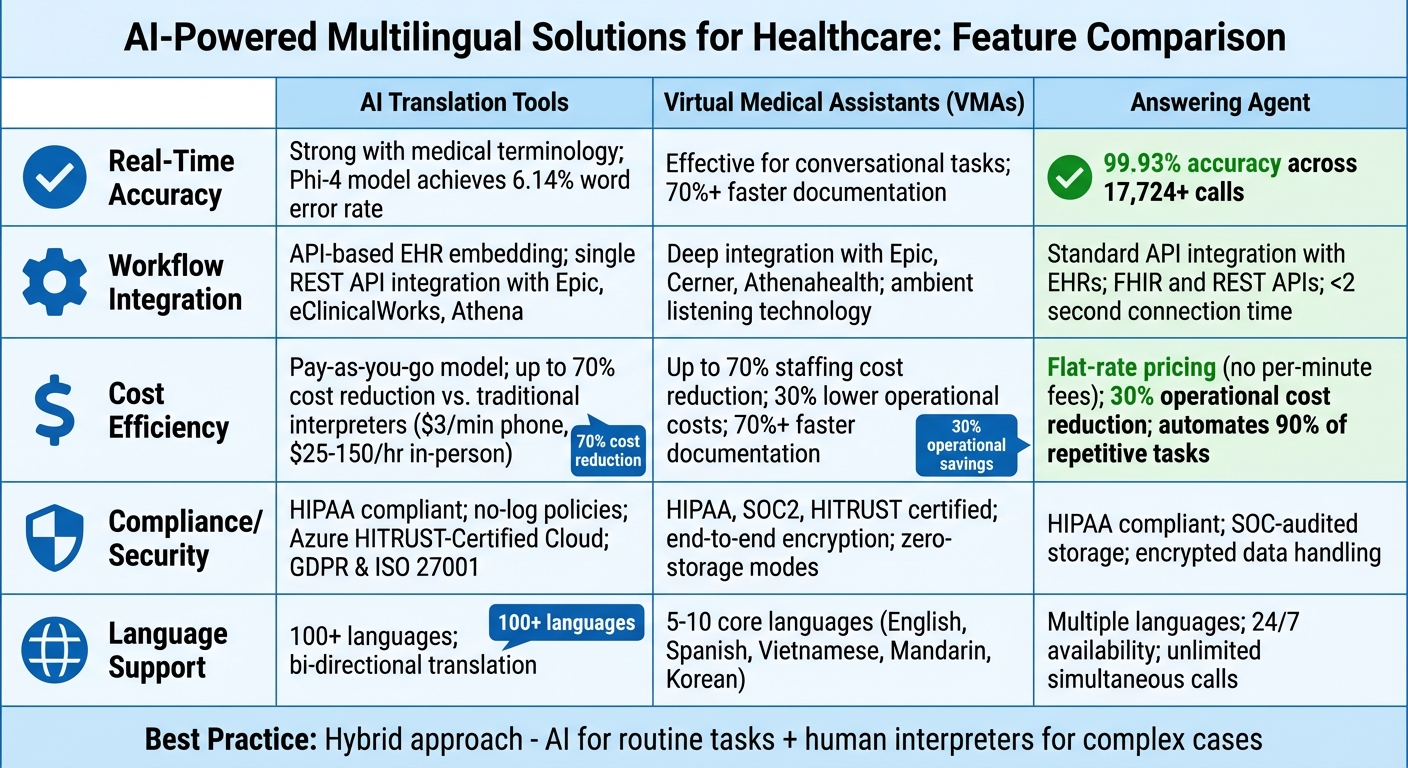
Comparison of AI-Powered Multilingual Healthcare Solutions: Features and Performance
AI-driven multilingual solutions bring a mix of advantages and challenges to medical workflows. For example, AI Translation Tools excel in supporting over 100 languages with impressive accuracy, though they may require human oversight for idiomatic expressions or cultural nuances. Meanwhile, Virtual Medical Assistants integrate deeply with EHR systems and can lower costs by up to 30%, but their language support is limited to a handful of core options. On the other hand, the Answering Agent boasts a stellar 99.93% accuracy rate across 17,724+ calls and handles unlimited simultaneous calls, yet complex or sensitive cases still need human intervention.
Each of these tools plays a key role in improving multilingual medical documentation and communication while balancing efficiency with patient safety. Among these, the Answering Agent stands out due to its high accuracy, flat-rate pricing (avoiding per-minute fees), and reliability for front-office automation.
Here’s a quick comparison of their features and trade-offs:
Feature AI Translation Tools Virtual Medical Assistants Answering Agent Real-Time Accuracy Strong with medical terminology Effective for conversational tasks 99.93% accuracy across 17,724+ calls Workflow Integration API-based EHR embedding Deep integration with systems like Epic Standard API integration with EHRs Cost Efficiency Pay-as-you-go model Cuts costs by up to 30% Flat-rate pricing; no per-minute fees Compliance/Security HIPAA compliant; no data logging HIPAA compliant; encrypted recordings HIPAA compliant; SOC-audited storage Language Support Over 100 languages 5–10 core languages Multiple languages; 24/7 availability
For the best results, a hybrid approach works well: leverage AI for routine administrative tasks and initial triage, but ensure certified human interpreters are available for complex clinical or legal discussions. This strategy strikes the right balance between efficiency and maintaining high-quality patient care.
Conclusion
When it comes to multilingual medical workflows, Answering Agent strikes the right balance between accuracy, seamless integration, and cost control. While tools like No Barrier AI excel in real-time patient interactions and platforms such as Simbo AI or healow Genie cater to specific administrative tasks, Answering Agent sets itself apart. Its standout features include 99.93% accuracy across 17,724 calls, unlimited simultaneous connections, and a transparent flat-rate pricing model. Operating 24/7, it ensures patients always have access without driving up costs. For instance, United Digestive, which handles over a million calls annually, adopted similar AI solutions to provide after-hours support and expand patient access - all without increasing their staffing needs.
As discussed earlier, the best results come from combining AI capabilities with human oversight. A hybrid model - leveraging AI for routine tasks while reserving human interpreters for more complex situations - ensures both efficiency and safety. This approach not only improves accuracy and documentation but also cuts operational costs by about 30%.
However, this shift toward AI-driven multilingual support goes beyond just financial benefits. It directly addresses health equity. Patients with limited English proficiency face a 50% higher risk of harm from medical errors. This makes tools like Answering Agent critical for ensuring accurate and accessible communication, ultimately enhancing patient safety and delivering better health outcomes for diverse communities. By adopting this technology, healthcare providers don't just streamline operations - they actively work to close the language gap, making healthcare safer and more inclusive for everyone.
FAQs
When should a clinic still use a human interpreter?
Clinics should depend on a human interpreter for complex medical decisions, nuanced conversations, or sensitive interactions that involve cultural understanding. These scenarios demand a level of empathy, contextual awareness, and emotional intelligence that AI might not fully grasp, ensuring clear communication and fostering trust.
How does AI connect to my EHR without copying data manually?
AI works seamlessly with your EHR by leveraging advanced speech-to-text and translation tools. It captures, translates, and organizes clinical data directly into the system without requiring manual input. This not only improves accuracy and ensures compliance but also simplifies workflows, saving time and effort.
What proof should I ask for to confirm HIPAA compliance?
When evaluating a vendor's ability to handle protected health information (PHI), it's crucial to request specific documentation or certifications that confirm their compliance with HIPAA regulations. Two key examples to look for include:
- Business Associate Agreement (BAA): This legally binding document outlines the responsibilities of the vendor in protecting PHI and ensures they adhere to HIPAA standards.
- Compliance Attestations: These may include certifications or third-party audits that verify the vendor's adherence to HIPAA requirements.
By reviewing these documents, you can confirm that the vendor meets the necessary standards for safeguarding sensitive health information.
Related Blog Posts
Book a walkthrough
See it handle your calls.
Book 20 minutes, or hear a sample call first.
Ready to see it handle your calls?
Book a walkthrough, or hear a short sample call first.
Related Articles
Healthcare AI Phone Systems: Cost Breakdown
Flat-rate HIPAA-ready AI phone systems cut healthcare call costs, boost response times, and reduce missed patient leads.
How Medical Practices Benefit from HIPAA-Compliant AI Systems
Secure HIPAA-compliant AI automates calls, scheduling, and EHR integration to reduce no-shows, save staff time, and protect PHI.
How NLP Handles Medical Jargon in Multiple Languages
Tokenization, multilingual models, ontologies, and translation pipelines that align medical terminology across languages for accurate clinical NLP.