
AI scheduling systems are transforming how businesses manage appointments, offering lower costs, faster service, and higher accuracy compared to human receptionists. Here’s a quick breakdown:
- Cost: A human receptionist costs $45,000–$75,000 annually, while AI systems range from $1,200–$7,000 per year.
- Availability: Humans work 40 hours/week; AI operates 24/7/365, ensuring no missed calls.
- Accuracy: AI achieves 99% booking accuracy versus 85% for humans.
- Efficiency: AI handles unlimited calls simultaneously, while humans manage one at a time.
- Missed Revenue: Businesses lose an average of $189,068 annually from unanswered calls; AI can prevent these losses.
While AI excels in routine tasks, human receptionists are better for complex or sensitive interactions. A hybrid approach - AI managing 60–80% of calls and humans handling the rest - offers the best balance of cost savings and customer care.
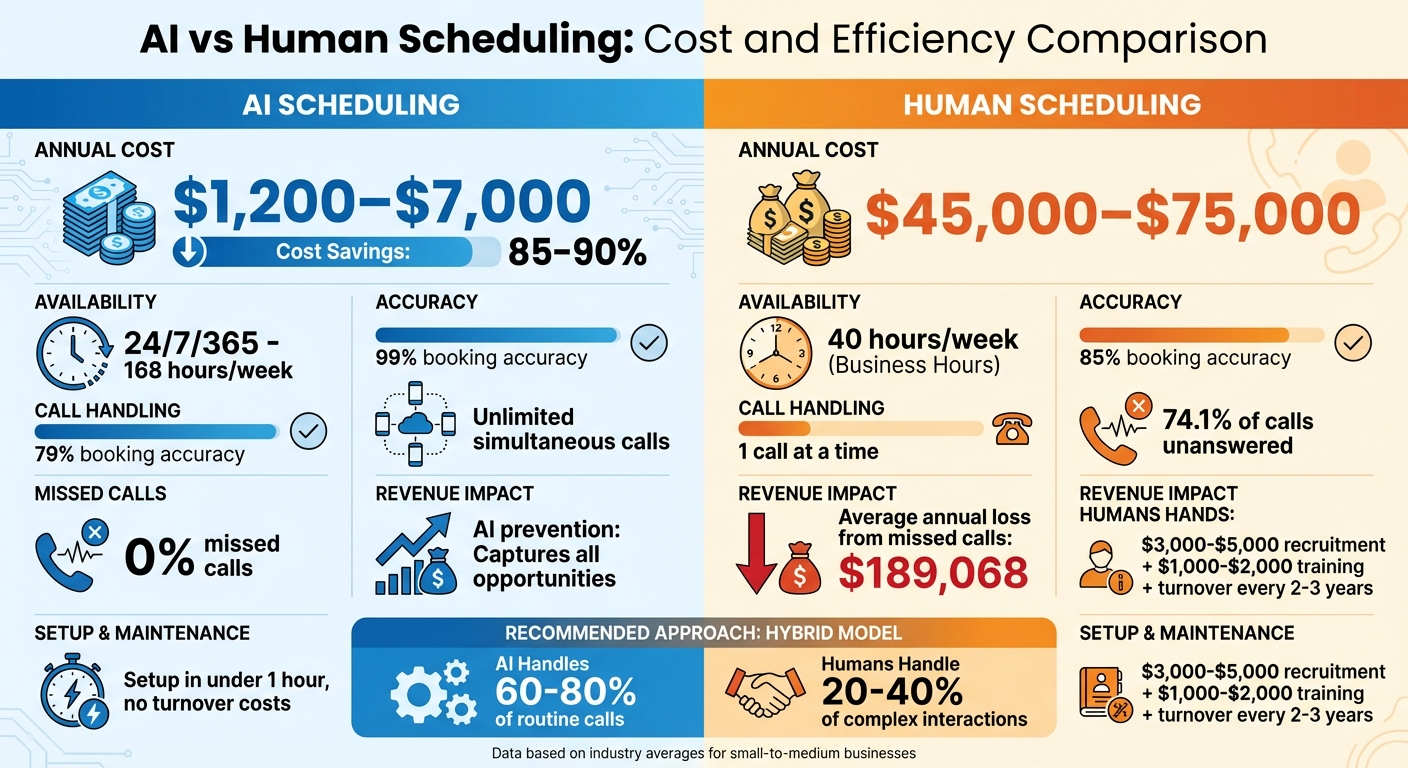
AI vs Human Receptionist Cost and Performance Comparison
Cost Comparison: AI vs Human Scheduling
Direct Costs
When hiring a human receptionist, the listed salary is just the tip of the iceberg. For example, a receptionist with a median base salary of $35,830 ends up costing a business between $56,168 and $62,200 annually when you factor in benefits (adding 29.4% to 35%), payroll taxes (7.65%), and overhead expenses. That breaks down to nearly $5,200 per month for just standard business hours.
In contrast, AI receptionists come with predictable, flat-rate subscription fees. Professional plans average around $199 per month (or $2,388 annually), with starter options as low as $99 per month and enterprise plans ranging from $399 to $699 per month. Even at the higher end, the yearly cost is approximately $8,388 - just a small fraction of what a human receptionist costs. Plus, AI systems provide 168 hours of weekly availability compared to a human's 40-hour workweek, costing only 4% to 15% of the total expense of employing a human. And that’s just the beginning - hidden costs and turnover make the gap even wider.
Hidden Costs and Turnover
Human receptionists come with a host of additional expenses that often go unnoticed. Recruitment alone can cost between $3,000 and $5,000 per hire, covering job postings, background checks, and 15 to 20 hours of management time. Training adds another $1,000 to $2,000, factoring in materials and the productivity loss during a 2–4 week onboarding period. Turnover, which typically happens every 2 to 3 years, incurs replacement costs ranging from 50% to 150% of the annual salary - about $7,500 on average. Then there’s the physical infrastructure, requiring $4,000 to $8,000 upfront and $50 to $150 monthly for software licenses.
AI solutions sidestep these expenses entirely. Setup is quick - often under an hour - and comes with little to no additional fees. There’s no need for benefits administration, no ongoing training, and no turnover-related costs, making expenses predictable and fixed.
Return on Investment Timelines
The cost differences aren’t just stark - they also translate into faster returns. AI receptionists often pay for themselves within the first month, with monthly savings exceeding $4,000 easily offsetting the subscription fee. On the other hand, the ROI for human receptionists can take anywhere from 12 to 24 months due to steep upfront recruitment and training costs.
The financial edge becomes even clearer when factoring in missed revenue. Small businesses lose an average of $189,068 annually from unanswered calls, with 74.1% of calls to home service businesses going unanswered when relying solely on human staff. AI systems solve this issue by handling unlimited simultaneous calls, while human receptionists can only manage one call at a time. Over the first year, an AI solution can deliver an ROI 10 to 20 times the initial investment.
"Gartner predicts $80B in contact center labor cost reduction by 2026, with 1 in 10 agent interactions automated by 2026 versus just 1.6% today." – Gartner
sbb-itb-abfc69c
Efficiency and Scalability: How AI Outperforms Humans
Scalability
AI systems can handle an unlimited number of calls at the same time, a feat that human receptionists simply can’t match. A human receptionist is limited to managing one call at a time, which can lead to busy signals, long hold times, or calls going to voicemail - especially during peak hours or seasonal spikes. In contrast, AI solutions can juggle hundreds or even thousands of interactions simultaneously without missing a beat or compromising performance.
Speed and Call Volume Handling
AI doesn’t just scale better; it’s also faster and more efficient. For example, AI can answer calls within 6–8 seconds and schedule appointments in just 60–90 seconds by syncing directly with a calendar. Compare that to human receptionists, who often need to make multiple follow-up calls or play phone tag to confirm appointments, causing unnecessary delays.
The accuracy of AI is another standout feature. It achieves a 99% accuracy rate for data entry, significantly higher than the 85% accuracy typical of human staff. Similarly, AI reduces appointment booking errors to just 1%, whereas human error rates hover between 8% and 12%. On top of that, AI automatically logs every call into your CRM, complete with transcripts and details, eliminating the risk of manual entry mistakes.
Long-Term Cost Trends
AI doesn’t just outperform in speed and accuracy - it’s also a smarter financial choice in the long run. Human labor costs tend to increase by about 3% annually, while AI subscription fees generally stay steady or even drop as the technology advances. With predictable monthly fees ranging from $199 to $499, AI solutions provide a consistent and budget-friendly option. For businesses with high call volumes or multiple locations, these savings can add up quickly over time.
Accuracy and Reliability: AI vs Human Performance
Accuracy Metrics
AI scheduling tools outperform human receptionists when it comes to accuracy. For example, Answering Agent has achieved an impressive 99.93% accuracy across 17,724 scored calls, with a minimal hallucination rate of just 0.07%. While AI may occasionally falter in 5–10% of unusual scenarios, the comparison of AI receptionists vs. human staff is stark. Human receptionists face a 74.1% failure rate, as three out of every four calls to small service businesses go unanswered when staff are busy, off-duty, or on break. This lack of availability translates to significant losses - over $260,000 in annual revenue for the average contractor. AI, on the other hand, ensures complete coverage and successfully handles 3.5 times more interactions than humans, minimizing missed opportunities and lost revenue.
Consistency
Consistency is where AI truly stands out. It delivers 100% consistent performance, strictly adhering to scripts and protocols every single time. AI doesn’t experience fatigue, mood swings, or personal stress, which often impact human performance. Whether it’s the first call of the day or the last one late at night, AI remains steady and reliable, unlike human receptionists who are prone to errors during busy periods or towards the end of their shifts.
Another advantage is the ability of AI to provide verbatim transcriptions of calls, a level of precision that human receptionists often struggle to maintain. Additionally, AI systems continuously refine their performance through feedback loops, improving accuracy by 2–3% weekly in the initial month of deployment.
Modern AI also excels in understanding caller requests, achieving 90–95% accuracy through natural language processing. This high level of understanding is maintained across unlimited simultaneous calls, with 99.9% uptime, making AI 400 times more available than human-only coverage. This unmatched consistency not only reduces costs but also boosts customer satisfaction and retention, proving the value of AI in scheduling and call management.
Case Studies and Results
Cost Savings Examples
Real-world examples bring the cost and efficiency benefits of AI scheduling tools into sharp focus. As noted earlier, the annual expenses of employing human receptionists can be significant. In contrast, AI scheduling tools are available for around $199 per month for unlimited calls, which translates to an impressive 99.5% cost reduction.
Another key advantage is revenue recovery. Small businesses in home services often miss 74.1% of incoming calls when relying solely on human staff. AI tools ensure every call is answered, recapturing opportunities that might otherwise result in major financial losses. For example, urgent calls - such as those for "emergencies" or "burst pipes" - can generate an average of $4,200 in revenue, which is 20% higher than routine jobs. Capturing these high-value inquiries underscores the importance of leveraging AI for consistent and reliable call handling.
Answering Agent vs Competitors
The top AI tools for appointment scheduling are transforming industries, from legal services to automotive care, by offering unmatched precision and unlimited call-handling capacity. This combination of reliability and affordability is reshaping how businesses manage customer interactions.
When comparing solutions, Answering Agent stands out with measurable results. The platform has successfully processed over 17,724 scored calls with a 99.93% accuracy rate and a minimal 0.07% hallucination rate. Additionally, it has pitched 20,375 offers, with 6,820 accepted, showcasing its ability to drive appointment bookings and convert leads effectively.
For law firms, competitors like Ruby and Smith.ai charge per minute, which can result in fluctuating costs. For instance, Ruby's 500-minute plan costs $1,725, creating the risk of unpredictable bills during busy times. Answering Agent, on the other hand, offers flat-rate pricing with unlimited simultaneous calls, eliminating overage fees entirely. Plus, while Ruby charges an extra $6–$8 per Spanish call, Answering Agent supports over 20 languages at no additional cost.
In the car wash sector, competitors such as HelloWash and Rinsed focus primarily on membership management rather than comprehensive phone answering. Answering Agent provides a more robust solution, capable of handling over 100 calls simultaneously . This ensures prompt service even during peak times. With a 98% caller satisfaction rate, Answering Agent maintains a personal touch, so much so that many customers don’t even realize they’re speaking with AI. This balance of efficiency and customer care makes it an ideal choice for service-driven businesses.
Choosing the Right Scheduling Solution
AI-Human Hybrid Models
Many businesses are discovering the benefits of combining AI with human expertise to create a balanced scheduling solution. Instead of choosing between AI and human receptionists, a hybrid approach uses the strengths of both. AI efficiently manages repetitive, high-volume tasks, while humans handle more complex situations that require creative thinking or empathy.
In an ideal setup, 60–70% of routine calls - like answering FAQs about hours, pricing, service areas, or scheduling basic appointments - are managed by AI. Meanwhile, 25–30% of calls are handled by human callbacks for more detailed or nuanced inquiries, and 5–10% are routed directly to humans for urgent or sensitive issues, such as emergencies or highly personalized requests.
For businesses hesitant about fully automating their scheduling, starting small can be a smart move. For instance, deploying AI for after-hours coverage - nights, weekends, and holidays - can help capture the 35–45% of leads that typically call outside regular business hours. This approach not only eases the transition but also maximizes the value of AI without fully replacing human involvement.
Why Answering Agent Is the Best Choice
When it comes to hybrid scheduling solutions, Answering Agent stands out as a reliable and cost-efficient platform. It seamlessly combines AI-driven efficiency with human support, ensuring no lead goes unnoticed.
The platform’s track record speaks for itself: it has pitched 20,375 offers, with 6,820 accepted, demonstrating its ability to convert leads into revenue. Unlike competitors that charge per minute or impose call limits, Answering Agent offers flat-rate pricing starting at $199/month, eliminating surprise fees. It also supports over 20 languages at no additional cost, and its AI is so well-designed that most customers don’t even realize they’re speaking to a machine.
With its combination of accuracy, scalability, and transparent pricing, Answering Agent offers a practical solution for businesses looking to improve customer interactions and streamline their scheduling processes.
Replacing Humans with A.I. (A Documentary Reviewed)
Conclusion
AI scheduling tools offer undeniable cost savings, improved efficiency, and consistent performance compared to human receptionists. The earlier challenges discussed show that adopting or integrating AI can address key inefficiencies that often plague service businesses.
For example, businesses losing 74% of incoming calls can directly tackle this issue with AI. These tools operate 24/7, handle unlimited simultaneous calls, and achieve an impressive 99% data accuracy - far surpassing the 85% accuracy rate of human agents. By capturing after-hours leads, eliminating busy signals during peak times, and responding to calls within 6–8 seconds, AI ensures no opportunity slips through the cracks.
The best results come from a hybrid model that blends AI and human expertise. Let AI manage routine calls - around 60–70% - while your human team focuses on complex situations and building relationships. This approach boosts efficiency while preserving the personal touch that matters in high-value interactions. The result? Recovered revenue and a clear path to long-term growth.
A great example of this balance is Answering Agent. Their results speak for themselves: 99.93% accuracy across 17,724+ calls, 6,820 accepted offers from 20,375 pitches, and straightforward pricing starting at $199/month with no hidden fees or per-minute charges. For businesses looking to recover lost revenue and grow efficiently, AI scheduling is the solution that delivers.
FAQs
What types of calls should be handled by a human?
Calls that involve empathy, tailored judgment, or intricate problem-solving are best handled by humans. Examples include addressing complaints, managing delicate situations, or negotiating significant sales deals. While AI tools like Answering Agent are great for straightforward tasks like scheduling appointments or responding to FAQs, human involvement is crucial when emotional intelligence or careful decision-making is required.
How hard is it to set up AI scheduling with my calendar and CRM?
Setting up AI scheduling with your calendar and CRM is usually a straightforward process. Most tools are built to work effortlessly with platforms like Google Calendar, Outlook, and widely-used CRMs. The setup typically involves a few quick steps, such as authenticating your accounts or installing plugins. In many cases, you can have everything up and running in just minutes to an hour. These systems are designed to be intuitive, so you don’t need advanced technical skills to start automating tasks like appointment bookings and follow-ups.
How do I measure ROI after switching to AI scheduling?
To determine ROI, start by comparing the total expenses associated with your previous human scheduling system - this includes salaries, benefits, and training costs - with the lower annual cost of AI solutions like Answering Agent (ranging from $199 to $3,700). Monitor key metrics such as the number of calls handled, appointment bookings made, and missed calls. Pay attention to accuracy rates, like 99.93%, and customer satisfaction levels. Don’t forget to account for additional revenue from increased bookings and the savings you gain from reduced overhead and lower employee turnover.
Related Blog Posts
Book a walkthrough
See it handle your calls.
Book 20 minutes, or hear a sample call first.
Ready to see it handle your calls?
Book a walkthrough, or hear a short sample call first.
Related Articles

How to Handle Pickleball Membership Cancellation Calls
How pickleball club desks handle membership cancellation calls without inventing policy or fighting the member.

How to Handle Failed Payment Calls on a Car Wash Membership
How wash desks handle failed payment and card-update calls on a membership without turning the call into a gate lockout.

Car Wash Membership Phone Calls: A Desk Guide
A desk guide to the membership phone calls car washes take, with links to the deep how-tos.