Ruby vs AI Scheduling: Which Fits Your Law Firm?
When it comes to managing calls for your law firm, the choice between Ruby's human receptionists and AI scheduling tools boils down to balancing personal interaction with automation. Here’s the key takeaway:
- Ruby: Offers U.S.-based human receptionists who provide empathy and a personal touch, ideal for sensitive legal matters. Pricing is based on call minutes, starting at $250/month for 50 minutes, with costs increasing as call volume grows.
- AI Scheduling Tools: Provide 24/7 immediate responses, unlimited call handling, and flat-rate pricing (around $199/month). These tools excel in speed, scalability, and cost predictability, making them suitable for firms with high call volumes.
Quick Comparison
| Feature | Ruby (Human Receptionists) | AI Scheduling Tools |
|---|---|---|
| Response Speed | Under 10 seconds | Under 5 seconds |
| Call Capacity | Limited by human staff | Unlimited simultaneous calls |
| Pricing | Per-minute billing | Flat monthly rate |
| Integration | Manual CRM sync | Automated real-time sync |
| Language Support | English & Spanish | 60+ languages |
| 24/7 Availability | Optional, extra cost | Standard |
If your firm handles a high volume of calls or needs predictable costs, AI tools like Answering Agent are a cost-effective choice. For firms prioritizing empathy and human interaction, Ruby may be a better fit.
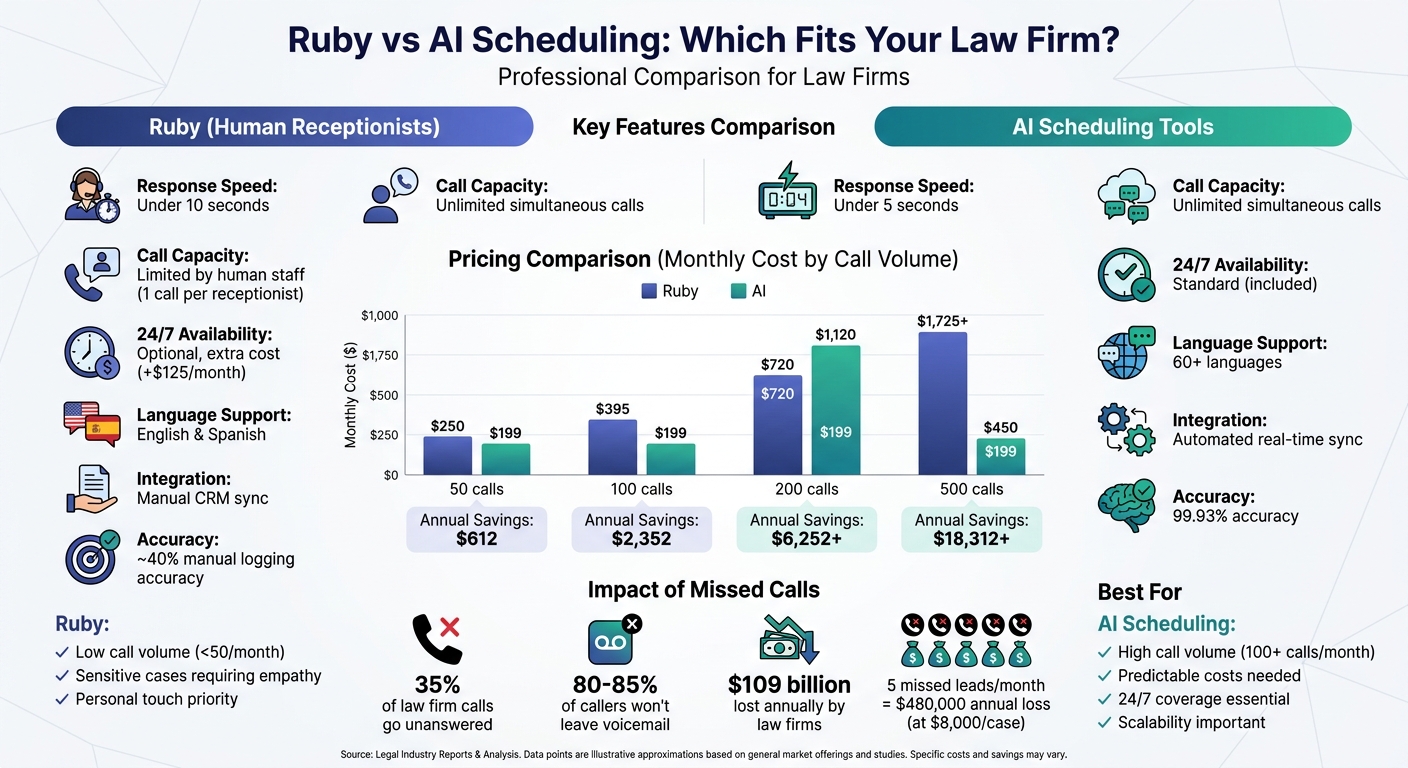
Ruby vs AI Scheduling Tools: Feature and Cost Comparison for Law Firms
AI Answering Service for Lawyers (Full Setup + Sample Call)
sbb-itb-abfc69c
What Ruby Virtual Receptionists Offer
Ruby provides 24/7/365 U.S.-based human receptionists, ensuring every caller interacts with a real person - never an automated system or voicemail. This personal touch is especially important for law firms handling sensitive cases, as the ROI of virtual receptionists often hinges on client trust like family law or personal injury, where empathy and understanding are crucial.
Ruby's Main Features
Ruby's receptionists answer 98% of calls within 9 seconds or less, using branded, customized scripts tailored to your firm's needs. They also offer bilingual support in English and Spanish at no additional charge and handle legal intake and lead qualification using detailed questionnaires (see our AI call handling lead conversion tips for more on automating this process).
The service integrates seamlessly with tools like Google Calendar and legal practice management software, including Clio, MyCase, and Rocket Matter, enabling real-time scheduling and consultation booking. With the Ruby mobile app, you can easily manage availability and call preferences on the go. Additionally, Ruby's team can make outbound calls to confirm appointments, relay messages, or follow up with clients. They even assist with secure retainer payments.
Ruby prioritizes security, offering HIPAA compliance and signing Business Associate Agreements for firms handling sensitive medical-legal information. The service also includes advanced spam filtering, ensuring robocalls don't waste your plan minutes.
How Ruby Works for Law Firms
When a potential client calls, a Ruby receptionist answers with your firm's name and greeting, following your specific instructions. They screen callers and collect essential case details, tailoring their approach to meet your legal intake needs. For new clients, receptionists gather information for conflict checks, such as opposing parties and case types, and escalate urgent matters based on your preferences.
"Ruby goes above and beyond for me. They will note my preferences and remember them during phone calls, and they even take initiative to contact me immediately on all of my numbers when a court clerk calls for an upcoming case."
– Andrew Bahr, Attorney
While Ruby employs AI-powered tools to assist with tasks like data entry, every caller interacts with a live receptionist. Nearly half of Ruby's customers are solo and small law firms, and 90% of Ruby customers capture more billable hours than the national attorney average. This focus on personalized client engagement sets Ruby apart from automated tools.
Ruby Pricing
Ruby operates on a per-minute billing model, with "receptionist minutes" billed in 30-second increments. Their tiered subscription plans are outlined below:
| Plan | Monthly Price | Minutes Included | Effective Cost Per Minute |
|---|---|---|---|
| Grow | $250 | 50 | ~$5.00 |
| Growth | $395 | 100 | ~$3.95 |
| Expand | $720 | 200 | ~$3.60 |
| Advanced | $1,725 | 500 | ~$3.45 |
All plans include U.S.-based receptionists, the mobile app, and bilingual support. Higher-tier options offer added benefits like lead qualification, CRM integrations, priority support, and dedicated account managers. Ruby also offers live chat-only plans starting at $140/month for 10 chats. Overage minutes are charged at the plan's effective per-minute rate.
Next, we’ll compare Ruby’s offerings and pricing with AI scheduling tools to help you decide which option best suits your law firm’s needs.
What AI Scheduling Tools Offer
AI scheduling tools take care of tasks like call handling, lead qualification, and appointment booking without human intervention. For law firms, this means they can capture 40–60% of website traffic that happens outside regular office hours. Whether attorneys are in court, meeting clients, or the office is closed, these tools ensure every call is answered immediately.
AI Scheduling Features
Modern AI scheduling platforms are impressively fast, answering calls in under 5 seconds and managing unlimited calls simultaneously. They qualify leads by asking key questions about jurisdiction, case type, and urgency, then route calls to the right attorney based on their practice area. For example, family law inquiries go to family law attorneys, while criminal defense calls are directed to criminal attorneys.
These tools integrate seamlessly with legal practice management software like Clio and MyCase, syncing appointment details automatically - no manual data entry required. They also gather opposing party information for conflict checks, send automated reminders via SMS and email to reduce no-shows, and even collect consultation deposits. For urgent matters, they detect keywords like "arrested" or "statute of limitations" and notify on-call attorneys immediately.
Benefits of AI Scheduling for Law Firms
The time savings are substantial. AI scheduling can cut paralegal and receptionist phone time by 50–70%, allowing staff to focus on billable tasks rather than fielding calls. This is critical because about 80% of callers won’t leave a voicemail - they’ll simply move on to the next firm. AI tools ensure no call is missed.
Cost predictability is another major plus. Unlike Ruby’s per-minute pricing model, which can fluctuate during busy times, AI scheduling platforms often charge a flat monthly fee - around $199 - for unlimited calls. For firms handling 500+ calls a month, this can result in costs that are 5–10 times lower than those associated with human receptionists, all while maintaining consistent, high-quality service.
Answering Agent for Law Firms

Among the available options, Answering Agent is a standout choice. Designed specifically for service businesses like law firms, it has handled over 17,724 scored calls with an impressive 99.93% accuracy (just a 0.07% hallucination rate). It books appointments around the clock using a natural, conversational tone.
Unlike Ruby’s per-minute billing, Answering Agent offers unlimited call capacity on a flat monthly rate, ensuring predictable expenses. It integrates effortlessly with legal CRMs and calendars, capturing lead details and scheduling consultations without requiring staff involvement. For firms struggling with missed after-hours calls or unpredictable receptionist costs, Answering Agent provides a scalable, cost-effective solution to keep operations running smoothly.
Ruby vs AI Scheduling: Feature Comparison
When deciding between Ruby and AI scheduling tools, law firms need to balance the value of personal interaction with the efficiency of automation. Ruby depends on live receptionists to manage calls, while AI scheduling tools handle calls, appointments, and lead qualification without human intervention.
One major distinction is in call handling speed and capacity. Ruby's receptionists typically answer calls in under 10 seconds. On the other hand, AI tools respond in under 5 seconds and can handle an unlimited number of calls simultaneously. This is a crucial advantage, especially since up to 80% of callers may not leave a voicemail and could instead turn to a competitor.
Appointment booking is another area where the two differ significantly. Ruby receptionists rely on manual entry, which can sometimes result in errors. AI platforms, however, automatically sync with calendars like Google Calendar or Outlook to check real-time availability, avoiding calendar sync errors and double bookings. They also push appointment details directly into legal CRMs such as Clio or MyCase with complete accuracy. These differences highlight the operational gap between human and AI approaches.
Industry experts sum up the comparison well:
"AI receptionists provide 24/7 availability, speed, and lower costs, while human receptionists offer empathy, trust, and personal interaction." – OpenMic.ai
For law firms looking for a scalable AI solution, Answering Agent is a standout option. It offers 24/7 availability with 99.93% accuracy across over 17,724 scored calls, unlimited simultaneous call handling, and straightforward flat-rate pricing.
Feature Comparison Table
| Feature | Ruby (Human-First) | AI Scheduling Tools |
|---|---|---|
| Handling | Live human; answers in under 10 seconds | AI voice; answers in under 5 seconds |
| Booking | Manual entry | Automated booking with real-time calendar sync |
| Clio/MyCase Integration | Basic message/appointment sync | Fully integrated, two-way sync |
| Scalability | Limited by human capacity; costs increase with usage | Unlimited concurrent calls; flat-rate pricing |
| Language Support | English & Spanish | Support for 60+ languages |
| Reporting | Basic call summaries | Detailed transcripts with CRM logging |
| 24/7 Coverage | Available, often at premium rates | Standard 24/7/365 coverage |
In the next section, we'll delve into pricing models to help you better evaluate which solution aligns with your firm's needs.
Ruby vs AI Scheduling: Cost Comparison
Ruby operates on a per-minute billing system, while AI scheduling platforms typically use flat monthly fees. This creates a noticeable gap in how costs add up, especially for businesses with varying call volumes. Let’s break down the numbers.
Ruby’s pricing starts at US $250/month for 50 minutes and can go up to US $1,695/month for 500 minutes. If you exceed your plan's minutes, overage charges range from US $3.39–US $5.40 per minute. Optional features, like after-hours coverage (an extra US $125/month) or billing for hold time, can further increase costs.
AI scheduling tools, on the other hand, offer flat-rate pricing. For example, NextPhone charges US $199/month for unlimited calls, while ClaireAI plans range from US $195 to US $450/month, all without overage fees. For law firms, services like Answering Agent provide 24/7 AI phone answering with flat rates, unlimited simultaneous calls, and a reported 99.93% accuracy across over 17,724 scored calls. This eliminates the financial strain of per-minute billing.
On average, law firms spend US $387/month on answering services, but 23% of firms overpay by US $200 or more monthly because their pricing model doesn’t match their call volume needs.
Here’s how the costs stack up:
- For 100 calls/month, Ruby costs approximately US $395, while AI platforms cost US $199, saving about US $2,352 annually.
- At 200 calls/month, Ruby’s costs jump to US $720–US $1,120, compared to US $199–US $450 for AI, resulting in annual savings exceeding US $6,252.
- For firms managing 500 calls/month, Ruby’s pricing exceeds US $1,725/month, while AI services remain at US $199–US $450, creating yearly savings of over US $18,312.
Pricing Comparison Table
| Monthly Call Volume | Ruby (Est. Cost) | AI Flat‑Rate (Est. Cost) | Annual Savings with AI |
|---|---|---|---|
| 50 calls | US $250 | US $199 | US $612 |
| 100 calls | US $395 | US $199 | US $2,352 |
| 200 calls | US $720–US $1,120 | US $199–US $450 | US $6,252+ |
| 500 calls | US $1,725+ | US $199–US $450 | US $18,312+ |
It’s also worth noting that costs can vary by practice area. For instance, criminal defense firms average US $523/month, while estate planning firms spend closer to US $265/month. Family law firms often face higher costs, as emotionally charged calls can quickly deplete minute-based plans.
With these cost differences in mind, the next step is to evaluate how integration, performance, and scalability factor into choosing the right solution for your law firm.
Legal Software Integrations
Ruby works seamlessly with Clio Manage, Clio Grow, MyCase, and Rocket Matter, covering many of the most common legal practice management tools. When a call comes in, Ruby's receptionists manually log and sync call data into these systems. For Clio Manage, this process includes linking communications to specific matters and contacts, which helps with time tracking and billing. Additionally, call data integrates into Clio Grow's Matter Pipeline, simplifying client intake. For legal software that Ruby doesn't natively support, firms often rely on Zapier to fill the gap.
AI scheduling tools take a more automated route. Platforms like Smith.ai offer direct integrations with Clio, Lawmatics, CASEpeer, Assembly Neos, Lawcus, and MyCase. Using HTTP webhooks and open APIs, these tools automatically push call data into your CRM. This means new leads are created, contact details are updated, and workflows are triggered without any manual intervention. Smith.ai also connects to over 5,000 apps through Zapier and Make, expanding its integration capabilities.
Answering Agent provides even more flexibility with its customizable integration options. It syncs call data, appointment bookings, and lead information directly into your existing legal software. With an impressive 99.93% accuracy rate across 17,724+ scored calls, it ensures reliable data capture - eliminating the need for manual logging. The setup process is quick, taking anywhere from 15 minutes to 2 days, compared to Ruby’s 3 to 7 days of operator training.
The depth of integration plays a major role in streamlining workflows. Ruby’s receptionists manually verify calendar availability, while AI tools perform real-time conflict checks by accessing calendars directly. For firms managing heavy call volumes or intricate intake processes, automated systems reduce bottlenecks caused by manual data entry. Practices using advanced CRM features like lead scoring or automated intake forms should lean toward AI-driven tools with native integrations. On the other hand, firms with lower call volumes (fewer than 50 calls per month) and basic Clio or MyCase usage might find Ruby’s manual sync sufficient - though it’s worth noting that per-minute billing can increase costs during lengthy calls.
These differences in integration approaches lay the groundwork for assessing performance and scalability in the next section.
Performance and Scalability
When evaluating systems for handling calls, performance under high call volumes is just as important as integration features, especially for law firms.
Ruby's performance is inherently tied to the capacity of its human operators. During busy periods - like a marketing campaign launch or a surge in calls due to a major news event - callers may face delays, waiting on hold or being sent to voicemail. Since each receptionist can only manage one call at a time, increasing call volume requires upgrading to more expensive plans, which can quickly escalate costs.
The best AI tools for appointment scheduling, on the other hand, don’t have this limitation. Take Answering Agent as an example - it can handle an unlimited number of calls simultaneously with an impressive 99.93% accuracy across over 17,724 scored calls. Whether 10 or 100 people call at the same time, every call is answered in under 5 seconds. Not only does it respond faster, but it also captures lead information with 99.93% accuracy, far outperforming the roughly 40% accuracy rate of manual logging. Similarly, Smith.ai boasts a 99.7% answer rate, and modern AI platforms consistently maintain a 99% caller satisfaction rate.
The contrast in scalability becomes even more apparent as law firms expand. Ruby’s pricing is based on call minutes, meaning costs increase linearly with call volume. Plans range from $245/month for 50 minutes to $1,695/month for 500 minutes, with overage fees between $3.95 and $5.40 per minute. In comparison, AI tools like Answering Agent offer flat-rate pricing - around $199/month for unlimited calls. This means that even during a sudden spike in call volume, costs remain steady. As Justas Butkus, Founder & CEO of AInora, explains:
"Whether you receive 10 calls or 1,000 calls per day, the AI scales without additional cost or setup".
While Ruby’s human receptionists may work well for firms with minimal call traffic, those dealing with high volumes, multiple locations, or seasonal fluctuations benefit significantly from AI’s ability to scale instantly. With AI, the 500th call of the day gets the same level of service as the first. For law firms expecting heavy or unpredictable call traffic, AI scheduling tools clearly outperform Ruby's human-dependent model in both scalability and cost-effectiveness.
Which Solution Fits Your Law Firm?
Deciding between Ruby and AI scheduling tools comes down to key factors like call volume, budget stability, and your firm's growth plans. If your firm fields over 80–100 calls per month, AI tools like Answering Agent often provide better cost efficiency and performance. Ruby's per-minute pricing can lead to fluctuating bills as your firm expands, while AI tools typically offer flat-rate pricing - usually around $199 per month for unlimited calls. This pricing model can be especially appealing in competitive practice areas where time is critical.
For firms in fields like personal injury or criminal defense, speed is a game-changer. Answering Agent picks up calls in less than 5 seconds with an impressive 99.93% accuracy rate across 17,724+ scored calls, significantly outpacing Ruby's standard response times. Considering that 35% of law firm calls go unanswered and 85% of potential clients won’t leave a voicemail, faster response times can directly impact your firm's revenue.
Scalability is another crucial factor, particularly for firms aiming to grow. Answering Agent supports unlimited simultaneous calls at a flat rate. On the other hand, Ruby’s human operators can only handle one call at a time, often leading to hold queues during busy periods. This limitation can result in costly plan upgrades, especially during seasonal spikes or marketing campaigns. With AI, you avoid the "growth penalty" tied to per-minute pricing.
Missed calls vs. AI answering can have a massive financial impact. Studies show law firms lose about $109 billion annually due to unanswered calls, and just five missed leads per month could cost a firm $480,000 annually, assuming an average case value of $8,000. With 24/7 availability, seamless integration with tools like Clio and MyCase, and instant CRM updates, Answering Agent delivers a scalable, budget-friendly solution for high-volume firms. For those prioritizing cost control, reliability, and unlimited growth potential, Answering Agent stands out as the smarter choice.
FAQs
How do I know if my call volume is high enough to switch to AI?
If you're facing rising call volumes, relying on human-based services like Ruby can quickly become expensive. For instance, monthly costs might jump from $280 to $720 as call volume grows from 50 to 150 calls. Once your call load exceeds 100–150 calls per month, AI-driven options like Answering Agent provide a cost-effective alternative. They offer unlimited, 24/7 call handling at a fraction of the cost, making them a practical solution for managing high call volumes.
Will an AI scheduler handle conflict-check questions correctly?
AI schedulers, especially when paired with AI receptionist platforms, are built to manage conflict-check questions with a high degree of accuracy. They excel at automating routine tasks like answering common inquiries, sorting calls, and collecting essential information. For situations that require more nuanced judgment or sensitivity, these systems often escalate the matter to human agents. This combination of automation and human oversight makes them a dependable choice for handling conflict checks in many legal settings.
How hard is it to connect AI scheduling to Clio or MyCase?
Connecting AI scheduling tools to Clio is a manageable process using calendar syncs and document-based event extraction. Clio integrates seamlessly with Google Calendar and Microsoft Office 365, allowing for smooth syncing. It also offers the ability to generate events directly from uploaded documents, streamlining scheduling.
For MyCase, integration typically involves using calendar feeds or setting up APIs. This process may require some technical assistance, depending on the complexity of the AI tool and your firm's technical expertise. Overall, the level of difficulty is moderate and varies based on your available resources and the specific tool being implemented.
Related Blog Posts
See how AI handles calls for your business
Enter your business name and we'll build a personalized AI receptionist demo in under 2 minutes. Talk to it right in your browser.
No signup required · Free to try · Works for any business
Related Articles
AI Call Answering ROI for Franchise Businesses
AI phone agents recover missed calls, cut receptionist costs, and boost franchise revenue with 24/7 accurate call handling.
How AI Handles 1,000+ Calls/Month for Law Firms
AI phone systems answer calls 24/7, qualify leads, schedule consults, integrate with CRMs, and reduce revenue lost from missed calls.
AI Call Handling ROI: Productivity Metrics Explained
AI call agents cut missed calls, halve average handle time, raise first-contact resolution, and recover lost revenue.