AI Dispatch vs. Manual Scheduling
AI dispatch systems outperform manual scheduling in every measurable way. They save time, reduce errors, cut costs, and improve productivity. Manual scheduling relies on outdated tools like spreadsheets and phone calls , often lacking the efficiency of AI call routing, leading to inefficiencies, higher costs, and lost opportunities. In contrast, AI systems use real-time data for AI phone scheduling to optimize schedules, boost job completions, and lower fuel expenses.
Key Takeaways:
- Manual Scheduling: Time-consuming (17 minutes per job), error-prone (10-15% error rate), and inefficient (20% productivity loss).
- AI Dispatch: Increases productivity by 29%, reduces delays by 67%, and saves $28,320 annually on fuel for a 5-technician team.
- Cost Savings: AI systems deliver a 340% ROI in the first year, while manual methods lead to unnecessary expenses.
- Real-World Impact: AI reduces drive time by 1 hour/day per technician, enabling 1–2 extra jobs daily and higher revenue.
Switching to AI dispatch is no longer optional - it’s a practical way to improve operations, save money, and keep customers happy.
AI vs Manual Dispatching: Traditional Dispatch vs AI Dispatch Explained
sbb-itb-abfc69c
Problems with Manual Scheduling
Before diving into the advantages of AI-powered dispatching, it’s important to take a closer look at the challenges that come with manual scheduling. This approach depends heavily on disconnected tools - like spreadsheets, whiteboards, sticky notes, and phone calls - that don’t sync in real-time. This lack of integration often leads to double-bookings, especially when appointments come in from different channels at the same time.
Errors and Slow Processing
Manual scheduling is prone to mistakes, with an error rate of 10% to 15%. Each error comes with a hefty price tag, costing between $100 and $200 on average. These errors also disrupt operations, as 1 in 5 appointments ends up being rescheduled or canceled due to scheduling failures. Worse yet, 43% of small businesses lose at least one client per month because of missed appointments or scheduling mistakes.
Time is another major issue. Handling scheduling, modifications, and cancellations manually eats up hours. Dispatchers can lose an entire day just managing the calendar, which becomes even more problematic during peak periods. Miscommunication and poor time estimates exacerbate the problem - 47% of technicians say appointments don’t go as planned due to these issues. Over time, these delays snowball, especially during busy seasons.
Difficulty Scaling During Busy Periods
Manual systems struggle to keep up when demand spikes. Whether it’s the lunch rush or a seasonal surge, dispatchers can only manage a limited number of variables at once. They can’t account for real-time factors like traffic, technician skills, parts availability, or equipment needs. This inability to adapt leads to missed opportunities - 28.5% of business calls come in after hours, and 51.5% of callers express urgency. Manual methods simply can’t keep up with this level of demand.
Emergencies or last-minute changes, like a sick technician or an urgent job, further highlight the limitations of manual systems. Dispatchers have to rely on extra phone calls and manual tweaks, which slows everything down. This inefficiency results in 14% of truck rolls being unnecessary, and for the worst-performing companies, the avoidable dispatch rate climbs to 24%. Customers notice these issues - late or missed appointments make them four times more likely to switch to a competitor. The inability to scale effectively not only frustrates customers but also drags down technician productivity.
Higher Fuel Costs and Lower Technician Productivity
Inefficient routing is another major drawback of manual scheduling. Without automated tools, dispatchers often create routes that waste time and fuel. As a result, field service technicians spend 15% of their working hours just traveling between jobs, while 30% of their time goes to administrative tasks. This leaves them with only about half their day for actual billable work.
Take the example of a plumbing service in Jerome, Idaho. Their technicians averaged just 3.5 jobs per day due to poor routing and high fuel costs. After adopting smart routing, they increased their daily job completion by 35%, boosting it to 4.5–5 jobs per technician, while also saving $3,600 annually on fuel costs. The math is straightforward: cutting drive time by just one hour per day allows a technician to complete 1 to 2 extra jobs. Route optimization can reduce travel distances and fuel expenses by up to 21%.
Beyond costs, inefficient routing also impacts employee satisfaction. Long drive times - especially when they exceed 50 minutes between jobs - contribute to technician turnover. With the industry projected to face a shortage of nearly 499,000 workers by 2026, losing skilled technicians due to poor scheduling is a problem businesses can’t afford to ignore.
Benefits of AI-Powered Dispatch Systems
AI-powered dispatch systems tackle the challenges of manual scheduling by processing multiple variables at once. These systems analyze real-time GPS data, technician certifications, traffic patterns, parts availability, job complexity, and historical duration metrics simultaneously. This data-driven approach eliminates the delays, errors, and inefficiencies that often plague manual scheduling, delivering measurable improvements in operations.
Real-Time Optimization and Dynamic Scheduling
Unlike static manual schedules, AI systems continuously update workloads using live data. If a technician calls out sick or an emergency job arises, the system instantly redistributes assignments to keep disruptions minimal , similar to how AI call routing for multi-location businesses manages high-volume incoming requests. Machine learning also identifies patterns like recurring traffic issues or seasonal spikes, enabling more precise and adaptable scheduling.
These systems group nearby appointments into geographic clusters, cutting down on "windshield time". Additionally, they assign complex tasks to technicians with the right certifications and proven expertise, reducing troubleshooting time and callbacks. The results? Companies using AI dispatch tools report a 39% faster resolution time and a 21% improvement in repair accuracy.
Boost in Daily Job Completions
AI systems make it possible for technicians to complete 20% to 30% more jobs per day without increasing work hours. For example, in November 2025, a four-technician HVAC company in Twin Falls, Idaho, adopted AI scheduling. By cutting average daily drive time from 2.3 hours to 1.6 hours per technician, they increased daily job completions from 16 to 22. This change boosted their weekly revenue by $6,000, adding up to $312,000 annually. The owner highlighted that AI scheduling allowed technicians to focus more on billable work instead of excessive driving.
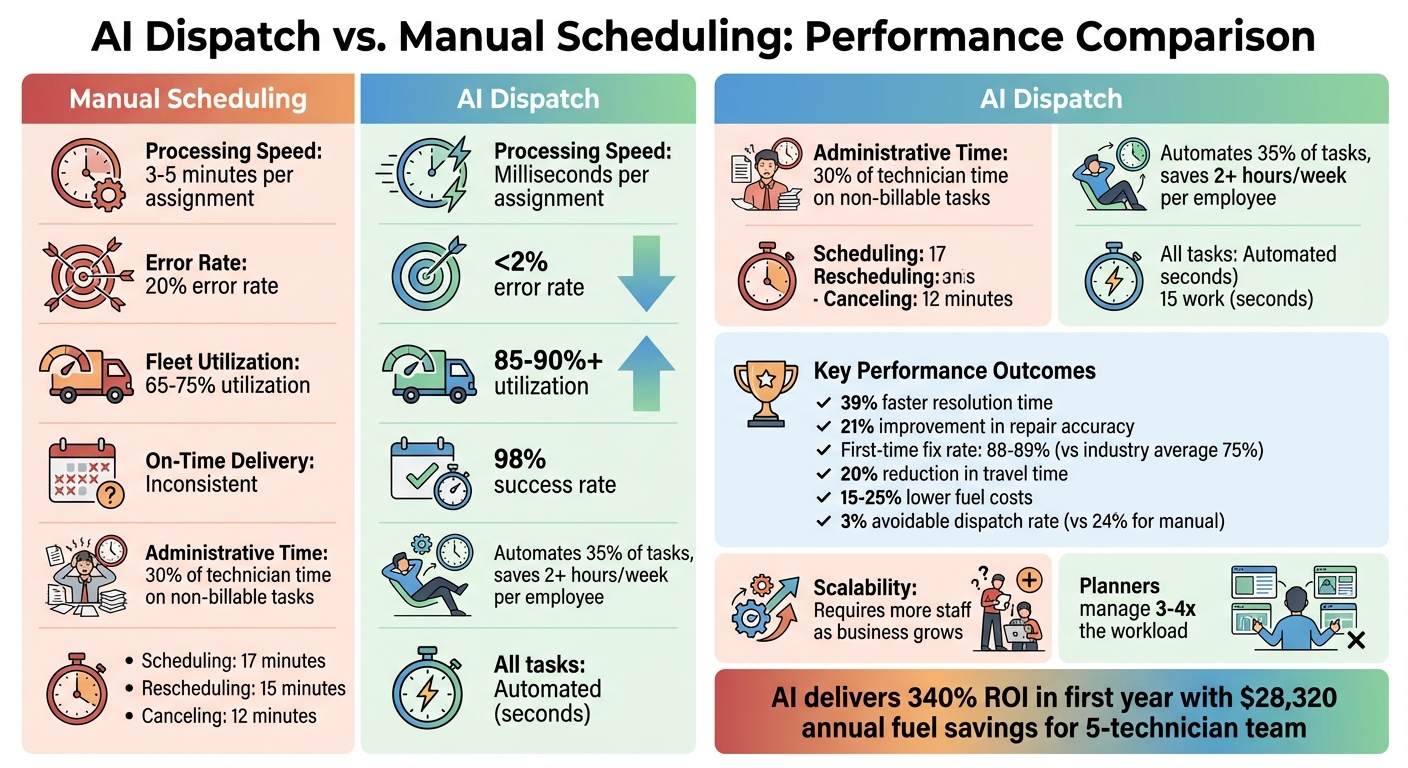
AI also reduces the burden of administrative tasks, often managed through a checklist for implementing 24/7 AI phone answering, which often take up 30% of a technician's working hours in manual systems. Scheduling a single service visit manually takes an average of 17 minutes, rescheduling takes 15 minutes, and canceling takes 12 minutes. AI tools automate 35% of these tasks, saving each employee over two hours per week. This leads to a 29% productivity boost and a 67% reduction in job delays per week.
Lower Costs and Environmental Benefits
AI dispatch systems address the high costs of fuel and inefficiencies caused by manual routing, delivering significant financial savings. On average, AI scheduling achieves a 340% ROI in the first year. By reducing travel time, organizations save on fuel expenses, with a typical five-technician team saving $28,320 annually. Top-performing organizations using AI report avoidable dispatch rates as low as 3%, compared to 24% for those still relying on manual methods. The financial disparity between high- and low-performing field service teams can reach $1.8 million annually.
AI also calculates route carbon footprints and optimizes assignments to reduce fuel consumption, helping businesses meet ESG (Environmental, Social, and Governance) objectives. By aligning technician skills with job requirements, it minimizes repeat "truck rolls", which are among the most expensive aspects of service operations. As Riten Debnath, Founder of Fueler, explains:
"The 'truck roll' is the single most expensive heartbeat of a service-based business".
Performance Comparison: AI vs. Manual Scheduling
AI Dispatch vs Manual Scheduling: Performance Metrics and Cost Comparison
Key Performance Indicators (KPIs) Comparison
The differences between AI and manual scheduling are striking when you look at the numbers. For starters, manual dispatching takes 3–5 minutes per assignment, while AI completes the same task in milliseconds. There’s also a big gap in error rates: manual methods result in mistakes about 20% of the time, while AI keeps errors under 2%.
Fleet utilization is another area where AI shines. Manual systems typically use 65%–75% of available resources, leaving about 25% idle. In contrast, AI-powered systems boost utilization to 85%–90% or even higher. On-time delivery also improves significantly, with AI systems achieving a 98% success rate, far outpacing the inconsistency of manual scheduling.
The administrative workload is another key difference. Manual scheduling forces technicians to spend roughly 30% of their time on non-billable tasks like coordination and paperwork. AI automates about 35% of these tasks, freeing up over two hours per week per employee. Tasks like common scheduling problems like rescheduling and canceling appointments are also much faster with AI.
These measurable improvements translate into better customer experiences and more streamlined operations.
How These Metrics Affect Field Service Operations
The impact of these KPIs on field service operations is profound. Companies using AI scheduling tools report a 39% faster resolution time and a 21% boost in repair accuracy. First-time fix rates, which average around 75% in the industry, jump to 88%–89% for top performers using AI. By reducing errors and downtime, AI not only improves efficiency but also enhances the customer experience.
Travel efficiency is another area where AI delivers immediate cost savings. Cutting just one hour of daily drive time allows technicians to add one or two extra jobs to their schedules. AI systems reduce travel time by 20% and lower fuel costs by 15%–25%. When it comes to scaling operations, manual systems require more staff as the business grows. AI, on the other hand, allows each planner to manage three to four times the workload, making growth far more cost-effective.
Combining AI Dispatch with AI Phone Answering: Answering Agent

Pairing AI dispatch with a phone answering system takes scheduling and lead management to the next level. Together, they create a seamless flow from handling customer calls to booking appointments.
Automated Appointment Booking and Lead Capture
AI phone agents work like virtual office managers, using natural language processing to answer calls 24/7 and schedule appointments directly into a technician's calendar. This system achieves incredible "speed to lead", converting calls into jobs in as little as 30 seconds. It also auto-fills work orders with critical customer details, eliminating the need for manual data entry and freeing up technicians' time.
The system is smart enough to differentiate between emergency and standard service requests, prioritizing high-urgency calls automatically. Plus, it can handle unlimited calls simultaneously, ensuring no leads slip through the cracks - even during busy periods or after hours. Considering that 35% of service calls occur outside regular business hours, this capability is a game-changer.
24/7 Call Handling with 99.93% Accuracy
Answering Agent has already processed over 17,724 scored calls with an impressive 99.93% accuracy rate, resulting in 6,820 accepted offers out of 20,375 pitches. It answers calls in under a second with no hold times, a stark contrast to the 15–45 seconds typical for human dispatchers. This translates to a 99.9% answer rate and 99%+ booking accuracy, far surpassing the 75%–85% answer rate and 92%–97% booking accuracy of human counterparts.
The AI integrates seamlessly with platforms like ServiceTitan, Housecall Pro, and Jobber, updating technician schedules in real-time. It’s programmed to recognize urgent keywords like "burning smell" or "sparking", escalating life-safety issues to on-call technicians immediately. This level of precision improves service quality while cutting operational costs.
Affordable Solution for High Call Volumes
The cost comparison is eye-opening. A human dispatcher costs between $47,402 and $62,044 annually, with an additional $5,000–$15,000 for overtime after-hours coverage. In contrast, Answering Agent costs just $1,188 to $4,788 annually for 24/7 service. Over five years, the savings are staggering: $237,010–$310,220 for a human dispatcher versus $5,940–$23,940 for the AI system.
"The technology essentially pays for 10+ years of service with a single year's savings compared to a full-time dispatcher." - AgentZap
Unlike human receptionists, who can only manage one call at a time, Answering Agent handles multiple calls simultaneously, making it an ideal solution for businesses of all sizes. This scalability ensures every lead is captured, even during peak call times, without increasing staff.
Conclusion: Why AI Dispatch Beats Manual Scheduling
The numbers speak for themselves: AI dispatch systems consistently outperform manual scheduling in every key area. Companies using AI tools see a 29% boost in productivity and a 67% drop in job delays per week. Top-performing teams using AI maintain an avoidable dispatch rate of just 3%, compared to 24% for those relying on manual methods.
The financial benefits and AI receptionist ROI are equally striking. AI scheduling delivers an impressive 340% ROI in the first year, with a typical five-technician team saving $28,320 annually just on fuel costs. The gap between high- and low-performing field service teams can reach a staggering $1.8 million annually.
Pairing AI dispatch with tools like Answering Agent takes these advantages even further. By capturing the 28.5% of calls that come in after hours and booking them directly into optimized schedules, businesses can operate seamlessly around the clock. Answering Agent has processed over 17,724 scored calls with 99.93% accuracy, leading to 6,820 accepted offers out of 20,375 pitches. And it does all this at a fraction of the cost: $1,188–$4,788 annually, compared to the $47,402–$62,044 cost of a human dispatcher.
For field service businesses looking to stay competitive in 2026, the choice is clear: stick with outdated manual scheduling and risk falling behind, or embrace AI systems that deliver 39% faster resolution times and 21% higher repair accuracy. Adopting AI-driven solutions isn’t just about keeping up with technology - it’s about making a smart, strategic move toward greater efficiency and customer satisfaction.
FAQs
How hard is it to switch from manual scheduling to AI dispatch?
Switching from manual scheduling to AI-powered dispatch has become much simpler with recent technological progress. This transition involves adopting AI tools that handle scheduling automatically, cut down on mistakes, and streamline operations. While the process does require some upfront effort - like setting up the system, training staff, and integrating data - the payoff is significant. Businesses often see improved accuracy, smarter use of resources, and reduced costs, making it a smart move for many field service companies.
What data does AI dispatch need to optimize routes and schedules?
AI-powered dispatch systems analyze various factors like technician skills, estimated job durations, customer availability, traffic conditions, and real-time updates. By processing this data, these systems streamline routes and schedules, leading to better resource management and more efficient service operations.
Can Answering Agent book jobs after hours and update schedules automatically?
Answering Agent is designed to handle after-hours job bookings seamlessly. It provides features like 24/7 appointment booking, rescheduling, and conflict detection, making scheduling more straightforward and ensuring appointments are managed efficiently.
Related Blog Posts
Author
Answering Agent
Related Articles
AI Concierge for Small Hotels: ROI Breakdown
Analyze costs, revenue gains, and payback for AI concierge solutions that reduce front-desk expenses and recover missed bookings.
White-Label AI Solutions for Multi-Location Businesses
How white-label AI handles unlimited calls, syncs leads with CRMs, and reduces multi-location staffing costs while keeping consistent brand voice.
Call Analytics in AI Feedback Loops
How real-time call analytics and AI feedback loops boost lead conversion, accuracy, and 24/7 scalability.