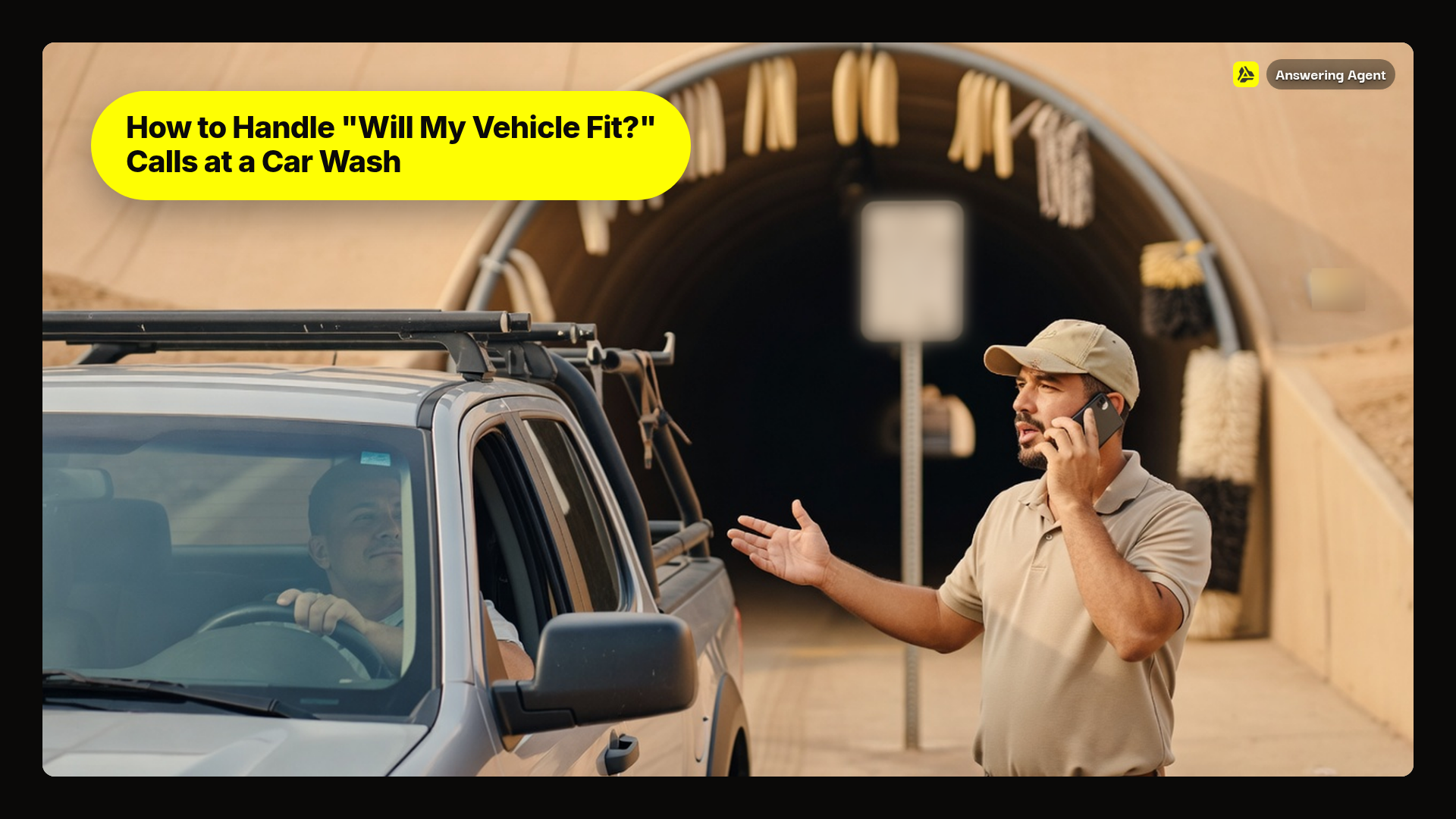
A good fit call ends with a caller who knows what to do before they drive over: pull into the tunnel, take the bike rack off first, head to the self-serve bay, or wait for the site manager's callback. The tunnel attendant gets a note with the vehicle and the answer.
I work these calls next to wash CX teams. Ask for the vehicle and everything on it, then read the matching line off the wash's written vehicle restrictions. The desk never guesses a clearance it cannot see.
What is the first question on a "will my vehicle fit?" call?
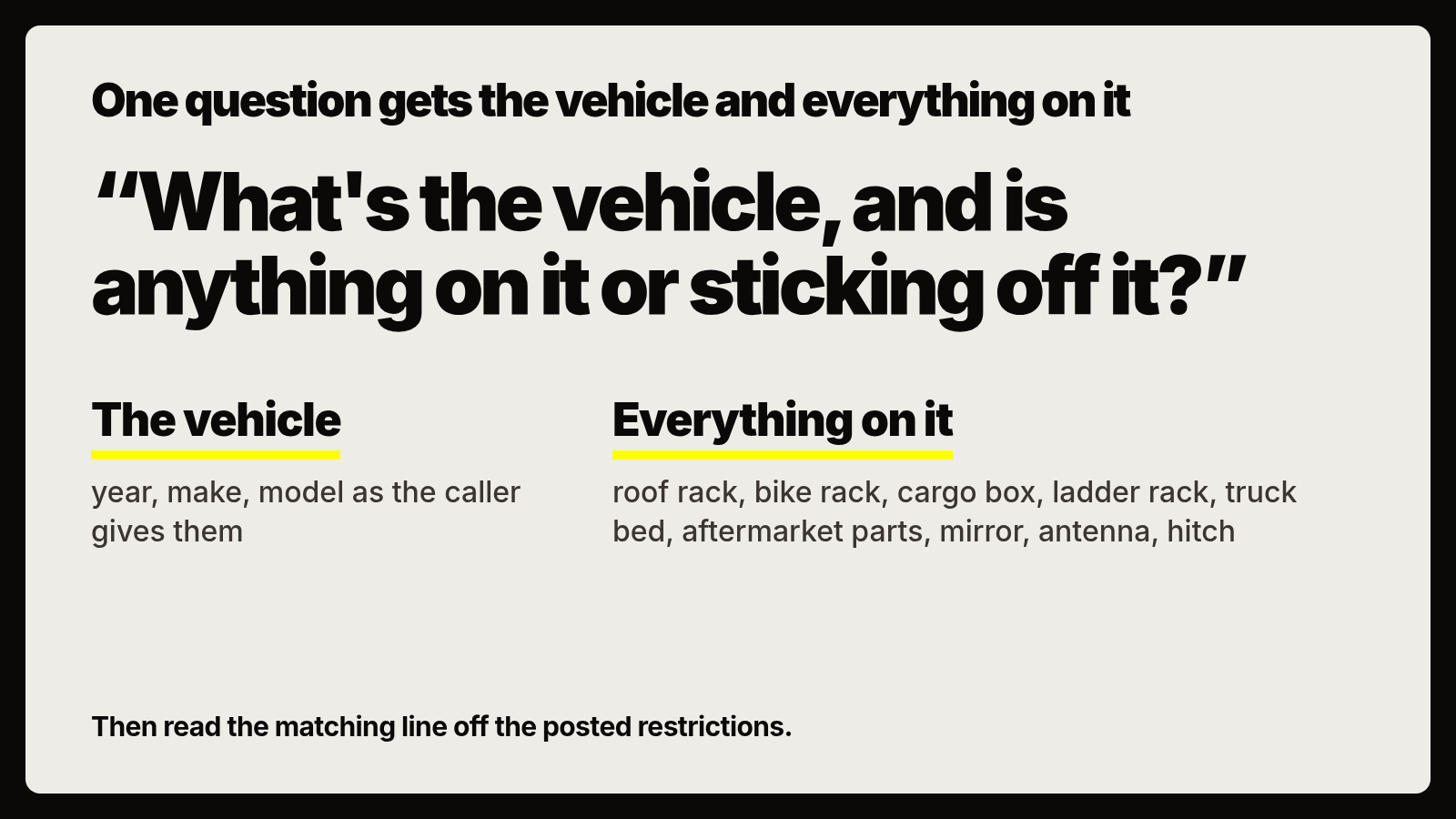
Ask for everything at once: "What is the vehicle, and is anything on it or sticking off it?" That gets the year, make, and model plus the roof rack, ladder rack, bed contents, and aftermarket mirrors in one pass. Then the desk can read the right line on the sheet the first time.
"What's the vehicle, and is anything on it or sticking off it?"
The second half of the question surfaces the long antenna, the hitch accessory, and the tonneau cover before the desk commits to an answer.
The sheet the desk reads should match the restrictions sign at the entrance and the restrictions page on the wash's website. If the three disagree, tell the site manager today.
| What the caller has | Sheet line to read | Answer type | Read back | Do not promise |
|---|---|---|---|---|
| Lifted truck | Height limit, lifted-truck rule | Yes, no, or manager | The posted limit, for the caller to check | That the lift "looks fine" |
| Dually or wide tires | Dually and wide-tire lines | Yes, no, or manager | The exact sheet line | That the conveyor will take it |
| Roof rack, bike rack, cargo box | Rack and cargo box lines | Yes, yes after removal, or no | The prep step, word for word | That leaving it on is okay "this once" |
| Ladder rack | Ladder rack line | Yes, yes after removal, or no | The prep step, if listed | That it counts as a roof rack |
| Truck bed with loose items | Truck bed rule | Yes, yes after securing or emptying, or no | How the bed must look at the entrance | That a few loose things are fine |
| Tonneau cover | Tonneau line | The line, or manager | The sheet line | That their cover type is included |
| Aftermarket wheels, mirrors, parts | Aftermarket line | The line, or manager | The sheet line, or the manager callback | That nothing will happen to them |
| Mirror or long antenna | Mirror and antenna lines | Yes, yes after folding or removing, or no | The prep step | That the antenna will just bend |
| Trailer, boat, hitch accessory | Trailer and hitch lines | The line, or manager | The sheet line, or "the manager decides" | Anything the sheet does not list |
What is the desk playbook for a vehicle fit call?
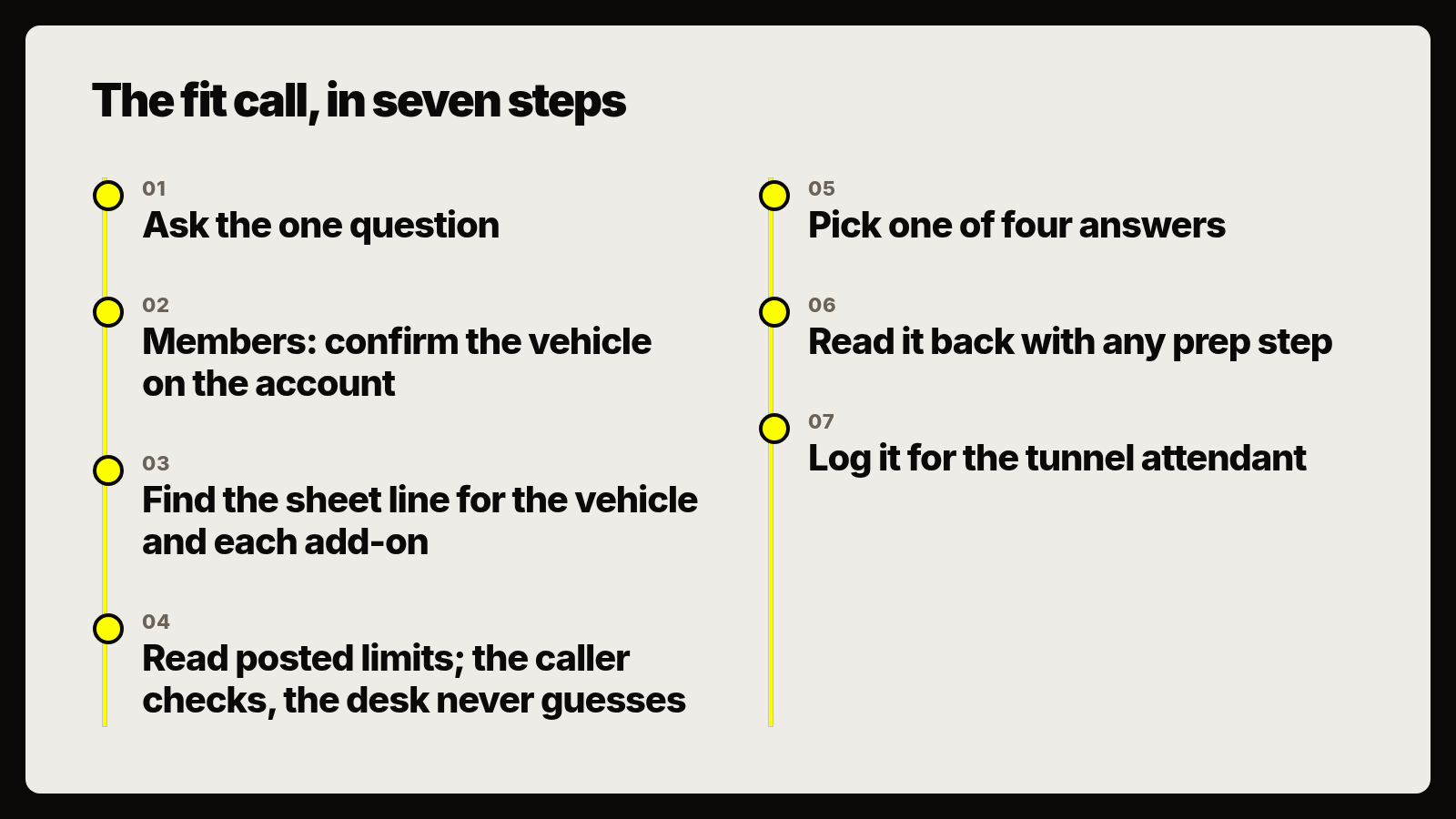
Work in this order. Get the vehicle and every add-on in one question, find the matching sheet line, pick the answer type, read it back with any prep step, and log it so the attendant at the entrance is not surprised. Anything the sheet does not answer goes to the site manager.
Ask the one question. Write down the year, make, and model as the caller gives them, plus every add-on they name
If the caller is a member, pull the vehicle on the account and confirm it matches what they described
Open the written vehicle restrictions sheet and find the line for the vehicle and each add-on
For a posted limit like the height limit, read the limit and ask the caller to check their vehicle against it. The desk does not measure, estimate, or judge from a description
Pick one of the four answers
Read the answer back with any prep step or other option, and ask the caller to repeat the prep step
Log the vehicle, the add-ons, the sheet line, and the answer in the desk note where the tunnel attendant and site manager will see it
What are the four answers the desk can give?
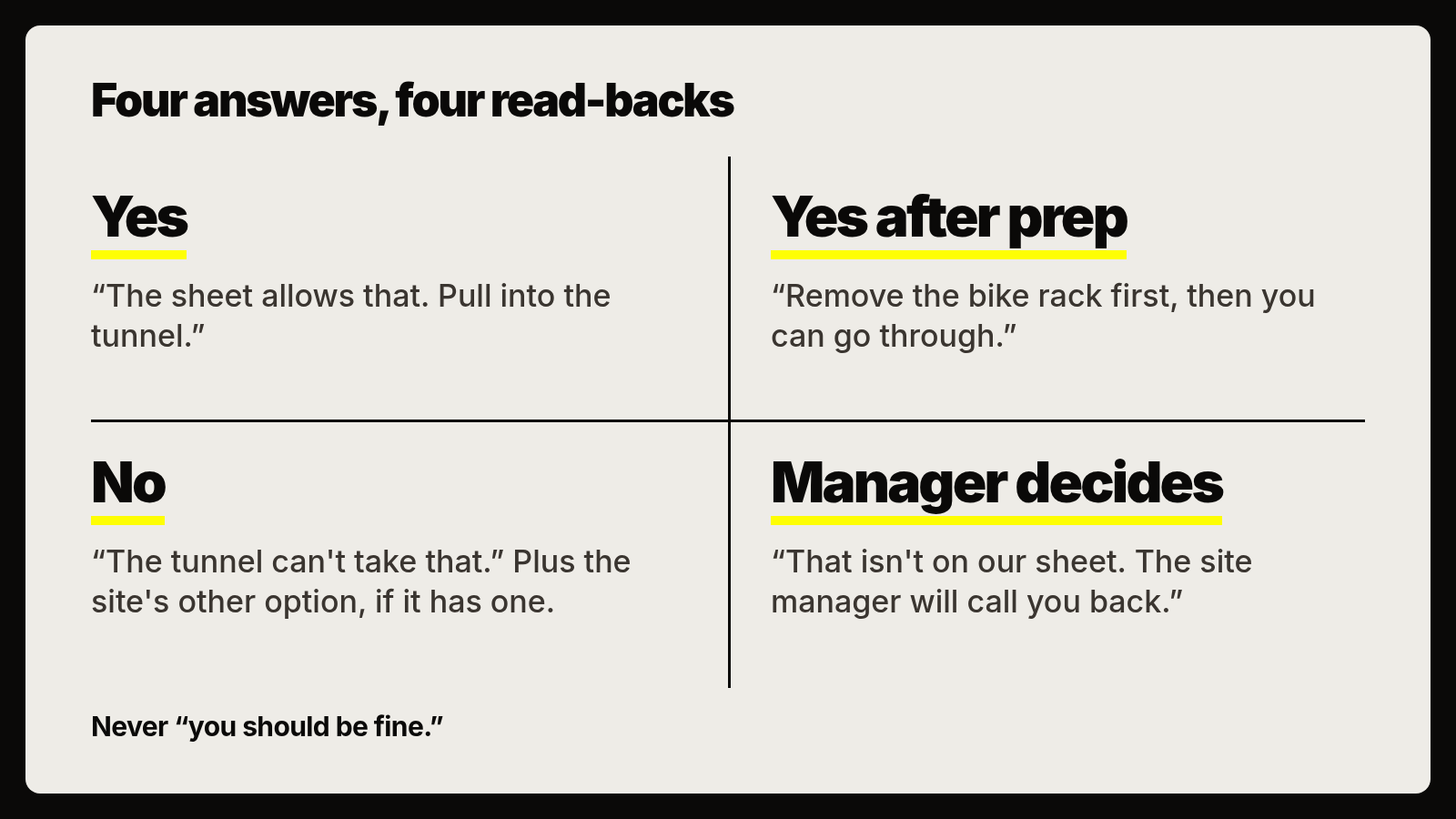
There are four answers, and each one gets its own read-back. Yes means pull in. Yes after means do the prep step first. No means the tunnel cannot take it, plus the site's other option if one exists. Manager means the sheet is silent and someone who can see the vehicle decides.
| Answer | When | What the desk says | Next step |
|---|---|---|---|
| Yes | The sheet allows the vehicle and every add-on | "The restrictions sheet allows that. You can pull into the tunnel." | Log it |
| Yes after prep | The sheet allows it once something is removed, folded, emptied, or secured | "The sheet says to remove the bike rack before entering. Once it's off, you can go through." | Read the prep step back, log it |
| No | The sheet does not allow the vehicle or an add-on | "The tunnel can't take that, per the posted restrictions." Name the self-serve bay, touchless lane, or hand wash if the site has one. | Offer the other option, log it |
| Manager decides | The sheet does not cover it, or the caller can't tell if they're within a posted limit | "That isn't on our restrictions sheet, so the site manager makes that call. Here's when you'll hear back." | Name the callback owner and window, log it |
Keep the four separate. A "yes after" read like a plain yes sends a bike rack to the tunnel entrance. A "no" without the other option leaves the caller nowhere to go. If the site has no other option, say so.
What if the restrictions sheet does not cover it?
If the sheet is silent, the site manager decides, and the desk says so out loud. Name who will call back and when, using the callback window the site manager has agreed to. Never fill the gap with "you should be fine." That sentence makes the desk own a clearance call it cannot see.
Read it back like this: "Our restrictions sheet doesn't cover that, so I'm sending it to the site manager. They'll call you back. Please hold off on the tunnel until you hear from them." Log the vehicle and the open question so the manager has the details.
When a question like a specific tonneau type or hitch accessory has no line on the sheet, ask the site manager to add one and update the entrance sign and website page at the same time.
What happens when the call turns into a damage claim or a membership change?
Answer the fit question first, then switch playbooks. A fit call is about a visit that has not happened yet. When the caller shifts to something that already happened, or to a change on their account, the desk follows that how-to instead and logs the fit answer it already gave.
If the caller says the wash already damaged the vehicle, follow the steps for car wash damage claim calls. If a member wants the truck on their plan, use the playbook for adding a vehicle to a car wash membership. Commercial vans, work trucks, and company accounts go through fleet account calls at a car wash. The car wash membership phone calls desk guide covers the rest of the member desk's calls.
What belongs in the desk note?
The desk note carries the vehicle, the add-ons, the sheet line read, and the answer, so the tunnel attendant and the next shift see what the caller was told. If the site manager is deciding, the note says who owes the callback, by when, and what is still open.
FIT CALL NOTE
Caller: [name, phone]
Member or non-member: [member / non-member, account if member]
Vehicle (as given): [year, make, model]
Add-ons named by caller: [every add-on the caller named]
Sheet line read: [quote the line]
Answer type: [yes / yes after prep / no / manager]
Prep step read back: [what the caller agreed to remove, fold, empty, or secure]
Other option offered: [self-serve bay / touchless lane / hand wash / site has none]
Manager follow-up: [owner, promised callback window]
Open item and owner: [what is unresolved, who has it]
Quote the sheet line word for word, so the attendant at the entrance reads the same words the caller heard.
What should a wash check before handing fit calls to phone coverage?
Check that the coverage follows the same playbook the desk does. It should ask one question for the vehicle and add-ons, read only from the restrictions sheet you approve, and never say "you should be fine." It should send anything off the sheet to the site manager and log every answer for the attendant.
-
Asks for the vehicle and every add-on in one question.
-
Reads only from the sheet you approve.
-
Never promises clearance.
-
Routes anything off the sheet to the site manager with a named callback owner.
-
Reads back the answer and any prep step before the call ends.
-
Leaves a note the attendant and the next shift can act on.
Answering Agent is one option to test against that list. The agent picks up and responds in about a second and a half. About two out of three calls are handled start to finish without needing a human. Read about car wash phone coverage, AI phone answering, and Answering Agent pricing.
Start by pulling your written restrictions sheet and checking it against the entrance sign and the website page. Then run the next fit call through the playbook above.
FAQ
Can a lifted truck go through an automatic car wash?
The desk reads the height limit and lifted-truck rule from the wash's written restrictions sheet, then asks the caller to check their truck against the posted limit. The desk does not measure, estimate, or judge a lift from a description. If the caller can't tell whether they're within the limit, the site manager decides.
Do I need to take my roof rack or bike rack off before a car wash?
It depends on what the wash's restrictions sheet says. The answer can be yes, yes after removal, or no. If the sheet says to remove the rack first, the desk reads that prep step word for word and asks the caller to repeat it. The desk never says leaving it on is okay "this once."
Will a dually truck fit in a car wash tunnel?
The desk reads the dually and wide-tire lines on the restrictions sheet exactly as written and gives yes, no, or a manager callback. It never promises the conveyor will take the truck. If the tunnel can't, the desk names the self-serve bay, touchless lane, or hand wash if the site has one.
Is it safe to take aftermarket wheels or mirrors through a car wash?
The desk won't promise that nothing will happen to aftermarket parts. It reads the aftermarket line on the wash's restrictions sheet. If that line doesn't settle the question, the site manager makes the call, and the desk tells the caller who will call back and when. Until then, the caller should hold off on the tunnel.
What should a car wash say when the restrictions sheet doesn't cover a vehicle?
Say that the sheet doesn't cover it and the site manager will decide. Name who will call back and give the agreed callback window. Ask the caller to hold off on the tunnel until they hear back. Never say "you should be fine," because that makes the desk own a clearance call it cannot see.
What should a car wash log after a vehicle fit call?
Log the vehicle as the caller gave it, the add-ons they named, the sheet line quoted word for word, the answer type, and any prep step or other option offered. If the site manager is deciding, note who owes the callback, by when, and what is still open, so the tunnel attendant sees it.
Book a walkthrough
See it handle your calls.
Book 20 minutes, or hear a sample call first.