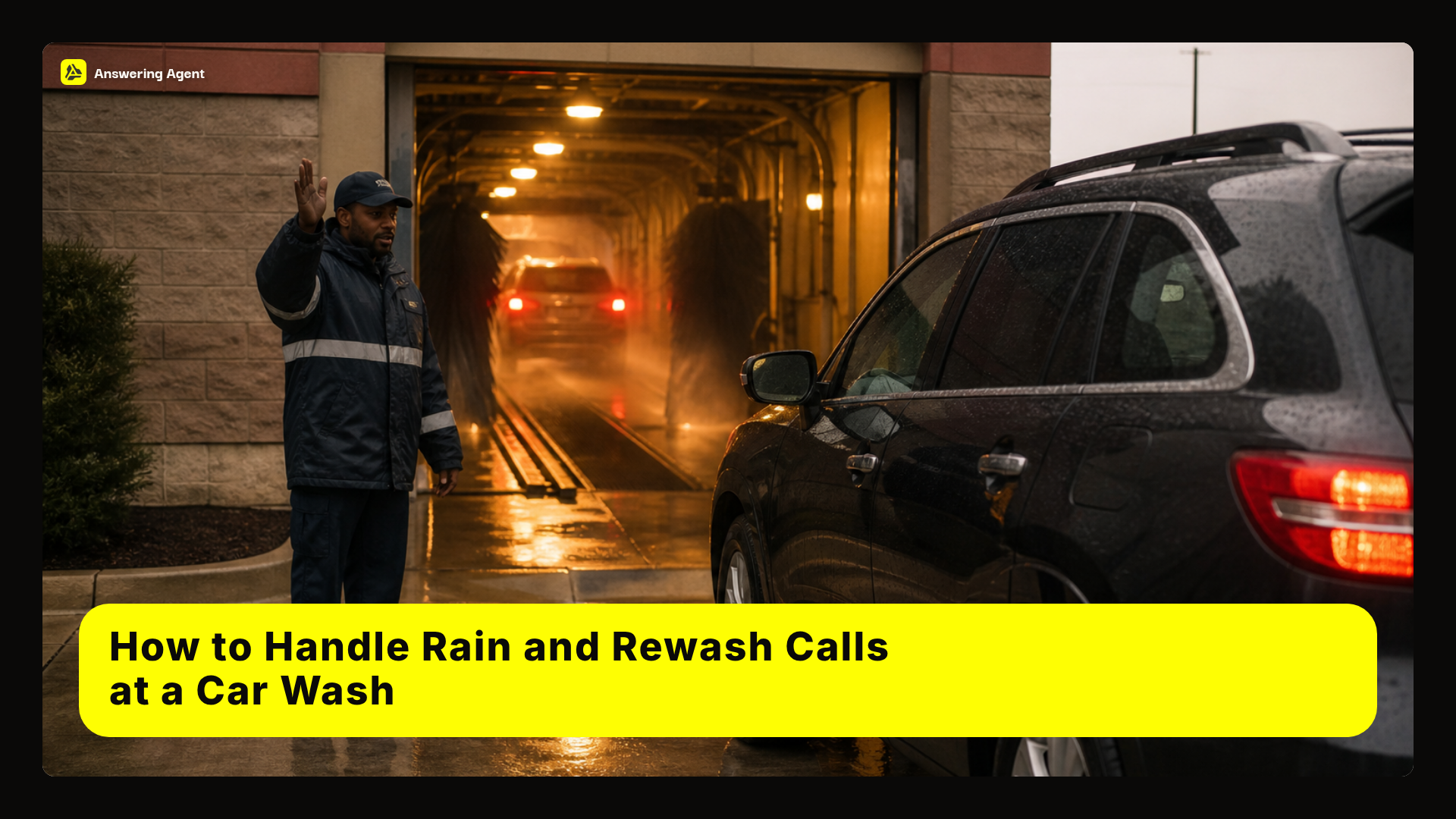
When it rains and the phone rings, do three things. Say whether you are washing right now. Name your rain policy and rewash rule out loud. Give one clear next step: pull in, come back at a stated time, or take your rewash.
The first minutes of a storm fill the phone with short questions. Most of them get no clear answer.
Why do people call about rain and rewashes?
Rain makes people unsure, and they want a straight answer from someone at the wash. Most rain callers fall into four groups:
- Hours checkers. They assume rain means closed and do not want to drive across town to find cones in the lane.
- Rewash callers. They already washed, then spots showed up or the storm hit on the drive home. They feel like they paid for nothing.
- Members. They mostly want to know the tunnel is open. A new member may ask whether a rainy wash is wasted. It is not, so tell them.
- Rain check seekers. They want a guarantee before they spend twenty dollars on a wash the sky might ruin.
Car washes that answer all four cleanly keep those people coming onto the lot.
What should you actually do on that call?
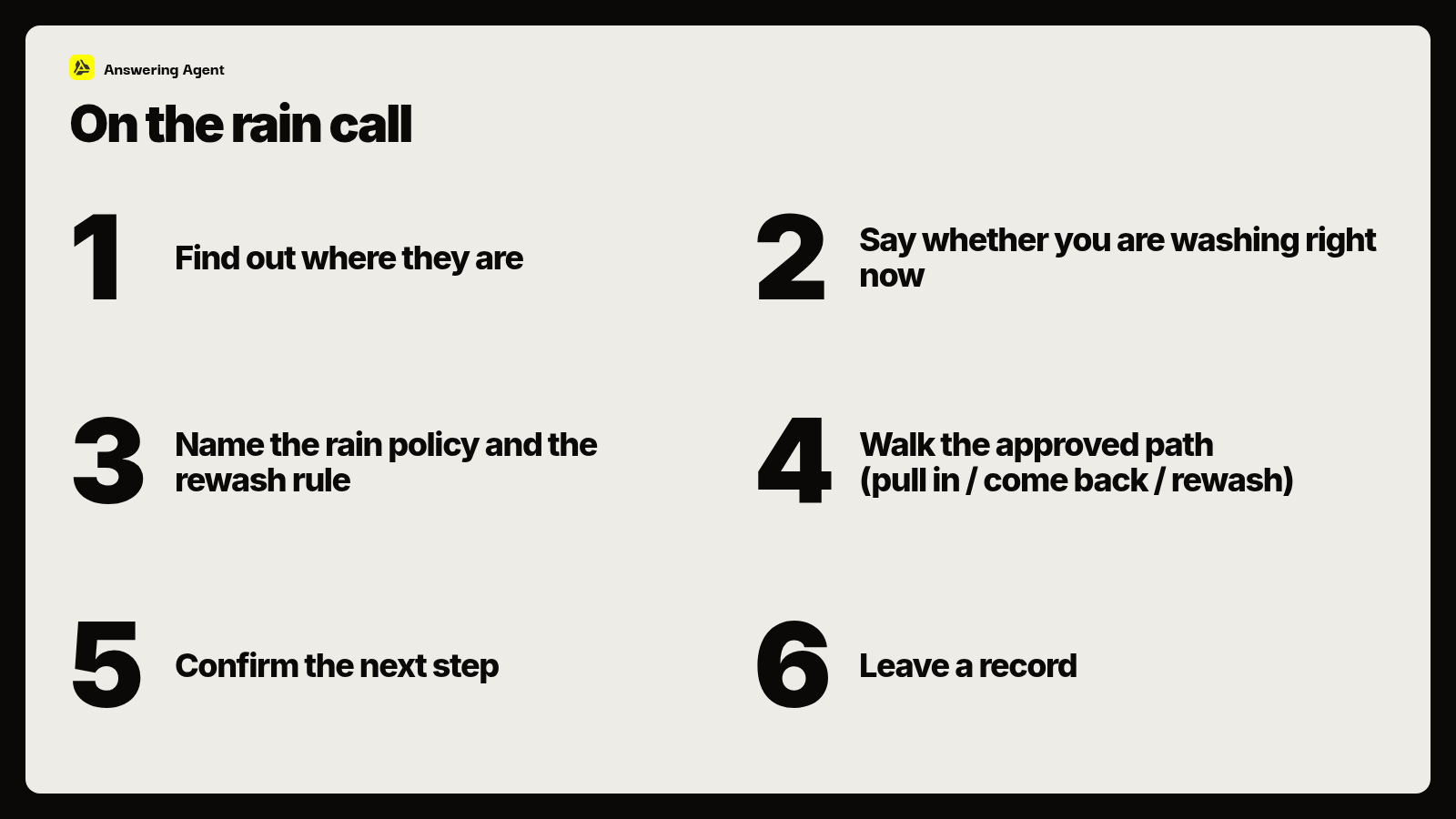
- Find out where they are. Someone at the tunnel needs something different from someone in their driveway, so ask first.
- Say whether you are washing right now. Answer yes or no in your first sentence. Do not make them work it out from the hours page.
- Name the rain policy and the rewash rule. Use the same words every time. For example: "We wash in the rain, and if it storms within 48 hours of your wash, come back for a free rewash." Whatever your rule is, script it.
- Walk the approved path. If you are open, tell them to pull in. If you closed for lightning or wind, give the restart time. If their car is already dirty, send them through on the rewash.
- Confirm the next step. Tell them which lane to use, how long the window lasts, and whether their membership covers the wash.
- Leave a record. Note any rewash or rain check on the account or the log so the next shift does not argue about it at the pay station.
None of these steps needs a manager. They need someone who picks up and knows the script.
Open in the rain, a free rewash, or come back later: how do you tell them apart?
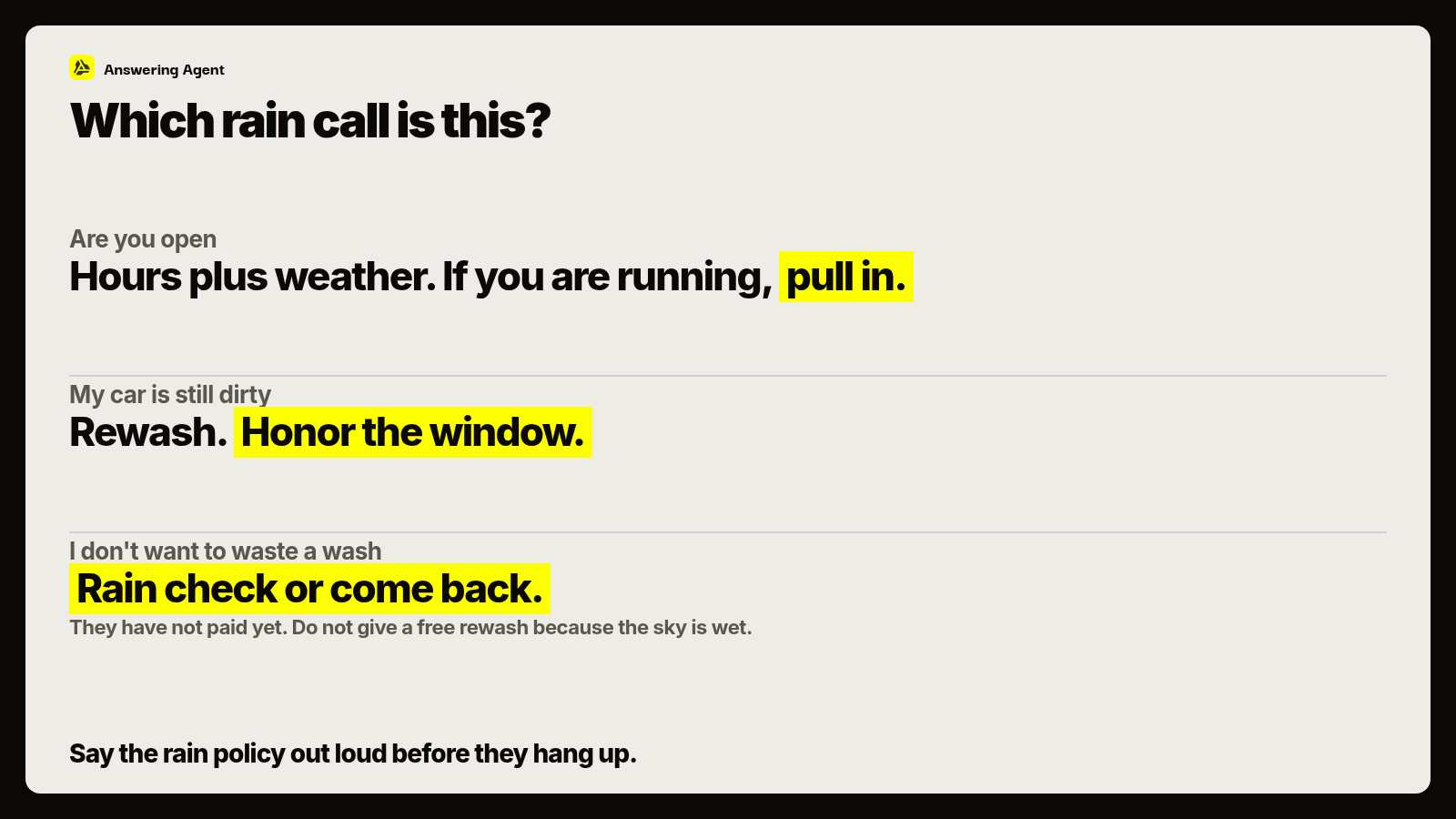
Each question points to a different answer:
- "Are you open?" is an hours question.
- "My car is still dirty" is a rewash.
- "I don't want to waste a wash" means come in now, or come back when you reopen.
If you mix them up, you give the caller the wrong next step.
Staff fumble the open question most often. If your tunnel runs in the rain, say so with some energy. The lot is empty and the caller is halfway to pulling in. If you closed for lightning, say when you expect to restart.
The rewash caller already paid and is testing whether your guarantee is real. Honor it quickly and cheerfully, because it costs you a few minutes of tunnel time.
The caller who has not washed yet does not get a free rewash. Wet is not dirty. Save the rewash for cars that actually went through your tunnel.
What do you do when they are already at the tunnel?
A caller on your lot can see the tunnel and wants a yes or no within thirty seconds. Confirm where they are, state the policy, and tell them exactly where to pull.
Say the rain policy out loud before they hang up.
A wave from the booth is not a policy. The driver pulls in without learning that a rewash exists or how long the window lasts.
If they already washed today and want a second pass, handle it on the phone. Confirm the wash and the rule, name the lane, and note it so the pay station does not stop them.
If you are paused for lightning, say so: "We pause for lightning. We should be running again within the hour. Your rewash window still holds." They will wait or come back instead of sitting there guessing.
How do you tell the phones the tunnel paused?
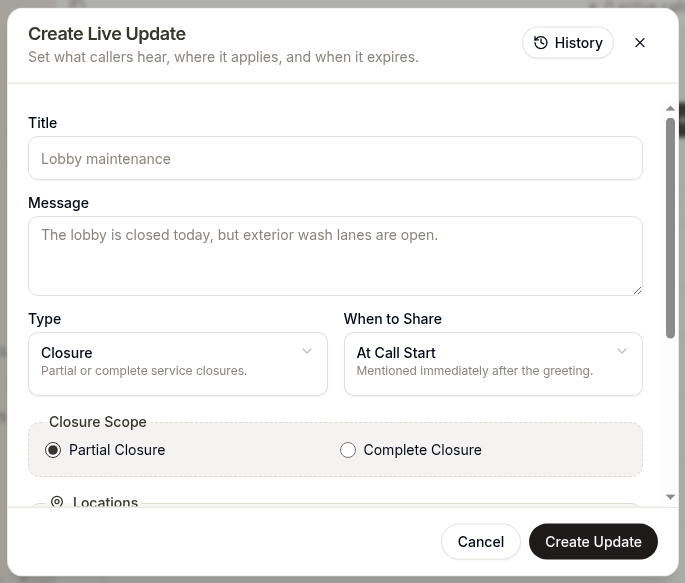
In Answering Agent, you handle a weather pause with a Live Update. You do not need to edit your regular hours. Write the line the next caller should hear, mark it a Closure, pick the locations, and set it to expire when you expect to reopen. After that, anyone who asks "are you open" hears that line instead of your regular hours.
For holiday hours and full-day site closures, I quote what the wash wrote down for that day and site, then leave a note the next shift can open. The intake steps are in the car wash holiday hours and closure call playbook.
For a storm, use these settings:
- Type: Closure. Choose Partial Closure if the tunnel is down but part of the site is still running, or Complete Closure if you flipped the sign.
- When to Share: At Call Start.
- Title: "Paused for lightning."
- Message: "We pause for lightning. We should be running again within the hour. Your rewash window still holds."
If you are still washing, use Wait Time or Schedule Change instead. A Closure overrides regular hours, so the agent will not tell callers you close at 7 when weather has already shut you down.
How is this different from taking a voicemail?
A rain caller wants to know whether you are washing now, and that answer is stale within an hour. A voicemail or a callback after the storm answers a question nobody is asking anymore.
| Voicemail | Message-taking service | Coverage that can work the membership | |
|---|---|---|---|
| Who answers | A greeting recorded in June | An operator reading a generic script | Something trained on your hours, policy, and rewash rule |
| What they can say | Nothing until you call back | "Someone will get back to you" | "Yes we are washing, pull into lane two" |
| Rain vs rewash vs cancel | Cannot tell them apart | Logs them all as "customer called" | Routes each to its own path |
| After the call | A blinking light | A callback list for tomorrow | A note on the member record and a done ticket |
| When they are at the tunnel | They drive off | They wait for a callback in your lot | They pull in with the rewash confirmed |
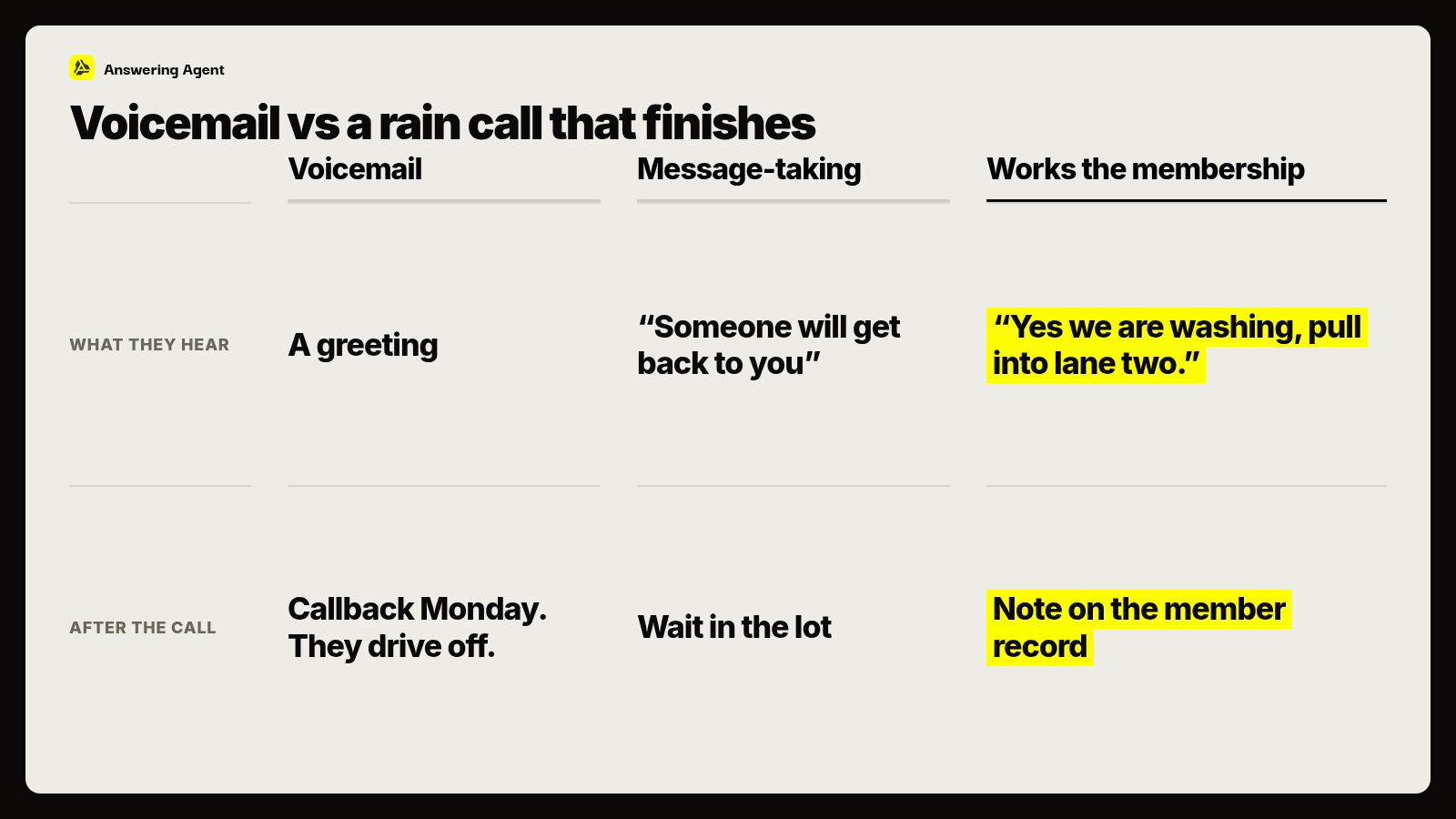
To judge anything answering your phones, ask one question: can it state the policy on this call? If all it produces is a note that says "customer asked about rain," it is just a voicemail with better handwriting.
What should you check before software takes that call?
Check that it can do what your best cashier does:
- Say whether you are washing right now.
- State your rain policy and rewash rule in your words.
- Pick up a Live Update when you pause for lightning.
- Know whether a membership covers a second pass.
- Hand the unusual calls to a person without a fight.
That last point matters. In Answering Agent, about 1 in 10 calls get forwarded to a person. A broken mirror or a paint scrape is a damage claim intake, not a rewash, and it should reach your manager.
For more detail, see how AI phone answering works, pricing, and phone coverage at car washes. Related membership calls:
To load your rain and rewash rules as facts the phones can say, see how to train car wash call handling.
Then put it on a test line and call it yourself. Say "Are you open? It's raining," and then "I want a rewash." It should answer both the way your best Saturday cashier would.
FAQ
How long should a rain check actually last?
Start with 48 hours and print it at the pay station. If your area gets multi-day storms, stretch it to 72. The exact number matters less than the booth, the phone, and the sign all quoting the same one.
Does an unlimited member get a rewash when it rains, or do they just come back tomorrow?
Members come back tomorrow, because that is what the plan is for. The rewash is for retail customers, like someone who bought a single wash at 2pm before it poured at 4pm. Keep the two answers separate.
We closed the tunnel for a storm. What should the phone say?
Say that you are closed, why, and when you expect to reopen, even if the reopen time is a guess. In Answering Agent, post a Live Update set to Closure and At Call Start, and have it expire when you reopen.
The cashier is in the booth with a line of cars. Who takes the rain call?
Not the cashier. Every call answered from the booth slows the line, and the queue stacks up as soon as the sun comes back. A rain call follows policy and needs no judgment, so it can be answered off the lot.
Does this only work if we connect our wash POS?
No. Most rain calls need only three things: the rewash window, whether the caller is a member or retail, and the current tunnel status. A POS connection lets the agent confirm a wash before promising a rewash, but you can start with policy and add lookup later.
What if they want a refund instead of a rewash?
Offer the rewash first. If they still want their money back, follow the refund and credit call playbook and transfer them to a person along with their name and what you already offered, so your manager does not start from zero.
How do we try it without changing our published number?
Forward your line instead of porting it. Set it to roll calls to the agent after a few rings, or only when the booth does not pick up. Your published number stays the same, and you can turn the forward off anytime. Setup details are at answeringagent.com/industries/car-wash.
What should a demo prove on a rain call specifically?
Call as a retail customer who just washed and say, "It rained on my wash, what are you going to do?" The agent should quote your rewash window, tell a member from a retail customer, and know the tunnel is closed if you closed it an hour ago. Book a demo and run that test.
Book a walkthrough
See it handle your calls.
Book 20 minutes, or hear a sample call first.